
Unleashing the power of the microgrids
2.4.2019 11:44:31 CEST | Aalborg Universitet | Press release
Today, a large number of private households, companies and public institutions have invested in autonomous solar power installations that only supply the limited number of buildings and users that are connected, and rely on the main grid. This means that a large part of the energy that is being produced goes to waste if there is no local demand on the grid.
According to one of the World’s leading researchers in microgrid technology, microgrids could be the key to a far more efficient, safe and reliable distribution of sustainable energy.
- If we can develop the technology to coordinate microgrids in clusters, we can achieve unprecedented levels of scalability expandability, efficiency and resilience. This is the next frontier of microgrid research, says Professor Josep M. Guerrero from the Department of Energy Technology at Aalborg University.
Lost in transmission
Right now, about 15 per cent of the power is lost in transmission between power plants and consumers. But microgrids that communicate and work together in clusters could be the most efficient way of bringing stable, sustainable energy generation to people.
- Imagine several villages in a rural area without electricity access. Each village could generate renewable energy, store and consume it locally thus forming a microgrid. The next step is to interconnect each microgrid village to build an electrical distribution system and share the power generation and consumption among the villages. This way we can conceive electrical grids from the population needs following a bottom-up approach, Professor Guerrero explains.
- The same thing can be applied in Denmark in houses with solar panels and electrical vehicles. Each microgrid house could be interconnected in the neighbourhood microgrid cluster. The challenge is to coordinate each microgrid and improve the efficiency of the whole energy system, he says.
Safe energy
With the current loss of power in transmission, it becomes questionable why we should build big power plants that are situated far away from the consumers, says Josep Guerrero. Particularly when those plants rely on either non-renewable power sources or dangerous nuclear fission.
- Everyone remembers the disaster in Fukushima following the tsunami in 2011. Today, with an increasing number of natural disasters such as earthquakes, tsunamis, volcanoes, or tornados, we need to develop highly resilient energy systems that can survive extreme events, he says. The solution could well be micro-grids.
Funding for the future
Professor Josep M. Guerrero is among a small group of elite researchers that has received funding from the Villum Foundation.With a grant of 39 million DKK, he will be able to focus on the development of a platform that makes it possible for multiple microgrids to collaborate on smart-grid scenarios.
- With this funding we will be able hire a large team of researchers to help the development of smart grids. The applications are multiple; energy communities, rural electrification, electric ships and vessels. The vision is to make us rely 100 per cent on renewable energy with high levels of resiliency. Those breakthroughs may not be possible to overcome without the help of this grant, he says.
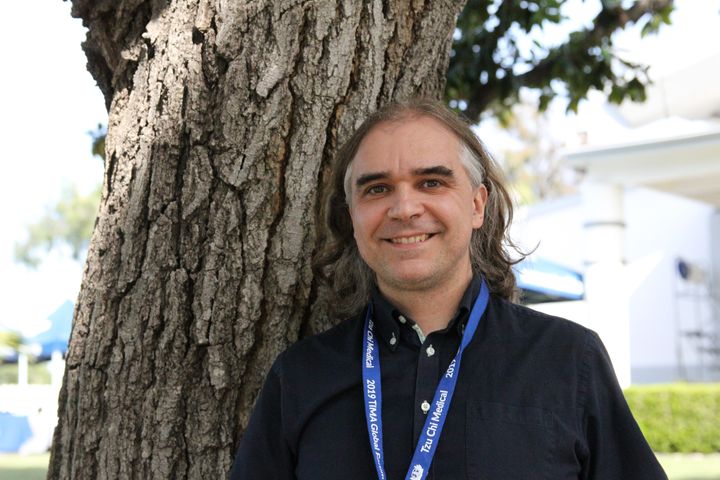
Photo caption: Professor Josep M. Guerrero from Aalborg University receives 39 million DKK from the Villum Foundation to develop safer and more efficient sustainable energy systems based on microgrids. Photo by Regan Wang.
Keywords
Contacts
For further information, please contact Professor Josep M. Guerrero: joz@et.aau.dk or Sanne Holm Nielsen at the AAU communication department: shn@adm.aau.dk - 9940 3517
Images
About Aalborg Universitet

Subscribe to releases from Aalborg Universitet
Subscribe to all the latest releases from Aalborg Universitet by registering your e-mail address below. You can unsubscribe at any time.
Latest releases from Aalborg Universitet
AAU-forskere udvikler unik lasermaskine15.4.2026 12:00:00 CEST | Pressemeddelelse
Efter mere end 15 års forskning har to forskere fra Aalborg Universitet udviklet en lasermaskine, der kan fremstille prototyper af metal i én samlet proces og dermed reducere både tidsforbrug og udgifter væsentligt. Nu skal maskinen ud fra laboratoriet og ind i industrien
Forskere tager igen temperaturen på danskernes seksuelle sundhed og trivsel13.4.2026 08:00:00 CEST | Pressemeddelelse
Mere end 250.000 danskere vil snart modtage et spørgeskema fra befolkningsundersøgelsen Projekt SEXUS. Formålet er at kortlægge danskernes seksuelle erfaringer og skabe ny viden om, hvordan det intime liv spiller sammen med både sundhed og sygdom.
Atrieflimren rammer langt flere danskere frem mod 20409.4.2026 06:06:00 CEST | Pressemeddelelse
En ny undersøgelse fra Aalborg Universitet viser, at antallet af danskere, der lever med atrieflimren, forventes at stige med 100.000 personer svarende til over 50 procent frem mod 2040. Stigningen vil øge presset på forebyggelse, udredning og behandling i sundhedsvæsenet betydeligt.
Unge på erhvervsuddannelserne skal guides bedre – forskere fra Aalborg Universitet lancerer 10 bud for god oplæring7.4.2026 05:30:00 CEST | Pressemeddelelse
Ny undersøgelse fra Aalborg Universitet har fundet en overset årsag til det store frafald på erhvervsuddannelserne: De unge har svært ved at få deres ungdomsliv til at hænge sammen med at have en læreplads. På den baggrund har forskerne udarbejdet en række råd, som er henvendt til både virksomheder og institutioner med lærlinge og elever.
Aalborg Universitet vil sende robot til Månen4.4.2026 07:01:00 CEST | Pressemeddelelse
Dansk robotteknologi skal til Månen. Aalborg Universitet udvikler selvkørende robot, der skal udforske Månens ressourcer og støtte fremtidige baser.
In our pressroom you can read all our latest releases, find our press contacts, images, documents and other relevant information about us.
Visit our pressroom