
Unresolved jar mystery becomes a 2,000-year natural experiment
28.8.2026 08:05:00 CEST | Københavns Universitet | Press release
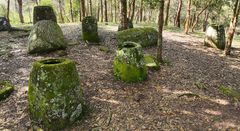
More than 2,000 years ago, massive stone jars were carved from bedrock and placed on a highland plateau in northern Laos. Today, they represent not only an archaeological mystery, but also a series of small, self‑contained ecosystems that now provide researchers from the University of Copenhagen with a unique opportunity to study how nature develops over millennia.
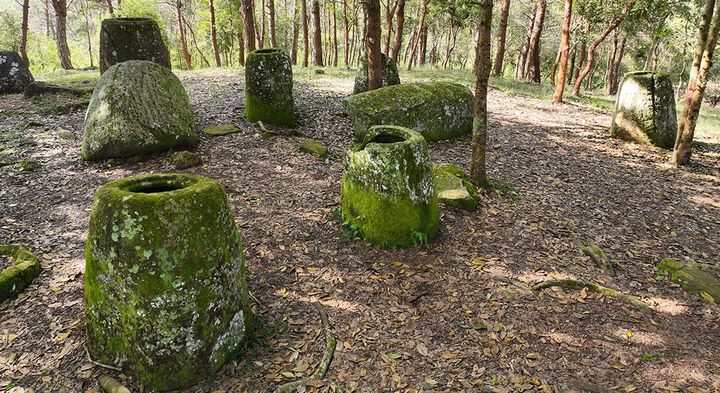
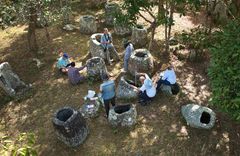
Across a hilly landscape in northern Laos, thousands of enormous stone jars are scattered across the terrain. Some are several meters tall and can weigh up to ten tons. The jars have remained in this place for more than 2,000 years and are believed to have played a role in ancient burial practices. Who created them, and how exactly they were used, remains unknown.
Over the centuries the jars have taken on a very different function. By collecting rainwater year after year, they have gradually developed into small, distinct freshwater ecosystems.
Researchers from the Faculty of Science, University of Copenhagen, in collaboration with local researchers, have now analysed water samples from 39 of the jars to investigate how life emerges and is shaped in isolated systems over very long periods of time.
“Most ecological research lasts only a few years. We manipulate a system, observe the outcome and then try to extrapolate what this might mean over longer timescales. With the jars in Laos, that limitation does not apply. They have effectively functioned as a natural experiment for around 2,000 years,” says Associate Professor Lars Båstrup-Spohr from the Department of Biology at the University of Copenhagen, senior author of the study.
Trees play a key role
Each year during the monsoon season, the jars are filled with rainwater. Over time, this water becomes home to a wide range of organisms, including microorganisms, algae, aquatic plants, insects and amphibians.
What happens inside the jars is strongly influenced by the surrounding trees, explains Lars Båstrup Spohr.
“Our results show that oxygen conditions and nutrient levels in the jars depend on whether trees grow above them. Jars located in open areas are not shaded and receive less organic material such as fallen leaves. As a result, there is less decomposition and lower nutrient availability.”
This finding reinforces what is already known: in small and isolated systems, surrounding vegetation can have a strong influence. What is striking, however, is that this pattern persists in a natural experiment that has been running for two millennia.
“One might have expected that, over 2,000 years, new organisms or adaptations would have emerged that changed the factors controlling life in the jars. But that is not the case. We still see that the surrounding environment determines oxygen and nutrient conditions inside the jars,” says Lars Båstrup-Spohr.
Does life reset – or continue?
The researchers are continuing to analyse samples from the jars. Among other things, they are investigating whether the ecosystems persist through seasonal cycles, when water evaporates during dry periods, or whether they largely ‘start from scratch’ each year.
To address this question, the researchers are using environmental DNA (eDNA), where genetic material in the water reveals which organisms have been present – including species that cannot be seen with the naked eye.
“Environmental DNA allows us to identify the entire biological community in the jars,” explains Laura Käse, Postdoctoral Researcher at the University of Copenhagen, who collected the eDNA samples.
Preliminary results suggest that life in the jars is far more dynamic than might be expected – even after 2,000 years.
“Previous studies often show that biological communities become stable after a certain period. That is not what we see here. The communities change substantially, and the system does not appear to be stable,” says Laura Käse.
This makes the jars particularly interesting to biologists, as they can help clarify whether it is environmental conditions that determine which species can live in a given place, or whether the sequence in which species arrive plays a greater role.
For the researchers, the study is therefore not only about what lives in the jars in Laos, but also about broader questions concerning life on Earth.
“We are interested in what creates or governs the composition of biological communities. What determines who lives where? This applies both globally and in more familiar settings, such as lakes in Europe. Why do some lakes contain pike and perch, while others are dominated by zander and bream?,” says Lars Båstrup-Spohr.
***
About the jars
- More than 2,100 jars are located on the Plain of Jars
- Most are carved from sandstone; others are made of granite, conglomerate or fossilised coral
- The jars are distributed across more than 90 sites in Xiengkhuang Province in Laos
- This is the first time the jars have been studied in a biological research context
- The Plain of Jars has been a UNESCO World Heritage Site since 2019
***
About the study
- The researchers analysed water samples from 39 jars across five sites near Phonsavan, Laos
- The results show that tree cover around the jars influences oxygen levels and nutrient availability
- Further analyses are ongoing, with additional results expected next year
- The findings are published in the scientific journal Ecography
- The study is funded by VILLUM FONDEN.
- Read the study
Keywords
Contacts
Lars Båstrup-SpohrAssociate Professor, Department of Biology
Tel:+45 35 32 11 66lbaastrupspohr@bio.ku.dkAmalie Viktoria GammelgaardKU Kommunikation, Presse
Tel:93 51 60 67amalie@adm.ku.dkImages
Links
Subscribe to releases from Københavns Universitet
Subscribe to all the latest releases from Københavns Universitet by registering your e-mail address below. You can unsubscribe at any time.
Latest releases from Københavns Universitet
Uopklaret krukke-mysterium er blevet til verdens længste eksperiment28.8.2026 08:05:00 CEST | Pressemeddelelse
For 2.000 år siden blev massive stenkrukker hugget ud af klippegrunden og placeret på en højslette i det nordlige Laos. I dag rummer de ikke blot et arkæologisk mysterium, men også små, selvstændige økosystemer, som nu giver forskere fra Københavns Universitet et enestående indblik i, hvordan naturen former sig over årtusinder.
Kæmpe fald i antallet af spædbørn indlagt med RS-virus efter tilbud om vaccine28.8.2026 06:00:00 CEST | Pressemeddelelse
Sidste efterår blev alle gravide for første gang tilbudt at blive vaccineret mod RS-virus for at beskytte deres nyfødte mod den farlige luftvejssygdom. Nu peger nyt studie fra Københavns Universitet og Nordsjællands Hospital på, at det tilsyneladende har haft en stor effekt.
KU lancerer stor AI-satsning: Ny viceprorektor og 110 mio. kr. skal ruste universitetet til en ny virkelighed27.8.2026 06:01:00 CEST | Pressemeddelelse
Kunstig intelligens ændrer forskning, uddannelse og arbejdsliv i et tempo, få havde forestillet sig. Nu lancerer Københavns Universitet en gennemgribende satsning, der skal hjælpe universitetet og det danske samfund med både at udnytte mulighederne i AI og håndtere de grundlæggende forandringer, teknologien fører med sig.
Narwhals help researchers uncover unique data from the deepest East Greenland fjords27.8.2026 06:00:00 CEST | Pressemeddelelse
For the first time, researchers have used data from narwhals to document how Atlantic water reaches deep into fjords along Greenland’s east coast. A new study from the University of Copenhagen sheds light on a poorly studied region, and the findings could have important implications for understanding and predicting climate change.
Narhvaler hjælper forskere med unikke data fra det dybeste af Østgrønlandske fjorde27.8.2026 06:00:00 CEST | Pressemeddelelse
For første gang har forskere brugt data fra narhvaler til at dokumentere, hvordan vand fra Atlanterhavet når dybt ind i fjorde på den grønlandske østkyst. Et nyt studie fra Københavns Universitet kaster lys på et underbelyst område i forskningen, og resultaterne kan få stor betydning for både at forstå og forudsige ændringer i klimaet.
In our pressroom you can read all our latest releases, find our press contacts, images, documents and other relevant information about us.
Visit our pressroom