
Narwhals help researchers uncover unique data from the deepest East Greenland fjords
27.8.2026 06:00:00 CEST | Københavns Universitet | Pressemeddelelse
For the first time, researchers have used data from narwhals to document how Atlantic water reaches deep into fjords along Greenland’s east coast. A new study from the University of Copenhagen sheds light on a poorly studied region, and the findings could have important implications for understanding and predicting climate change.
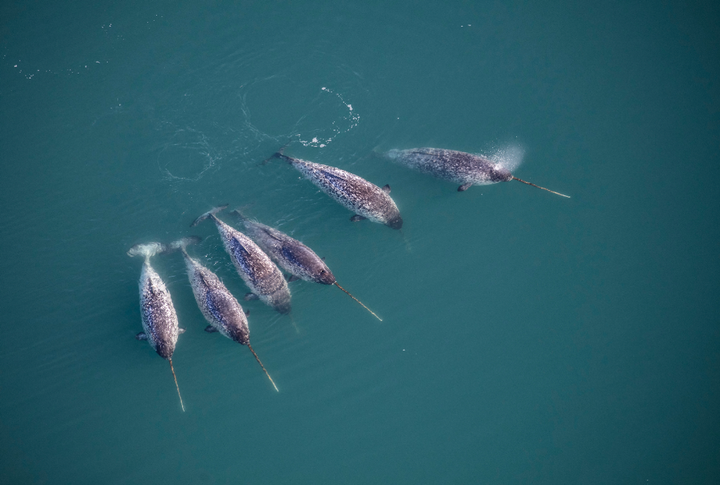
They live in some of the most inaccessible waters on Earth, where ocean temperatures hover around freezing. And because they move through areas that humans rarely reach, they have been able to help researchers with a very special task.
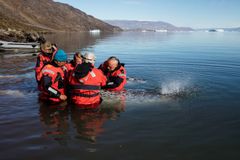
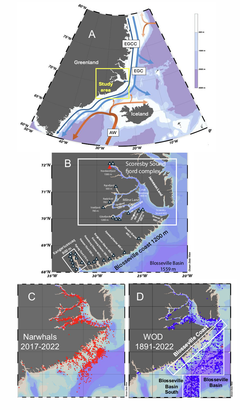
Equipped with sensors, six narwhals from the Scoresby Sound region, the world’s largest fjord system on Greenland’s east coast, collected data during their natural movements. This provided researchers from the University of Copenhagen, the Greenland Institute of Natural Resources and other institutions with entirely new data that would otherwise have been impossible to obtain.
“The narwhals have been in parts of the fjords where very few measurements have been taken before. And there, 300 kilometres from the coast, we find traces of Atlantic water. It is completely new that we can show this,” says Mads Peter Heide-Jørgensen, Professor at the Greenland Institute of Natural Resources.
The water in the fjord system is a mixture of cold Polar Water originating in the Arctic and warmer, more saline Atlantic Intermediate Water from the Atlantic Ocean.
But the region has long been one of the major blind spots on the oceanographic map. Where research vessels often must turn back, narwhals can continue swimming.
“Now we suddenly have measurements from places we can use in our models, giving us a much more complete picture of the ocean. It is absolutely fantastic to use the animals in this way,” says Susanne Ditlevsen, Professor at the Department of Mathematical Sciences.
Warm water accelerates glacier melting
In the study, which has just been published in the scientific journal Science Advances, the researchers combined the narwhal measurements with historical oceanographic data from the World Ocean Database (WOD) for the Scoresby Sound region.
“We used the two large datasets to build a robust model showing how temperature, salinity and depth are related. The models show that the layer consisting of Atlantic water has become thicker, while the upper layer of Polar Water has become thinner,” says Susanne Ditlevsen.
The researchers show that warm Atlantic Intermediate Water now reaches deep basins in front of glaciers hundreds of kilometres into the fjord systems.
“This is the water that helps melt the glaciers. We show how the warm water can contribute to accelerating the rate at which glaciers lose ice,” says Mads Peter Heide-Jørgensen.
Helping predict climate change
For the researchers, the results are not only about ocean conditions in East Greenland. They can also help improve the climate models used to predict future climate change.
Melting from Greenland’s glaciers and ice sheet is an important factor in climate research. When glaciers melt, large volumes of freshwater are released into the ocean, which can influence ocean circulation and climate patterns far beyond the Arctic.
“In the large climate models used to predict future climate change, glacier melt plays a major role. That is why it is crucial that we improve our understanding of it, particularly because Greenland contains so much ice,” says Susanne Ditlevsen.
***
Fact box: How the narwhals helped the researchers
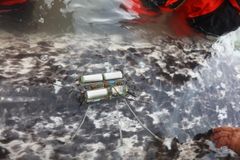
- Six narwhals were equipped with CTD sensors that measured ocean temperature, salinity and depth.
- The narwhals were captured and tagged by local hunters near Scoresby Sound in East Greenland.
- The sensors remained attached for between 85 and 332 days, collecting a total of 2,060 oceanographic profiles between 2017 and 2020.
- Measurements were collected to depths of more than 1,500 metres.
- The narwhals were able to gather data in areas that research vessels rarely or never reach because of sea ice and difficult access.
***
Fact box: About the study
- The new narwhal measurements were combined with more than 2,200 historical oceanographic profiles from the World Ocean Database.
- The study shows that warm, saline Atlantic Intermediate Water penetrates farther into East Greenland fjords than previously documented.
- Ocean temperatures in the region increased by around 0.047 degree Celsius per year between 1960 and 2021.
- The researchers find that the layer of Atlantic water is becoming thicker while the layer of Polar Water is becoming thinner.
- The results can contribute to improved estimates of glacier melt in future climate models.
- The study was funded in part by the Danish Ministry of Climate, Energy and Utilities, the Danish Ministry of the Environment (DANCEA) and the Greenland Institute of Natural Resources.
Nøgleord
Kontakter
Susanne DitlevsenProfessor, Department of Mathematical Sciences
Tlf:+45 35 32 07 85ditlevsen@math.ku.dkMads Peter Heide-JørgensenProfessor, Greenland Institute of Natural Resources
Tlf:+45 40 25 79 43mhj@ghsdk.dkAmalie Viktoria GammelgaardKU Kommunikation, Presse
Tlf:93 51 60 67amalie@adm.ku.dkBilleder
About the University of Copenhagen
The University of Copenhagen was founded in 1479 and today has 37,000 students and 10,000 employees – of whom more than 5,000 are researchers – and revenues of DKK 11.3 billion.
10 Nobel Prizes have been awarded to researchers at the University.
Følg pressemeddelelser fra Københavns Universitet
Skriv dig op her, og modtag pressemeddelelser på e-mail. Indtast din e-mail, klik på abonner, og følg instruktionerne i den udsendte e-mail.
Flere pressemeddelelser fra Københavns Universitet
KU lancerer stor AI-satsning: Ny viceprorektor og 110 mio. kr. skal ruste universitetet til en ny virkelighed27.8.2026 06:01:00 CEST | Pressemeddelelse
Kunstig intelligens ændrer forskning, uddannelse og arbejdsliv i et tempo, få havde forestillet sig. Nu lancerer Københavns Universitet en gennemgribende satsning, der skal hjælpe universitetet og det danske samfund med både at udnytte mulighederne i AI og håndtere de grundlæggende forandringer, teknologien fører med sig.
Narhvaler hjælper forskere med unikke data fra det dybeste af Østgrønlandske fjorde27.8.2026 06:00:00 CEST | Pressemeddelelse
For første gang har forskere brugt data fra narhvaler til at dokumentere, hvordan vand fra Atlanterhavet når dybt ind i fjorde på den grønlandske østkyst. Et nyt studie fra Københavns Universitet kaster lys på et underbelyst område i forskningen, og resultaterne kan få stor betydning for både at forstå og forudsige ændringer i klimaet.
Many workplaces resist plant-based lunches despite substantial climate benefits26.8.2026 10:52:01 CEST | Press release
Are organisations ready for plant-based food at work? A new study from the University of Copenhagen explores this question and shows that only a small proportion of workplaces in Denmark exhibit readiness for this change – despite its potential to reduce the climate footprint of workplace lunches. In general, introducing plant-based food is likely to stir strong emotions.
Så stor er modstanden mod vegetarmad i kantinen26.8.2026 07:22:00 CEST | Pressemeddelelse
Hvor klar er danskerne til at spise mere planterigt på arbejdet? Det afdækker en undersøgelse lavet af Københavns Universitet. Den viser, at det er et emne, der bringer stærke følelser frem. Samtidig spiller arbejdspladsens parathed en vigtig rolle for kantinemadens klimaaftryk. Forskerne tilbyder arbejdsgiverne et værktøj til at måle, hvor parat deres organisation er til mindre kød.
Researchers create a Little Big Bang: Bowling-pin-shaped nuclei shed new light on the Universe’s first moments20.8.2026 09:07:36 CEST | Press release
Researchers from the University of Copenhagen have succeeded in recreating the primordial matter that filled the Universe shortly after the Big Bang – by smashing much smaller atomic nuclei together than previously thought possible. These microscopic Big Bangs could provide new insights into the Universe’s earliest moments while also helping researchers understand one of the fundamental questions in nuclear physics.
I vores nyhedsrum kan du læse alle vores pressemeddelelser, tilgå materiale i form af billeder og dokumenter samt finde vores kontaktoplysninger.
Besøg vores nyhedsrum