Post Release — Different “Liberation” Experiences after WWII: Lessons for the Present
14.5.2026 14:00:09 CEST | Ukraine House in Denmark | Pressemeddelelse
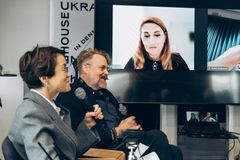
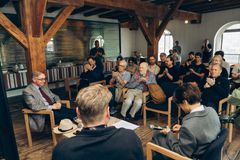
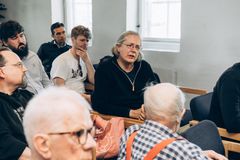
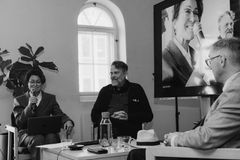
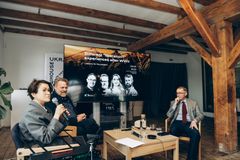
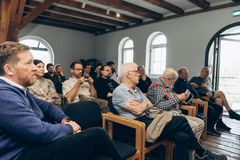
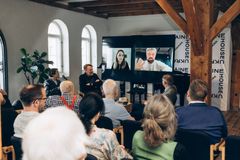
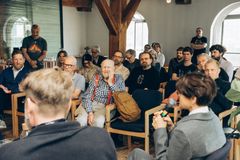
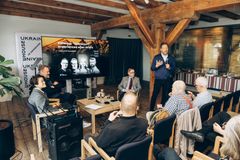
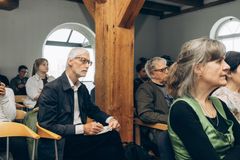
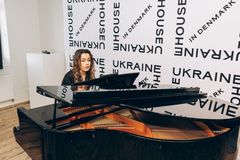
In connection with Europe Day, Ukraine House in Denmark, in cooperation with the European Commission Representation in Denmark, hosted a public conversation on the many meanings of “liberation” after the Second World War. The event brought together historians and public intellectuals from Ukrainian, Crimean Tatar, Danish, and broader European contexts to reflect on how the end of WWII was remembered, silenced, distorted, and politically used across different societies.
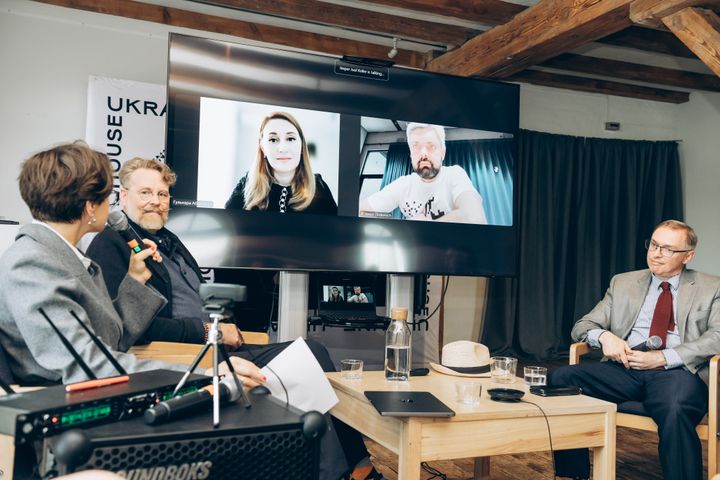
The conversation was moderated by Nataliia Popovych, Chairperson of Ukraine House in Denmark, who opened the discussion by placing May 9 in its contemporary political context. For many European countries, the date is connected to Europe Day, democracy, and the post-war project of peace. Nataliia recalled that Ukraine’s own memory politics changed significantly after the Revolution of Dignity when in 2015 the country moved away from the Soviet framing of the “Great Patriotic War” and began marking May 8 together with other European nations as a day of remembrance. In the Ukrainian context, she noted, the slogan “never again” had already been broken by Russia’s war in 2014. This is why Ukraine’s formula – “We remember. We prevail” – carries a different meaning today: historical memory for Ukrainians is their immunity against Russia's war of aggression and genocide. For Russia, May 9 continues to be a ritual of militarized memory, imperial continuity, and the glorification of state violence.
The discussion began with a broader European perspective from Spartacus Olsson, a Swedish historian and documentary producer known for his work on public history projects about the World Wars. He challenged the idea that liberation can be understood as one clear national experience. For some, especially those freed from Nazi concentration camps, liberation meant survival in the most direct sense. For others, it meant destroyed cities, new violence, political uncertainty, or the beginning of another form of domination. As he put it, “It's not a national thing. It's a regional thing. And it's an individual thing.”
Olsson pointed to France and Ukraine as examples of how deeply varied liberation could be even within one country. In Ukraine, the meaning of liberation depended on region, previous occupation, and the political realities that followed. For Spartacus, the central question is not only what happened in 1945, but how later generations remembered it. He warned against heroic myths that flatten history and argued for a memory rooted in historical truth rather than national self-glorification. Looking at the Russian war against Ukraine today, he added how only now Europe understands the slogan “never again”:
“We failed you in the 90s and we failed you in the early 2000s. And we especially failed you in 2014. And I can only hope that we continue on the path that we have set out now and try to avoid that the war on Ukraine becomes yet another memory that is distorted to the point of where we don't remember what is really at play here. And what is at play is democracy, it is safety, it is human rights – that is what we're talking about.”
Speaking about wartime sexual violence and transgenerational trauma, Spartacus Olsson noted that these experiences often remain among the most hidden parts of historical memory. Unlike many other wartime crimes, they are difficult to document not only because evidence disappears, but because survivors are often forced into silence by shame and stigma. This silence can then pass from one generation to another and shape communities even when the original violence is never openly named. It is also reinforced by national histories that prefer heroic or simplified narratives, and by a male-dominated unwillingness to confront sexual violence as part of war: “We've got the private factor of shame and embarrassment. We've got the national unwillingness to talk about these topics and we've got the male unwillingness to talk about these topics. And when they come together, it becomes very, very difficult for us to do our job [as historians].”
From the Ukrainian perspective, Anton Drobovych, historian, former head of the Ukrainian Institute of National Memory, now a serviceman in the Armed Forces of Ukraine and Head of Human Rights and War Memorialization Center at Kyiv School of Economics, spoke about the danger of calling Soviet rule a liberation. He described Soviet “liberation” in many European contexts directly: “For many European countries, it wasn't a liberation, but a change of scenery in a totalitarian theater. The Nazi play was simply replaced by a communist one.” For Ukraine, the end of Nazi occupation did not erase violence, repression, deportations, or the totalitarian logic of Soviet power. It marked the defeat of one evil, but not the arrival of freedom.
Drobovych emphasized that Ukraine’s current approach to WWII memory is built on two inseparable words: remembrance and victory. Remembrance protects society from triumphalism and from the dangerous cult of victory that has become central to Russian propaganda. Victory, at the same time, reminds Ukrainians that evil can be defeated, and this memory strengthens resistance today. As he put it, remembrance is “a safeguard against pride and excessive obsession with triumph,” while “only victory religion is a very dangerous one.” His contribution placed Ukraine’s contemporary struggle within a longer history of resisting distorted memory. Historical truth, access to archives, accountability, and honest education, he argued, are necessary not only for understanding the past, but for defending the future.
The Crimean Tatar perspective was brought by Gulnara Abdulayeva, historian, writer, and journalist from Crimea. Her contribution made clear that for Crimean Tatars, 1944 was not a moment of liberation. It was the year of deportation. As translated during the discussion, “the labeling of the entire Crimean Tatar people and accusing them of collaborationism with the totalitarian regime by Stalin was not because it had any evidence, it was to find one very simple accusation that would justify the deportation of an entire nation.”
This collective accusation became a tool of violence. The word “total” was central: the entire people were labelled as traitors, without distinction between individual lives, choices, roles, or experiences: “this total labeling of the entire nation has enabled that there weren't nuances of different cases of people and their behavior, heroic during the war or undercover or women or children or the elderly.” In this logic, an entire nation could be punished as one body. “When the entire nation is announced a traitor, then you can justify any violence towards it.”
The discussion underlined the devastating scale of this crime. “When the nation was deported on 19th of May, 1944 and during the first years after the deportation, 46.2% of the Crimean Tatars died, so it was the true genocide of the Crimean Tatar nation.” What followed was an attempt to erase identity and belonging. Gulnara also emphasized how the Soviet accusation did not remain in the past: “this myth of traitorship still prevails in the current Russian propaganda and the current Russian mythology,” because recognizing their own crime by the Russian would mean questioning the imperial foundations of the Russian state itself.
Gulnara connected this history to the present Russian occupation of Crimea. Since 2014, Crimean Tatars have again faced arrests, house searches, persecution, pressure on journalists, and the destruction of representative institutions, including the Mejlis. For Crimean Tatars today, “liberation means not or would mean not only just the change of the flag or new jurisdiction in Crimea, but the ability to live without fear, without prejudice, without persecution.” It also means return and the right to belong: “coming back home and living at home is the priority.” In this sense, liberation is not revenge. It is freedom, safety, identity, and, as Gulnara stressed, “the renewal of historical accountability.”
A Danish perspective was introduced by Jakob Seerup, historian and museum curator at Bornholm Museum, who spoke about Bornholm’s unusual and often underrecognized post-war experience. While the rest of Denmark celebrates liberation on May 4–5, Bornholm followed a different path. Soviet aircraft bombed Rønne and Nexø on May 7–8, 1945, after the German commandant refused to surrender to Soviet forces. Soviet troops then landed on the island on May 9 and remained there until April 5, 1946.
For Jakob, Bornholm complicates the Danish story of liberation. As he said, “It is indeed a different kind of liberation and it is also a contested word.” In one sense, Soviet forces removed the German presence. In another, their arrival brought bombing, military occupation, cases of sexual violence, uncertainty, and later decades of geopolitical ambiguity. He described how Bornholm’s Soviet cemetery and monuments remain contested sites of memory today. They are used by Russian representatives for propaganda, but also by historians as places where the manipulation of history can be exposed and explained. As he put it, “One day each year, Ambassador Barbin uses it as a place of propaganda for Russia. All the other days of the year, I use it to educate people about how Russia abuses its history.”
Across the different perspectives, the event returned repeatedly to the same question: what happens when the word “liberation” is told from the position of empire? For some communities, the end of WWII brought relief. For others, it brought deportation, repression, silence, or another occupying power. The speakers showed that memory is never only about the past. It shapes how societies understand violence, responsibility, justice, and the threats they face today.
The conversation also drew a direct line to Russia’s ongoing war against Ukraine. Russia continues to use the memory of WWII as a political weapon, presenting itself as a permanent liberator while denying or justifying its own imperial violence. Against this, there is a need for a more honest European memory – one that does not simplify history into myths of victory and does not allow the crimes of both Nazi and Soviet totalitarian regimes to remain unnamed and unpunished.
This discussion became a reminder that democracy and freedom cannot be treated as inherited guarantees. To protect them, Europe must remember not only the moments of liberation but also the histories in which “liberation” became another name for occupation and deportation, along with unfinished accountability.
Nøgleord
Billeder


Følg pressemeddelelser fra Ukraine House in Denmark
Skriv dig op her, og modtag pressemeddelelser på e-mail. Indtast din e-mail, klik på abonner, og følg instruktionerne i den udsendte e-mail.
Flere pressemeddelelser fra Ukraine House in Denmark
Danmarks første udstilling om ukrainsk naiv kunst viser kulturens rolle i en tid med krig20.8.2026 08:00:00 CEST | Pressemeddelelse
Den 21. august åbner Ukraine House in Denmark NAÏV: Ukrainian Visions – den første udstilling i Danmark dedikeret til ukrainsk naiv kunst. Mens Ukraine ofte bliver betragtet gennem krigens prisme, retter udstillingen blikket mod en kunstnerisk tradition, der gennem generationer har været med til at udtrykke, bevare og forsvare ukrainsk kultur og identitet, og som har fået fornyet betydning i en tid, hvor Ukraines kulturarv igen er under pres.
Kyiv til København: Velorukh. Cycling in Ukraine fortsætter sin europæiske turné med en boglancering i Ukraine House in Denmark29.7.2026 16:07:44 CEST | Pressemeddelelse
København, den 7. august 2026. Efter præsentationer i Berlin, Barcelona, Prag og på Mallorca kommer den engelsksprogede udgave af Velorukh. Cycling in Ukraine nu til København som led i bogens europæiske turné. Arrangementet finder sted i Ukraine House in Denmark, en af Skandinaviens førende platforme for formidling af moderne ukrainsk kultur til et internationalt publikum.
Ukraine House in Denmark and Texty.org.ua Present “Infographics of the Russian-Ukrainian War” Pop-Up Exhibition26.6.2026 13:41:10 CEST | Pressemeddelelse
From June 26 to August 14, Ukraine House in Denmark and the Ukrainian data journalism outlet Texty.org.ua will display a pop-up exhibition “Infographics of the Russian-Ukrainian War” exploring Russia's war against Ukraine through data and visual storytelling.
Ukraine House in Denmark Presents "Form in the Making" Exhibition at 3daysofdesign8.6.2026 14:20:22 CEST | Pressemeddelelse
For the third year in a row, Ukraine House in Denmark joins 3daysofdesign, Copenhagen’s biggest design festival on June 10-12. This year, together with the Ukrainian Association of Furniture Manufacturers, the Embassy of Ukraine in Denmark, and curators Anait Danielian and Larysa Tsybina, we present “Form in the Making” – a collective exhibition exploring how contemporary Ukrainian design is made today.
Post-Release: Tymofii Brik on the Evolution of Ukrainian Society through Data on Social Change and Cohesion4.3.2026 12:21:51 CET | Pressemeddelelse
On January 22, Unity of Ukraine Day, Ukraine House in Denmark hosted a public discussion examining how Ukrainian society has transformed over the past three decades and what makes it resilient today amid full-scale war. Drawing on extensive sociological research, the event explored questions of trust, identity, decentralization, civil society, and polarization, offering a data-driven perspective that goes beyond simplified narratives. The discussion was moderated by Nataliia Popovych, who opened the event by framing Ukraine’s current resilience as the outcome of long-term social change rather than a sudden wartime phenomenon. The keynote presentation was delivered by Tymofii Brik, sociologist and rector of the Kyiv School of Economics, who presented findings from multiple national and international studies conducted before and during the war.
I vores nyhedsrum kan du læse alle vores pressemeddelelser, tilgå materiale i form af billeder og dokumenter samt finde vores kontaktoplysninger.
Besøg vores nyhedsrum