
Europe’s Security Through Ukraine: Briefing & Policy Roundtable with the Da Vinci Wolves Battalion
4.3.2026 12:14:14 CET | Ukraine House in Denmark | Pressemeddelelse
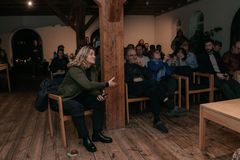
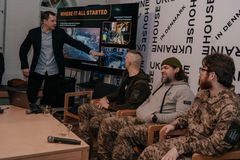
On February 3, Ukraine House in Denmark hosted a discussion on Europe’s security through the lens of Ukraine’s wartime experience. The event brought together Ukrainian defenders of the Separate Assault Battalion “Da Vinci Wolves” of the Armed Forces of Ukraine — one of the most adaptive frontline units of the full-scale war, and representatives of Ukraine’s defence-focused civil society.
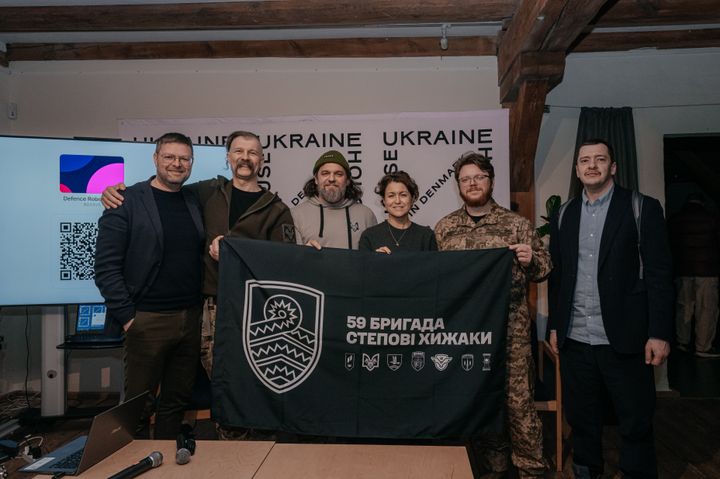
Ukraine House was honoured to welcome Oleksandr Yabchanka and Ivan Kutiepov, officers of the Da Vinci Wolves Battalion, alongside Vasyl Arbuzov, Co-Founder of the non-profit organisation “Defence Robotics UA”. During the event, participants examined how Ukraine’s combat-tested military innovations, particularly in unmanned and robotic systems, are reshaping modern warfare and why Ukraine should be seen not only as a country defending itself, but as a critical contributor to Europe’s security.
Frontline Innovation and the Speed of Modern War
A central focus of the briefing was how rapidly modern warfare is evolving at the frontline. Oleksii Makhrinskyi, Deputy Battalion Commander, demonstrated how technological innovations are evolving in real time. Originally a frontline infantry unit, since mid-summer 2025 the battalion has expanded its mission from defending physical terrain to include the defence of low-altitude airspace. As a result of the growing use of cheap mass drones, a new battlefield layer is forming — tactical air interception at drone scale.
The emergence of FPV interceptors — small, high-speed drones designed to hunt and destroy other drones, illustrates a new battlefield layer: tactical air interception at drone scale. Developed, tested, and deployed within months, these systems cost a fraction of traditional air defence and show how frontline units have become innovation hubs rather than end-users. As Oleksii Makhrinskyi stressed: “Innovation cycles in modern war are measured in months, not years”.
Civil Society as a Force Multiplier
The discussion also underscored the decisive role of civil society in sustaining Ukraine’s defence. Vasyl Arbuzov from Defence Robotics UA Foundation highlighted how volunteer engineers, small workshops, and decentralised hubs have become a strategic force multiplier. In Ukraine’s wartime realities, the structural integration of civic society converges to deliver rapid adaptation under conditions of constant attrition. This model stands in contrast to the EU's highly institutionalised innovation sector. Ukraine’s experience demonstrates that “civil society innovation must be structurally integrated, not tolerated ad hoc”.
Legacy, Learning, and Strategic Cooperation
Throughout the roundtable, speakers invoked the legacy of Dmytro "Da Vinci" Kotsiubailo. After the start of the full-scale invasion, Dmytro became the youngest battalion commander in the history of the Ukrainian Army leading a Separate Mechanized Battalion “Da Vinci’s Wolves”. His spirit and leadership continue to shape the battalion’s approach to warfare and cooperation.
The event concluded with a clear call for deeper engagement. Officers encouraged Danish military professionals, defence experts, and industry representatives to engage directly with Ukraine through visits, joint learning, and cooperation with frontline units such as the Da Vinci Wolves Battalion. They mentioned that Ukraine should be treated as part of Europe’s defence innovation space as Ukraine’s wartime system offers valuable, transferable lessons.
The discussion was met with strong interest from both Danish and Ukrainian participants, reflecting a broad engagement from civil society and a clear willingness to listen to, learn from, and support Ukraine’s military experience at the frontline.
We thank all speakers for sharing their frontline experience and strategic insights, and all visitors for their engagement and participation. The discussion underscored that Europe’s security is inseparable from Ukraine’s, and that sustained cooperation with Ukraine’s military, industry, and civil society is essential for building credible and future-ready European defence in an era of rapidly evolving warfare.
Nøgleord
Billeder

Følg pressemeddelelser fra Ukraine House in Denmark
Skriv dig op her, og modtag pressemeddelelser på e-mail. Indtast din e-mail, klik på abonner, og følg instruktionerne i den udsendte e-mail.
Flere pressemeddelelser fra Ukraine House in Denmark
Ukraine House in Denmark and Texty.org.ua Present “Infographics of the Russian-Ukrainian War” Pop-Up Exhibition26.6.2026 13:41:10 CEST | Pressemeddelelse
From June 26 to August 14, Ukraine House in Denmark and the Ukrainian data journalism outlet Texty.org.ua will display a pop-up exhibition “Infographics of the Russian-Ukrainian War” exploring Russia's war against Ukraine through data and visual storytelling.
Ukraine House in Denmark Presents "Form in the Making" Exhibition at 3daysofdesign8.6.2026 14:20:22 CEST | Pressemeddelelse
For the third year in a row, Ukraine House in Denmark joins 3daysofdesign, Copenhagen’s biggest design festival on June 10-12. This year, together with the Ukrainian Association of Furniture Manufacturers, the Embassy of Ukraine in Denmark, and curators Anait Danielian and Larysa Tsybina, we present “Form in the Making” – a collective exhibition exploring how contemporary Ukrainian design is made today.
Post Release — Different “Liberation” Experiences after WWII: Lessons for the Present14.5.2026 14:00:09 CEST | Pressemeddelelse
In connection with Europe Day, Ukraine House in Denmark, in cooperation with the European Commission Representation in Denmark, hosted a public conversation on the many meanings of “liberation” after the Second World War. The event brought together historians and public intellectuals from Ukrainian, Crimean Tatar, Danish, and broader European contexts to reflect on how the end of WWII was remembered, silenced, distorted, and politically used across different societies.
Post-Release: Tymofii Brik on the Evolution of Ukrainian Society through Data on Social Change and Cohesion4.3.2026 12:21:51 CET | Pressemeddelelse
On January 22, Unity of Ukraine Day, Ukraine House in Denmark hosted a public discussion examining how Ukrainian society has transformed over the past three decades and what makes it resilient today amid full-scale war. Drawing on extensive sociological research, the event explored questions of trust, identity, decentralization, civil society, and polarization, offering a data-driven perspective that goes beyond simplified narratives. The discussion was moderated by Nataliia Popovych, who opened the event by framing Ukraine’s current resilience as the outcome of long-term social change rather than a sudden wartime phenomenon. The keynote presentation was delivered by Tymofii Brik, sociologist and rector of the Kyiv School of Economics, who presented findings from multiple national and international studies conducted before and during the war.
Oleksandra Matviichuk's speech at "Ukrainske Stemmer — historier om frihed" solidarity evening at Det Ny Teater3.3.2026 16:30:01 CET | Aktuelt
Read the speech by Oleksandra Matviichuk delivered during the solidarity evening at Det Ny Teater on February 22, 2026.
I vores nyhedsrum kan du læse alle vores pressemeddelelser, tilgå materiale i form af billeder og dokumenter samt finde vores kontaktoplysninger.
Besøg vores nyhedsrum