Ukraine House in Denmark Opens “Voices of Dignity: Literature of Resistance” Exhibition – A Century of Ukrainian Cultural Defiance
20.2.2026 10:49:04 CET | Ukraine House in Denmark | Presseinvitation
On February 23, 2026, Ukraine House in Denmark opens its new exhibition “Voices of Dignity: Literature of Resistance” — an exploration of how Ukrainian literature has functioned not only as art, but as an act of resistance across the twentieth and twenty-first centuries. It is a tribute to the Ukrainian literary voices who were persecuted or silenced under imperial and totalitarian regimes, those who were killed as a result of Russia’s full-scale invasion, and those who continue to write under the conditions of war.
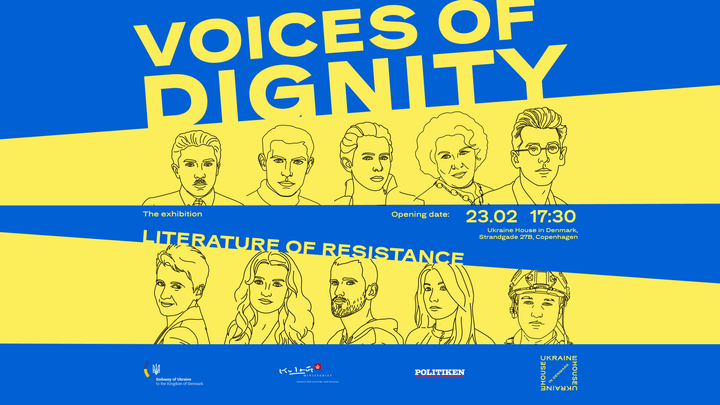
For centuries, Ukraine has faced not only Russian military invasion but systematic cultural erasure. As of today, Russia has stolen the lives of at least 289 Ukrainian cultural figures, including contemporary writers and poets who have been killed since the start of Russia’s full-scale invasion.
The exhibition is the visual continuation of the long-term signature platform Voices of Dignity, launched by Ukraine House in Denmark in 2024 to amplify Ukrainian intellectual and artistic voices in Europe and to promote translation and publishing of Ukrainian literature in Danish and other European languages. Since its inception, this platform has evolved into a key part of the institution's cultural diplomacy, drawing over 2000 guests across multiple iterations, featuring 15 Ukrainian authors, Danish actors and influencers, members of diplomatic corps, Ukrainian actors, and opinion makers.
This exhibition places literature at the center of Ukraine’s cultural survival: as a space where memory is preserved, imperial narratives are challenged, and human dignity is articulated in the face of repression.
Nataliia Popovych, curator of the platform “Voices of Dignity”, says:
“For more than a century, Ukrainian сulture has developed in cycles of renaissance and repression. Writers have been forced to defend not only aesthetic ideas, but the very right of Ukrainian culture to exist. ‘Voices of Dignity’ shows that literature in Ukraine has never been separate from history — it has been a frontline. In Denmark, we invite audiences to see Ukrainian literature and its authors as part of Europe’s shared moral and democratic tradition.”
Tamara Hundorova, literary scholar and consultant to the exhibition, adds:
“Ukrainian literature has always been a political matter. To be a Ukrainian writer meant to stand on the side of the Ukrainian language, culture, and history — and to fight for them. This became especially significant in the twentieth century, which turned into an era of totalitarianism, cultural colonization, wars, and political upheavals. The struggle for Ukraine unites generations, peoples, and ethnic communities. It unfolds in waves of cultural revival which, tragically, were erased throughout the twentieth century by the totalitarian machine and are today being destroyed by Russian military aggression. Each time, this revival has had to begin again.”
At a time when Russia’s war against Ukraine continues, the exhibition offers Danish audiences a deeper historical perspective: Ukraine’s resistance did not begin in 2022. For over a century, Ukrainian writers have stood at the frontline of cultural and political struggle.
The exhibition unfolds chronologically through key literary generations whose work shaped Ukraine’s modern identity of resistance.
It begins with Lesia Ukrainka (1871–1913) — one of the foundational figures of modern Ukrainian literature. Writing at a time when the Russian Empire sought to marginalize the Ukrainian language, she transformed it into a language of philosophical drama and global imagination. Her reinterpretations of classical myths and historical themes positioned Ukraine within a European intellectual tradition. For her refusal to conform to imperial expectations, her work was censored and her family persecuted.
The second chapter turns to the generation known as the Executed Renaissance — writers of the 1920s and 1930s who built a vibrant modernist culture before being destroyed by Stalinist repression. Figures such as Mykola Khvylovyi, Mykhal’ Semenko, Les Kurbas envisioned a European, independent cultural future for Ukraine. By the late 1930s, many were imprisoned or executed, others committed suicide. Their loss represents not only political terror but an attempted erasure of cultural continuity from generation to generation.
The exhibition then moves to the Sixtiers (Shistdesiatnyky) — writers and intellectuals of the 1960s who revived suppressed cultural memory during Soviet stagnation. Through samizdat publishing, poetry readings, and civil activism, they reasserted literature as a space of moral resistance, placing language and cultural rights as human rights at the center of their worldview. For many, including Lina Kostenko, it meant being excluded from publishing, for others like Vasyl Stus, it led to imprisonment, exile, torture and death.
After Ukraine regained its independence in 1991, Ukrainian literature entered a new phase of self-definition. Authors such as Oksana Zabuzhko reframed Ukrainian history through postcolonial and feminist perspectives, reconnecting fragmented generations and bringing Ukrainian intellectual discourse into dialogue with Europe and the wider world. Her works, widely translated, helped international audiences understand Ukraine beyond geopolitical headlines.
The final chapter presents contemporary writers whose work has been shaped directly by war since 2014 — and especially since Russia’s full-scale invasion in 2022.
Authors who participated or whose work was showcased in the Voices of Dignity in 2024 – 2026, including Kateryna Kalytko, Yaryna Chornohuz, Oleksandr Mykhed, Yuliya Musakovska, Iryna Shuvalova, Halyna Kruk, Iryna Tsilyk, Iya Kiva, Myroslav Laiuk, Artur Dron, Valerii Puzik, Kateryna Yegorushkina and late Victoria Amelina, Maksym Kryvtsov, Volodymyr Vakulenko are featured in this chapter. They represent a generation writing from within history as it unfolds. Their texts move between poetry, essays, diaries, documentary prose, and testimony — confronting loss, displacement, frontline experience, and the limits of language itself. A dedicated commemorative space honors writers and cultural figures killed during the full-scale invasion.
Through full-text wall installations, historical documents, archival materials, videos and contemporary publications, the exhibition invites visitors to encounter literature as a living force — not peripheral to history, but central to it. “Voices of Dignity: Literature of Resistance” asserts that Ukrainian literature is not a peripheral chapter of European culture, but a vital part of its contemporary ethical landscape.
Contributions:
The exhibition incorporates materials from the national project “100 Names of Lesia”, initiated by the Ministry of Culture and Information Policy of Ukraine, the State Agency for Arts and Artistic Education, the agency Postmen, and the National Center “Ukrainian House,” with contributions from over 50 institutions and experts, including Pavlo Hudimov, Yevhenii Stasinevych, Vlad Troitskyi, Vira Aheyeva, Tamara Hundorova, and Diana Klochko.
Research contributions were also provided by WeAreUkraine.info/OPIR (Resilient Ukraine CSO), including texts by Inha Vyshnevska, Kvitka Perehinets, and Olha Kostiuk.
Special thanks to the team of Mystetskyi Arsenal and its exhibition “Vasyl Stus. As Long As We Are Here, Everything Will Be Fine”, including Olha Melnyk, Olesya Ostrovska-Lyuta, Anna Pohribna, and Lera Guevska.
Acknowledgment is extended to Olena Lodzinska (Museum of the Sixtiers), Viktoriia Mukha (Museum of the History of Kyiv), Lyudmyla Rybchenko (Museum of the History of Kyiv), and Oles Fedoruk (Taras Shevchenko Institute of Literature), Dmytro Stus (Stus Center), Yaroslav Fayzulin, Oleksandr Amelin, Jon Kyst, Maksym Kalinichenko, Valentyna Shapovalova, Vian Backer Shaker, Luka Viievski, Jesper Juul Keller, and Tetiana Teren.
Ukraine House in Denmark also expresses gratitude to all participating authors and collaborators whose voices shape this exhibition: Lina Kostenko, Oksana Zabuzhko, Kateryna Kalytko, Yaryna Chornohuz, Oleksandr Mykhed, Yuliya Musakovska, Iryna Shuvalova, Halyna Kruk, Iryna Tsilyk, Iya Kiva, Myroslav Laiuk, Artur Dron, Valerii Puzik, and Kateryna Yegorushkina.
We are grateful to the sponsors of Ukraine House in Denmark, without whom this exhibition would not be possible: Politiken-Fonden, the Ministry of Culture of Denmark and its Agency for Culture and Palaces, and Wistifonden.
Opening Event:
23 February 2026, 17:30, Ukraine House in Denmark
EXHIBITION DETAILS
Exhibition “Voices of Dignity: Literature of Resistance”
Dates: 23.02.2026–31.05.2026
Venue: Ukraine House in Denmark, Gammel Dok, Strandgade 27B, 1401 Copenhagen
Co-curators: Nataliia Popovych, Tamara Hundorova
Art direction and curation: Kateryna Stukalova
Design: Anastasiia Chervinska
Project Coordination: Daria Boiko, Marichka Marko-Mortensen
Fundraising: Dariia Mochalova
Communications: Valeriia Prylypko
Opening Hours:
Tuesday–Saturday: 12:00–18:00
Sunday: 12:00–16:00
Monday: Closed
About Ukraine House:
The Ukraine House in Denmark is a Ukrainian cultural institution with a mission to deepen Ukrainian-Danish cooperation in the field of culture and creative industries for sustainable peace in Europe based on common values.
The Ukraine House is the only public cultural diplomacy institution representing Ukraine in Western Europe that is open 6 days a week serving the interests of both the Danish society and the Ukrainian community through creative collaborations within music, theatre, photography, art, academic research, and a wide variety of diverse programs supporting the struggle to preserve and communicate Ukrainian language, history and culture.
In February 2023, the Danish Ministry of Culture allocated the former premises of the Danish Architectural Center at Gammel Dok in the center of Copenhagen to implement the strategy and activities of the Ukraine House team.
Since then, an international volunteer team of 25 people in Copenhagen has worked hundreds of volunteer shifts and hosted more than 17,500 guests, held 13 exhibitions of Ukrainian modern art and wartime architecture, organized more than 210 dialogues, panel discussions, lectures and presentations involving 225+ Ukrainian and Danish parliamentarians, journalists, artists, architects and other opinion leaders, integrated Ukrainian content into leading Danish cultural platforms, such as the Copenhagen Democracy Summit, Copenhagen Architecture Festival, Night of Culture, Copenhagen Photography Festival, and 3DaysofDesign.
About Voices of Dignity:
Voices of Dignity is a literary and musical programme conceived as a living dialogue between Ukrainian literature and European audiences. Organized by Ukraine House in Denmark, each edition brings together Ukrainian invited keynote speakers, authors and texts that articulate Ukraine’s experience of resistance — not only as a political condition, but as a moral and existential one, as well as freedom of expression and conscience, which is foundational for Ukrainians. Ukrainian authors read their texts in the original language, while renowned Danish actors and leaders perform the same works in Danish, creating a shared space of listening, translation, and recognition. Music forms an integral part of the performance.
Følg pressemeddelelser fra Ukraine House in Denmark
Skriv dig op her, og modtag pressemeddelelser på e-mail. Indtast din e-mail, klik på abonner, og følg instruktionerne i den udsendte e-mail.
Flere pressemeddelelser fra Ukraine House in Denmark
Post Release — Different “Liberation” Experiences after WWII: Lessons for the Present14.5.2026 14:00:09 CEST | Pressemeddelelse
In connection with Europe Day, Ukraine House in Denmark, in cooperation with the European Commission Representation in Denmark, hosted a public conversation on the many meanings of “liberation” after the Second World War. The event brought together historians and public intellectuals from Ukrainian, Crimean Tatar, Danish, and broader European contexts to reflect on how the end of WWII was remembered, silenced, distorted, and politically used across different societies.
Post-Release: Tymofii Brik on the Evolution of Ukrainian Society through Data on Social Change and Cohesion4.3.2026 12:21:51 CET | Pressemeddelelse
On January 22, Unity of Ukraine Day, Ukraine House in Denmark hosted a public discussion examining how Ukrainian society has transformed over the past three decades and what makes it resilient today amid full-scale war. Drawing on extensive sociological research, the event explored questions of trust, identity, decentralization, civil society, and polarization, offering a data-driven perspective that goes beyond simplified narratives. The discussion was moderated by Nataliia Popovych, who opened the event by framing Ukraine’s current resilience as the outcome of long-term social change rather than a sudden wartime phenomenon. The keynote presentation was delivered by Tymofii Brik, sociologist and rector of the Kyiv School of Economics, who presented findings from multiple national and international studies conducted before and during the war.
Europe’s Security Through Ukraine: Briefing & Policy Roundtable with the Da Vinci Wolves Battalion4.3.2026 12:14:14 CET | Pressemeddelelse
On February 3, Ukraine House in Denmark hosted a discussion on Europe’s security through the lens of Ukraine’s wartime experience. The event brought together Ukrainian defenders of the Separate Assault Battalion “Da Vinci Wolves” of the Armed Forces of Ukraine — one of the most adaptive frontline units of the full-scale war, and representatives of Ukraine’s defence-focused civil society.
Oleksandra Matviichuk's speech at "Ukrainske Stemmer — historier om frihed" solidarity evening at Det Ny Teater3.3.2026 16:30:01 CET | Aktuelt
Read the speech by Oleksandra Matviichuk delivered during the solidarity evening at Det Ny Teater on February 22, 2026.
Nobelprismodtager, danske stjerner og ukrainske forfattere markerer fireåret for krigen i Ukraine med storstilet solidaritetsaften på Det Ny Teater13.2.2026 12:43:20 CET | Presseinvitation
Den 22. februar 2026 inviterer Ukraine House in Denmark, Dansk Kulturinstitut og Det Ny Teater til ”Ukrainske Stemmer – historier om frihed”, en solidaritetsaften for Ukraine på tærsklen til fireåret for Ruslands fuldskalainvasion. På scenen kan bl.a. opleves den ukrainske nobelprismodtager Oleksandra Matviichuk, den danske verdensstjerne Nikolaj Coster-Waldau, Bodil Jørgensen, Ellen Hillingsø, Christine Albeck Børge, et 26 personers stort kammerorkester, samt en række ukrainske kunstnere.
I vores nyhedsrum kan du læse alle vores pressemeddelelser, tilgå materiale i form af billeder og dokumenter samt finde vores kontaktoplysninger.
Besøg vores nyhedsrum