Post-Release: Tymofii Brik on the Evolution of Ukrainian Society through Data on Social Change and Cohesion
4.3.2026 12:21:51 CET | Ukraine House in Denmark | Pressemeddelelse
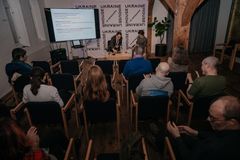
On January 22, Unity of Ukraine Day, Ukraine House in Denmark hosted a public discussion examining how Ukrainian society has transformed over the past three decades and what makes it resilient today amid full-scale war. Drawing on extensive sociological research, the event explored questions of trust, identity, decentralization, civil society, and polarization, offering a data-driven perspective that goes beyond simplified narratives.
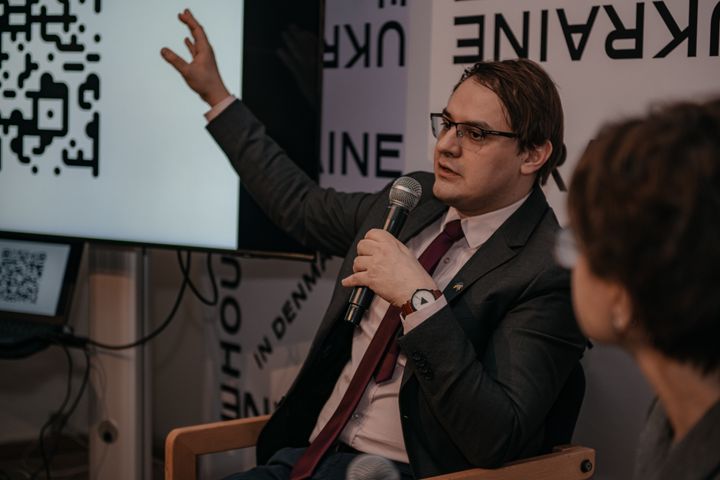
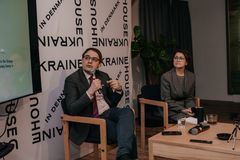
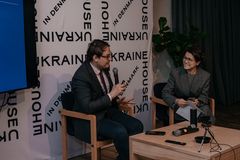
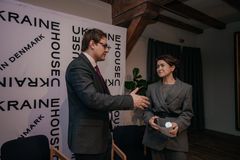
The discussion was moderated by Nataliia Popovych, who opened the event by framing Ukraine’s current resilience as the outcome of long-term social change rather than a sudden wartime phenomenon. The keynote presentation was delivered by Tymofii Brik, sociologist and rector of the Kyiv School of Economics, who presented findings from multiple national and international studies conducted before and during the war.
A Society under Constant Transformation
Opening the conversation, Tymofii Brik argued: “Ukraine is such a paradoxical society in that way, and there are many narratives that co-exist even today. On the one hand, … Ukraine has not had elections for many years and perhaps will rally around the flag effect. There could be concerns about the state of democracy in Ukraine, but on the other hand we also know that Ukraine has supported the European Union, European integration, and the EU is valued quite a lot among Ukrainians”. Before turning to regional identity studies, the sociologist outlined data from the National Academy of Sciences, demonstrating that support for privatization dropped dramatically from around 50% in 1992 to roughly 25% by 2018. At the same time, while only about 45% of respondents identified primarily as Ukrainian citizens in the early 1990s, this share has grown to over 70% in 2025. These reversals, Brik argued, illustrate Ukraine’s high degree of social flexibility — “a society under transformation”, moving in different directions over time under the influence of major political events, from independence and the Orange Revolution to Euromaidan and the full-scale invasion.
Later, he revisited classic sociological research on identity formation in Ukraine, including studies by Natalia Chernysh, who compared local identities in Lviv and Donetsk in the 1990s. Early post-Soviet Ukraine showed sharp contrasts: political and national identification in the west versus occupational and social identification in the east. Younger generations across regions increasingly adopted political and civic identities, such as identifying as Ukrainian or as part of the state.
Importantly, Brik emphasized that regional differences in Ukraine should not automatically be seen as divisive. “Regions are just the vehicles”, he noted, shaped by local schools, churches, and media. Change at the local level, therefore, can produce lasting shifts in identity.
This argument was reinforced by research from political scientist Leonid Peisakhin, who demonstrated that even within the same administrative region, historical legacies, such as former imperial borders can still influence political attitudes. The implication is that Ukraine’s diversity operates at the micro level and cannot be reduced to a simple East–West divide.
Trust, Mobilization, and the Power of Networks
A central paradox addressed during the talk was Ukraine’s high level of civic mobilization despite persistently low trust in formal institutions. Survey data show that Ukrainians have historically distrusted courts, political parties, and central authorities, yet they repeatedly mobilized during the Orange Revolution, Euromaidan, and the full-scale invasion.
According to Brik, this paradox can be explained by networks rather than institutions. Studies by Olga Onuch as well as Brik’s own research demonstrate that Ukrainians are mobilized primarily through social media, personal contacts, and informal networks. This pattern remains visible today: surveys conducted during anti-corruption protests in 2024 showed that calls from bloggers, online communities, and trusted personal contacts were the most important triggers for participation.
Socioeconomic status also matters. Data analyzed by Olena Somancheva indicate that participants in the Orange Revolution and Euromaidan were disproportionately drawn from small and medium-sized business owners and the professional “service class.” These groups’ “desire to support democracy and be mobilised correlates with social and economic status because… those who are integrated in the market economy, also want to defend their vision of socio-economic development in Ukraine”.
Civil Society as Identity, Not Membership
While only 10–15% of Ukrainians formally belonged to NGOs or associations during the 1990s and 2000s, surveys conducted by Kateryna Zarembo reveal a striking contrast. Nearly 80% of Ukrainians consider themselves part of civil society. When asked to define this belonging, respondents cited values, actions, and democratic commitment rather than formal membership.
This self-perception was echoed in 2024 protest surveys, where participants framed their involvement not only as opposition to corruption, but also as a way to “act like citizens in a democracy” or signal European values.
Resilience Through Decentralization and Cooperation
Turning to wartime resilience, Brik presented findings from a study of Ukrainian municipalities conducted after the Russian invasion of Ukraine. Moving beyond the idea of resilience as simply “bouncing back,” the research conceptualized resilience as a combination of preparedness, robustness, and adaptability.
The results showed that preparedness depended strongly on fiscal decentralization, particularly on municipalities’ own revenue sources rather than central transfers. Robustness was shaped by proximity to the frontline, while adaptability was often strongest in frontline communities forced to innovate under pressure.
One factor, however, proved decisive across all models: horizontal cooperation agreements between municipalities. Cities and communities that had prior partnerships were able to mobilize resources, share equipment, and support each other immediately after the invasion. According to Tymofii Brik, these networks represent a form of social capital that decentralization reforms helped unlock long before the war began.
Values, Europe, and the Question of Polarization
Using data from the European Social Survey, Brik situated Ukraine within a comparative map of values. Before 2014, Ukrainians closely resembled Poles and Slovaks: community-oriented rather than individualistic, and moderately open to change. Crucially, these values appeared remarkably consistent across regions, age groups, and genders.
Data from Euromaidan protesters showed a distinctive shift: while still community-oriented, protesters were significantly more open to change, resembling societies such as Finland or Norway. Whether Ukrainian society as a whole has since moved in this direction remains an open empirical question.
Addressing widespread fears of wartime polarization, Brik presented results from a 2024 experimental survey measuring affective polarization. Respondents were exposed to different scenarios involving neighbors with varying language use, religious affiliation, and wartime behavior. Contrary to expectations, the study found no strong evidence of systematic hostility toward any particular group. Attitudes toward Russian-speaking Ukrainians, displaced persons, or civilians abroad remained largely moderate.
While acknowledging the limitations of the data, for instance the absence of military respondents, Brik concluded that Ukrainian society remains remarkably cohesive. However, it is still vulnerable to future polarization if institutional support erodes.
Trust, Cynicism, and the Future
In the discussion that followed, participants addressed declining trust in central authorities after the initial “rally around the flag” in 2022. Brik noted that while trust in the army and volunteers remains high, trust is fragile without institutionalization. Scandals involving volunteer fundraising illustrate how quickly social trust can erode if transparency mechanisms are absent.
He also highlighted Ukraine’s persistent “social cynicism”: a belief that others are dishonest, while oneself and close networks are moral. While cynicism can protect against authoritarian populism, it also discourages long-term engagement. Expanding the boundaries of trust through institutions, transparency, and inclusion remains a key challenge.
In his concluding remarks, Brik stressed that Ukraine cannot be understood or supported through isolated reforms or single narratives. Trust, identity, resilience, and democratic values are shaped simultaneously by institutions, local governance, networks, economic structures, and discourse.
We thank Tymofii Brik for a rigorous and nuanced analysis of Ukrainian society grounded in three decades of sociological data. His lecture showed that Ukraine’s resilience is not accidental, but the result of long-term social transformation from shifting identities and values to the growth of local trust and civic engagement. While Ukraine has remained a low-trust society toward formal institutions, the data reveal how decentralization, local governance, and social networks have strengthened social cohesion and collective action, even under the pressure of war. Understanding these findings is essential not only for grasping how Ukraine endures today, but also for supporting its democratic development and European future.
Nøgleord
Billeder
Følg pressemeddelelser fra Ukraine House in Denmark
Skriv dig op her, og modtag pressemeddelelser på e-mail. Indtast din e-mail, klik på abonner, og følg instruktionerne i den udsendte e-mail.
Flere pressemeddelelser fra Ukraine House in Denmark
Danmarks første udstilling om ukrainsk naiv kunst viser kulturens rolle i en tid med krig20.8.2026 08:00:00 CEST | Pressemeddelelse
Den 21. august åbner Ukraine House in Denmark NAÏV: Ukrainian Visions – den første udstilling i Danmark dedikeret til ukrainsk naiv kunst. Mens Ukraine ofte bliver betragtet gennem krigens prisme, retter udstillingen blikket mod en kunstnerisk tradition, der gennem generationer har været med til at udtrykke, bevare og forsvare ukrainsk kultur og identitet, og som har fået fornyet betydning i en tid, hvor Ukraines kulturarv igen er under pres.
Kyiv til København: Velorukh. Cycling in Ukraine fortsætter sin europæiske turné med en boglancering i Ukraine House in Denmark29.7.2026 16:07:44 CEST | Pressemeddelelse
København, den 7. august 2026. Efter præsentationer i Berlin, Barcelona, Prag og på Mallorca kommer den engelsksprogede udgave af Velorukh. Cycling in Ukraine nu til København som led i bogens europæiske turné. Arrangementet finder sted i Ukraine House in Denmark, en af Skandinaviens førende platforme for formidling af moderne ukrainsk kultur til et internationalt publikum.
Ukraine House in Denmark and Texty.org.ua Present “Infographics of the Russian-Ukrainian War” Pop-Up Exhibition26.6.2026 13:41:10 CEST | Pressemeddelelse
From June 26 to August 14, Ukraine House in Denmark and the Ukrainian data journalism outlet Texty.org.ua will display a pop-up exhibition “Infographics of the Russian-Ukrainian War” exploring Russia's war against Ukraine through data and visual storytelling.
Ukraine House in Denmark Presents "Form in the Making" Exhibition at 3daysofdesign8.6.2026 14:20:22 CEST | Pressemeddelelse
For the third year in a row, Ukraine House in Denmark joins 3daysofdesign, Copenhagen’s biggest design festival on June 10-12. This year, together with the Ukrainian Association of Furniture Manufacturers, the Embassy of Ukraine in Denmark, and curators Anait Danielian and Larysa Tsybina, we present “Form in the Making” – a collective exhibition exploring how contemporary Ukrainian design is made today.
Post Release — Different “Liberation” Experiences after WWII: Lessons for the Present14.5.2026 14:00:09 CEST | Pressemeddelelse
In connection with Europe Day, Ukraine House in Denmark, in cooperation with the European Commission Representation in Denmark, hosted a public conversation on the many meanings of “liberation” after the Second World War. The event brought together historians and public intellectuals from Ukrainian, Crimean Tatar, Danish, and broader European contexts to reflect on how the end of WWII was remembered, silenced, distorted, and politically used across different societies.
I vores nyhedsrum kan du læse alle vores pressemeddelelser, tilgå materiale i form af billeder og dokumenter samt finde vores kontaktoplysninger.
Besøg vores nyhedsrum