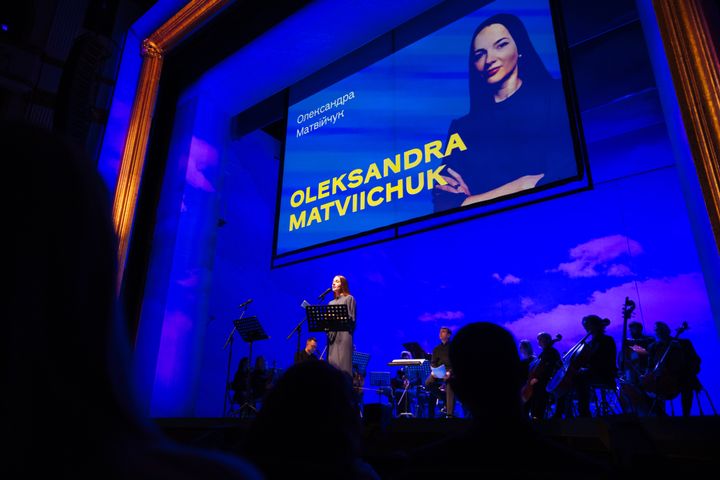
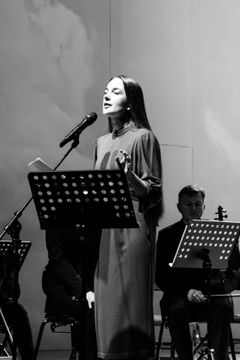
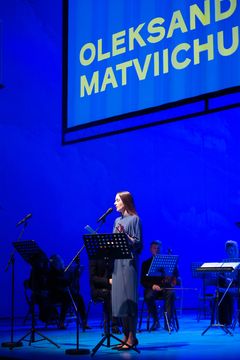
Oleksandra Matviichuk's speech at "Ukrainske Stemmer — historier om frihed" solidarity evening at Det Ny Teater
3.3.2026 16:30:01 CET | Ukraine House in Denmark | Aktuelt
Read the speech by Oleksandra Matviichuk delivered during the solidarity evening at Det Ny Teater on February 22, 2026.
"This is the fourth winter of the full-scale invasion. And it is very difficult.
Russian missiles and drones are deliberately destroying the energy infrastructure on which the survival of civilians depends. In January and February, temperatures drop to minus 25 degrees Celsius. Ukrainian cities are literally freezing. Millions of people have limited or no access to heating, water, and electricity.
I remember in 2022, when the Russians first began striking the energy infrastructure, a photograph appeared online of a Kyiv schoolteacher. She was wearing a red winter jacket and a warm hat, standing on tiptoe beside a metal pole on which she had placed her computer — outside, somewhere near a shop where a power generator was running and there was internet access. And there, in the freezing cold, she was giving her students a lecture.
And I thought: the Russians came to take everything from us — our land, our freedom, our future, our children’s education. And this Kyiv schoolteacher decided to give them nothing. Even something as simple as teaching a lesson became an act of resistance.
From my own experience, I know that when you cannot rely on the international system of peace and security, you can always rely on people. We are used to thinking in categories of states and intergovernmental organizations, but ordinary people possess far more power than they themselves realize.
Four years ago, I was in Kyiv when Russian forces tried to encircle the city. No one believed we could withstand such a massive military threat. We greeted each morning as a victory because we had survived another night. I remember international humanitarian organizations evacuating their staff. But ordinary people stayed — and began to resist. Ordinary people began doing extraordinary things.
One of those people was my friend, the Ukrainian writer Viktoriia Amelina. In the first days of the full-scale invasion, she interrupted her trip and returned to Ukraine. Soon she joined efforts to document war crimes. And she did many other things at the same time.
I remember telling her: you are already doing so much, almost beyond exhaustion — writing a book, documenting war crimes, traveling on field missions, volunteering. Why take on new projects?
She answered that she had a persistent feeling that she was not doing enough. And that she did not know how much time she had — or how much time any of us had.
A month after that conversation, a Russian missile struck a café in Kramatorsk. At that moment, Vika was there with Colombian writers whom she was accompanying to the east. She was gravely wounded and fell into a coma.
It may sound irrational, but I wrote to her every day in Messenger. I was convinced she would wake up and read it all. Even when our mutual friend, who was beside her in intensive care, told me we needed not only to prepare but to accept the inevitable, I answered that I would not lose hope.
When I was preparing this speech, I opened that final conversation that Vika never read. And this is what I want to tell you.
First. I do not know what historians of the future will call this period. But the international order based on the UN Charter and international law has been broken.
The UN system was created after the Second World War to protect people from war and mass violence. But even my phone has an expiration date. This system was never reformed. And now it is stalling, performing ritual gestures. It is easy to predict that fires like wars will erupt more frequently in different parts of the world because the international wiring is faulty and sparking everywhere.
Ukraine has found itself at the epicenter of events that will determine the future development of the world. Because this is not simply a war between two states — it is a war between two systems: authoritarianism and democracy.
Putin seeks to prove that a country with powerful military capacity and nuclear weapons can break the international order, dictate its rules to the global community, and even forcibly change internationally recognized borders.
Putin did not launch the full-scale invasion to capture another piece of Ukrainian land. It is naïve to think Russia has lost hundreds of thousands of soldiers to occupy Avdiivka or Bakhmut. Putin launched this invasion to occupy and destroy all of Ukraine — and then move further.
His logic is historical. He dreams of restoring the Russian Empire. People in other European countries are safe only because Ukrainians continue to hold back the Russian army.
Second. People begin to understand that war is happening only when bombs fall on their own heads. But war also has an informational dimension, and this struggle for reality has no state borders.
The way people see the world determines their decisions and actions. That is why authoritarian regimes attack truth.
We all spend more and more time on social media, flooded with fakes and disinformation. People lose the ability to distinguish truth from lies. Now even residents of the same small community no longer share a common picture of the world. Without a shared picture of reality, they cannot act together. And without collective action, how can we defend our freedom?
We live in what is called a “post-truth world.” But it seems to me it is a post-knowledge world. Knowledge is losing value. People prefer listening to Instagram bloggers rather than researchers or scientists. People demand simple solutions.
Perhaps in peaceful times we could afford that. But no one lives in peaceful times anymore. Therefore, instead of simplification, we must cultivate complexity.
We must also resist the normalization of cruelty.
A few weeks ago, Russians killed an elderly couple who were trying to leave an occupied village in the Sumy region. The husband was pulling his wife on a sled toward a point where rescuers were waiting. An FPV drone dropped explosives directly on the woman. The husband wept and would not leave her body. Then a second FPV drone struck him.
As I studied these materials, I remembered that the gas chambers in Auschwitz were built by professional German engineers. And that the collapse of the international system was preceded by the loss of humanity.
And finally.
Freedom is not a given — it is a condition for survival. For three centuries Ukrainians lived in the shadow of the Russian Empire. We would never have survived as a nation if we had not persistently sought freedom throughout those centuries.
I recorded the testimony of Ukrainian scholar and philosopher Ihor Kozlovskyi after 700 days of Russian captivity. Before that, I had interviewed more than a hundred survivors. They described being beaten, tortured, forced into wooden boxes, having limbs cut off, knees crushed, electric currents applied to their genitals, forced to write in their own blood. It was hard to shock me.
But Ihor mentioned something seemingly insignificant for legal documentation — and it struck me deeply.
He described his days in solitary confinement. It was a basement cell that in Soviet times held death row prisoners. There were no windows. No sunlight. The air was scarce. It was hard to breathe. Sewage ran across the dirty floor. Rats emerged from the drain.
And this scholar, known across the country, told me how he gave philosophy lectures to the rats — simply to hear the sound of a human voice.
Ihor Kozlovskyi was a victim in the legal sense: kidnapped, held in inhuman conditions, tortured so severely he had to relearn how to walk. But he refused to live himself as a victim.
Because the foundation of our existence is dignity, not victimhood.
And dignity is action.
We are not hostages of circumstances. We are participants in this historical process. Dignity gives strength to fight even in circumstances unbearable for a human being.
We stand on the shoulders of those who came before us. The murders of Ukrainian intellectuals, the bloody repression of poets and artists, the artificial famine of millions — none of this destroyed Ukrainian identity in Soviet times. Because then, as now, there were always people who taught Ukrainian children. People who wrote Ukrainian books. People who preserved memory.
We sow.
We sow seeds.
We sow even in winter, when everything is frozen.
We sow what is not afraid of the cold.
We sow as an act of faith, knowing that spring will inevitably come and everything we have planted will grow.
Yes, this is long work. But those who plan for the long term are the ones who win.
When I reread the messages Vika never read, I thought about how much she managed to do in her short life. I thought about the love she generously shared with me, with her family, with our friends. I looked again at the photographs in her unfinished book about women in war — a book published after her death and coming out in Denmark this year.
Human life is fragile. But even so, it can be filled with eternal meaning.
I now know many things about hope.
Hope is not the belief that everything will be fine.
Hope is the deep understanding that all our efforts have meaning."
Read the text in Danish published in Weekendavisen: https://www.weekendavisen.dk/opinion/et-froe-af-haab
Billeder
Følg pressemeddelelser fra Ukraine House in Denmark
Skriv dig op her, og modtag pressemeddelelser på e-mail. Indtast din e-mail, klik på abonner, og følg instruktionerne i den udsendte e-mail.
Flere pressemeddelelser fra Ukraine House in Denmark
Danmarks første udstilling om ukrainsk naiv kunst viser kulturens rolle i en tid med krig20.8.2026 08:00:00 CEST | Pressemeddelelse
Den 21. august åbner Ukraine House in Denmark NAÏV: Ukrainian Visions – den første udstilling i Danmark dedikeret til ukrainsk naiv kunst. Mens Ukraine ofte bliver betragtet gennem krigens prisme, retter udstillingen blikket mod en kunstnerisk tradition, der gennem generationer har været med til at udtrykke, bevare og forsvare ukrainsk kultur og identitet, og som har fået fornyet betydning i en tid, hvor Ukraines kulturarv igen er under pres.
Kyiv til København: Velorukh. Cycling in Ukraine fortsætter sin europæiske turné med en boglancering i Ukraine House in Denmark29.7.2026 16:07:44 CEST | Pressemeddelelse
København, den 7. august 2026. Efter præsentationer i Berlin, Barcelona, Prag og på Mallorca kommer den engelsksprogede udgave af Velorukh. Cycling in Ukraine nu til København som led i bogens europæiske turné. Arrangementet finder sted i Ukraine House in Denmark, en af Skandinaviens førende platforme for formidling af moderne ukrainsk kultur til et internationalt publikum.
Ukraine House in Denmark and Texty.org.ua Present “Infographics of the Russian-Ukrainian War” Pop-Up Exhibition26.6.2026 13:41:10 CEST | Pressemeddelelse
From June 26 to August 14, Ukraine House in Denmark and the Ukrainian data journalism outlet Texty.org.ua will display a pop-up exhibition “Infographics of the Russian-Ukrainian War” exploring Russia's war against Ukraine through data and visual storytelling.
Ukraine House in Denmark Presents "Form in the Making" Exhibition at 3daysofdesign8.6.2026 14:20:22 CEST | Pressemeddelelse
For the third year in a row, Ukraine House in Denmark joins 3daysofdesign, Copenhagen’s biggest design festival on June 10-12. This year, together with the Ukrainian Association of Furniture Manufacturers, the Embassy of Ukraine in Denmark, and curators Anait Danielian and Larysa Tsybina, we present “Form in the Making” – a collective exhibition exploring how contemporary Ukrainian design is made today.
Post Release — Different “Liberation” Experiences after WWII: Lessons for the Present14.5.2026 14:00:09 CEST | Pressemeddelelse
In connection with Europe Day, Ukraine House in Denmark, in cooperation with the European Commission Representation in Denmark, hosted a public conversation on the many meanings of “liberation” after the Second World War. The event brought together historians and public intellectuals from Ukrainian, Crimean Tatar, Danish, and broader European contexts to reflect on how the end of WWII was remembered, silenced, distorted, and politically used across different societies.
I vores nyhedsrum kan du læse alle vores pressemeddelelser, tilgå materiale i form af billeder og dokumenter samt finde vores kontaktoplysninger.
Besøg vores nyhedsrum