
Framework for assessing national contributions towards the 30% protection target has been internationally peer-reviewed
2.3.2026 17:33:20 CET | Biodiversitetsrådet | Pressemeddelelse
A new internationally peer-reviewed scientific article introduces a science-based operational framework developed with the Danish Biodiversity Council. The framework can help countries assess their genuine national contributions to protecting 30% of land and sea by 2030. When applied to Denmark, the framework shows that the official Danish reporting substantially overestimates the country’s progress towards meeting the international targets.
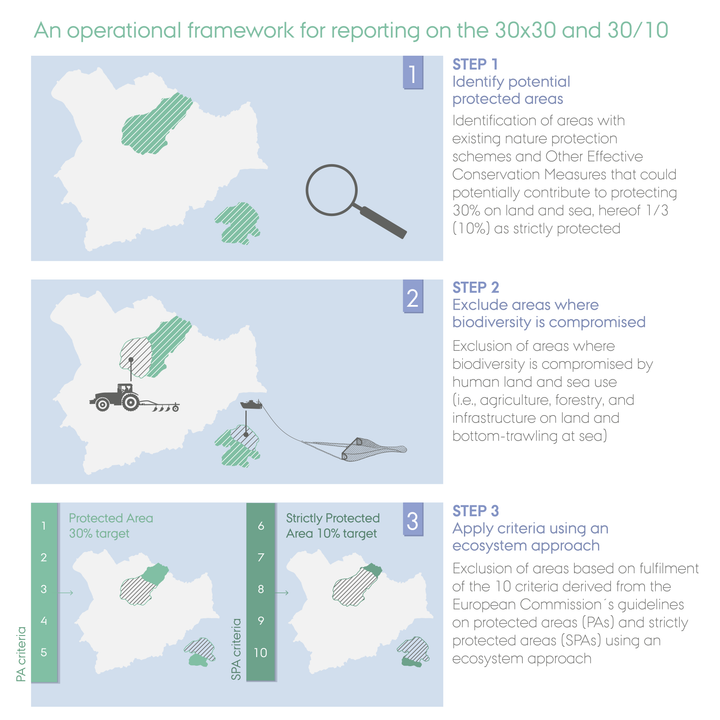
European biodiversity policies call for protecting 30% of land and sea, hereof one-third (10%) as strictly protected by 2030, requiring countries to demonstrate genuine progress toward this 30/10 target. However, without rigorous assessment of protection effectiveness, reported figures risk substantially overestimating progress and undermining the overall aim of halting and reversing biodiversity loss.
The framework presented in the newly published article outlines a three-step process on how to identify areas that genuinely contribute to the EU 30/10 target: (1) identify areas with existing protection schemes that could potentially contribute to the 30/10 target; (2) exclude areas that compromise biodiversity, and (3) apply criteria for protected and strictly protected areas derived from the European Commission's guidelines to assess which areas meets the criteria using an ecosystem approach, see figure 1.
Applying the science-based operational framework to Denmark using a geospatial analysis revealed that only 2% of land and 2% of sea genuinely contribute towards the 30% target, while the Danish authorities have reported contributions more than 7 to 15 times larger for land and sea, respectively.
The framework could strengthen conservation across the EU
The framework is applicable to other EU Member States and enables them to evaluate whether protected areas meet basic criteria for protection effectiveness.
“Researchers have pointed to the need for ensuring not only protected area quantity, but quality in area-based targets for years. The framework from Denmark here makes a proposal on which reported protected areas might count towards an implementation of the 30x30 biodiversity target. It is extremely timely as it helps to initiate a discussion on what effective conservation for biodiversity recovery would mean at national and pan-European level,” says Martin Jung, senior research scholar and conservation scientist at Institute for Applied Systems Analysis (IIASA).
The framework operationalises the European Commission’s guidelines for protected and strictly protected areas by deriving specific criteria and implementing a clear, transparent, and stepwise recipe using an ecosystem approach. This ensures that protection covers entire ecosystems rather than isolated species and habitat subsets, and it clarifies that Natura 2000 areas should not automatically be counted toward the 30% target. In Denmark more than one-third of Danish Natura 2000 areas includes land uses that compromise biodiversity.
“What I find particularly compelling about this framework is its insistence that areas only contribute to the 30% target if they protect the ecosystem as a whole. In particular, the study provides a strong case for why Natura 2000 areas should not be counted towards the 30x30 target by default, as indicated by the EU Commission’s guidelines for protected and strictly protected areas,” says Vigdis Vandvik professor of ecology at University of Bergen and Centre Director at Centre for Sustainable Area Management.
By offering an operational and science-based way to assess real protection, the framework helps ensure that reported conservation progress aligns with science-based knowledge on biodiversity outcomes. Its EU-wide applicability makes it an important tool for guiding countries toward genuinely meeting the 30 % target for protected areas.
>> Read the full scientific article here
Citation and background
The stepwise and operational framework was developed by The Danish Biodiversity Council together with three researchers associated to the Biodiversity Council’s secretariat.
The authors of the peer-reviewed article are: Pedersen P.B.M, Petersen A.H., Corcoran D., Madsen N., Svenning J.C., Timmermann K., Kaae B.C., Kragh T., Olsen B.E., Strange N., Normand S., Rahbek C. Publication: “Identifying Conservation Gaps: A Framework for Evaluating National Contributions to the 30x30 Target”
The peer-reviewed scientific article introduces an operational framework based on the approach and analyses in the following reports by the Danish Biodiversity Council:
Biodiversitetsrådet (2022). Fra tab til fremgang – beskyttet natur i Danmark i et internationalt perspektiv.
Biodiversitetsrådet (2023). Mod robuste økosystemer – anbefalinger til en dansk lov om biodiversitet.
Nøgleord
Kontakter
Pil Birkefeldt Møller Pedersen,Hovedforfatter, adjunkt, Aarhus Universitet
Tlf:+45 28 58 13 85Signe NormandForperson, Biodiversitetsrådet
Tlf:+ 45 93 52 28 77forperson@biodiversitetsraadet.dkTina FruelundKommunikationsansvarlig, Biodiversitetsrådets sekretariat
Tlf:+45 29 21 96 32tf@biodiversitetsraadet.dkLinks
Biodiversitetsrådet
Biodiversitetsrådet er et uafhængigt forskningsbaseret ekspertorgan, der har som opgave at rådgive regeringen og Folketinget om indsatser, der kan vende tabet af biodiversitet til fremgang. Rådet består af ni medlemmer og beskæftiger sig med en række problemstillinger indenfor natur og biodiversitet – både i vand og på land, herunder samspillet med lovgivning, økonomi og adfærd.

Følg pressemeddelelser fra Biodiversitetsrådet
Skriv dig op her, og modtag pressemeddelelser på e-mail. Indtast din e-mail, klik på abonner, og følg instruktionerne i den udsendte e-mail.
Flere pressemeddelelser fra Biodiversitetsrådet
Biodiversitetsrådet deltager for første gang med egen stand på Naturmødet19.5.2026 14:39:52 CEST | Pressemeddelelse
Biodiversitetsrådet deltager i år for første gang med egen stand på Naturmødet. Her er du inviteret indenfor til dialog, vidensformidling og samtaler om, hvordan vi vender tabet af biodiversitet til fremgang i Danmark.
Presseinvitation til Biodiversitetsrådets konference: Veje mod beskyttelse og genopretning af Danmarks biodiversitet12.11.2025 11:37:20 CET | Presseinvitation
Onsdag d. 19. november 2025 kl. 10:00-14:30 afholder Biodiversitetsrådet konferencen “Veje mod beskyttelse og genopretning af Danmarks Biodiversitet” i Landstingssalen på Christiansborg. Konferencen åbnes af folketingsmedlem, Marianna Bigum (SF), mens journalist Tine Gøtzsche vil lede publikum igennem dagens faglige indlæg og politiske debatter.
Danmark mangler mindst 162 mia. kr. frem mod 2050 til at beskytte og genoprette biodiversiteten6.11.2025 06:01:10 CET | Pressemeddelelse
En ny rapport fra Biodiversitetsrådet viser, at den statslige finansiering til biodiversitet i Danmark er utilstrækkelig og har en usikker biodiversitetseffekt. Et markant løft og målretning af finansieringen er nødvendig for at vende tabet af biodiversitet til fremgang, og for at vi kan leve op til vores internationale forpligtelser i EU og FN.
Ny rapport fra Biodiversitetsrådet om finansiering af Danmarks biodiversitetsindsats offentliggøres den 6. november29.10.2025 14:29:45 CET | Pressemeddelelse
Torsdag d. 6. novemer kl. 06.00 udgiver Biodiversitetsrådet rapporten ‘Mere og bedre finansiering – estimering af finansieringsgabet i Danmarks biodiversitetsindsats’, der vurderer finansieringen af Danmarks biodiversitetsindsats og undersøger, om der er behov for mere og bedre målrettet finansiering.
Biodiversitetsrådets anbefalinger til en kommende biodiversitetslov8.5.2025 09:59:00 CEST | Pressemeddelelse
Danmark tager et vigtigt skridt mod en styrket biodiversitetsindsats, når regeringens arbejde med en ny biodiversitetslov går i gang i 2025. Biodiversitetsrådet lancerer i dag en ny hjemmeside med konkrete, faglige anbefalinger til, hvordan biodiversitetsloven kan opbygges og anvendes.
I vores nyhedsrum kan du læse alle vores pressemeddelelser, tilgå materiale i form af billeder og dokumenter samt finde vores kontaktoplysninger.
Besøg vores nyhedsrum