
Plants use engineering principles to push through hard soil
26.11.2025 17:01:00 CET | Københavns Universitet | Press release
An international research team led by the University of Copenhagen, Shanghai Jiao Tong University and the University of Nottingham has discovered how plant roots penetrate compacted soil by deploying a well-known engineering principle. The finding could have major implications for future crop development at a time when pressure on agricultural land is increasing.
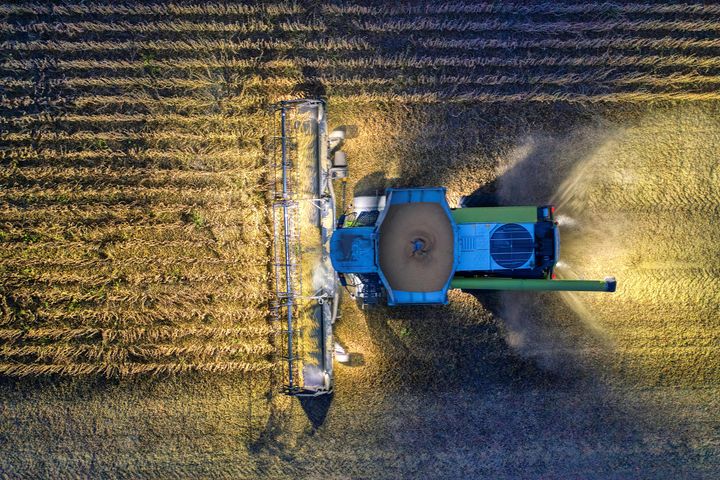
Across the globe, soil compaction is becoming an ever more serious challenge. Heavy vehicles and machinery in modern agriculture compress the soil to such an extent that crops struggle to grow. In many regions, the problem is aggravated by drought linked to climate change.
But plants may in fact be able to solve part of the problem themselves – with a little help from us. It is already known that when soil becomes dense and difficult to penetrate, plants can respond by thickening their roots. Until now, however, it has remained unclear how they manage this, beyond the fact that the plant hormone ethylene plays a key role.
Researchers from the University of Copenhagen, Shanghai Jiao Tong University, the University of Nottingham and partners have now pieced together the mechanism. Their results have been published in the prestigious journal Nature.
“Because we now understand how plants ‘tune’ their roots when they encounter compacted soil, we may prime them to do it more effectively,” says Staffan Persson, professor at the University of Copenhagen and senior author of the study.
A biological wedge in the soil
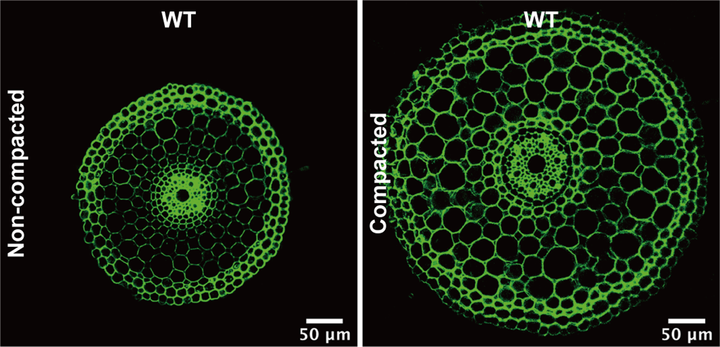
The team found that when soil is compacted and ethylene accumulates around the root, the hormone activates a gene called OsARF1. This gene reduces the production of cellulose in certain root cells, making the middle layer of the root thinner, softer and more flexible. This allows the cells to swell and the root to expand. At the same time, the outermost layer of the root (the epidermis) becomes thicker and stiffer.
“In other words, the root changes its structure in line with a basic engineering principle: the larger a pipe’s diameter and the stronger its outer wall, the better it can resist buckling when pushed into a compact material,” explains Bipin Pandey, senior author and associate professor at the University of Nottingham.
The combination of root swelling and a reinforced outer layer allows the root to act as a kind of biological wedge, easing its way down through the soil.
“It’s fascinating to see how plants draw on mechanical concepts familiar from construction and design to solve biological challenges,” says Staffan Persson.
Helping plants grow better in hard soil
The study also reveals how this mechanism can be amplified:
“Our results show that by increasing the levels of a specific protein – a transcription factor – the root becomes better able to penetrate compact soil. With this new knowledge, we can begin redesigning root architecture to cope more effectively with compacted soils. This opens new avenues in crop breeding,” says first author Jiao Zhang, postdoc at Shanghai Jiao Tong University.
Although the experiments were conducted in rice, the researchers believe the mechanism applies broadly across plant species. Parts of the same mechanism have also been identified in Arabidopsis, which is evolutionarily distant from rice.
“Our results could help develop crops that are better equipped to grow in soils compacted by agricultural machinery or climate-related drought. This will be crucial for future sustainable agriculture,” says professor and senior author Wanqi Liang from Shanghai Jiao Tong University.
The work also opens new opportunities in plant breeding more generally. The team has identified many additional transcription factors that appear to be key regulators of cellulose production – with far-reaching implications for plant form and structure. For example, it may become possible to design plants with different shapes, which could benefit certain crops.
“The transcription factors we’ve discovered are a goldmine for cell-wall biology. There’s more than enough here to keep me busy until retirement,” concludes Staffan Persson.
The study is the result of a collaboration between researchers in China, the UK, Japan, Argentina and Denmark, drawing on laboratory experiments, genetic analyses and advanced microscopy.
*
WHAT THE RESEARCHERS FOUND
- When soil becomes compacted, the plant hormone ethylene accumulates around the roots, triggering a chain reaction that alters root structure.
- Ethylene activates the gene OsARF1 in the root cortex (the middle layer), reducing production of cellulose – a key cell-wall component.
- Lower cellulose levels make cortex cell walls thinner and more flexible, allowing cells to swell and the root to expand.
- Meanwhile, the epidermis (the outer root layer) becomes thicker and more robust. The combination of a soft cortex and a strong epidermis helps roots push through hard soil.
ABOUT THE STUDY
- The research article is published in Nature.
- Contributing institutions include Shanghai Jiao Tong University; the University of Nottingham; Universidad Argentina de la Empresa; the National Institute of Advanced Industrial Science and Technology; Zhejiang University; Duke University; Ludwig Maximilian University; and the University of Copenhagen.
Keywords
Contacts
Staffan Persson
Professor
Department of Plant and Environmental Science
University of Copenhagen
staffan.persson@plen.ku.dk
+45 35 32 13 52
Maria Hornbek
Communications Officer
UCPH Communication
University of Copenhagen
maho@adm.ku.dk
+45 22 95 42 83
Images
Links
Subscribe to releases from Københavns Universitet
Subscribe to all the latest releases from Københavns Universitet by registering your e-mail address below. You can unsubscribe at any time.
Latest releases from Københavns Universitet
Mødre uden særlig fedtsyre i blodet får oftere børn med astma1.5.2026 06:05:00 CEST | Pressemeddelelse
Et lille molekyle i gravide kvinders blod kobles sammen med børns risiko for at udvikle småbørnsastma og luftvejsinfektioner, viser nyt studie.
Første psykiatriske indlæggelse bliver for de fleste starten på et langvarigt sygdomsforløb30.4.2026 10:39:41 CEST | Pressemeddelelse
Ved at følge en gruppe unge med psykiske problemer gennem 20 år har forskere fra Københavns Universitet fundet, at hele 95 procent igen kommer i kontakt med hospitalspsykiatrien. Samtidig har patienterne en tydelig social slagside, og det peger på, at første indlæggelse er et kritisk vindue for at sætte ind med massiv støtte.
Less food waste: Supermarkets can save money by giving surplus food away23.4.2026 10:03:13 CEST | Press release
When supermarkets choose the right strategy for surplus food, they can both reduce food waste and improve their bottom line. An analysis from the University of Copenhagen shows that it is often more profitable to donate surplus food than to throw it away. In many cases, doing so leads to a direct financial gain.
Historiske analyser kan hjælpe kommunerne i mål med den grønne omstilling21.4.2026 10:07:05 CEST | Pressemeddelelse
Gamle konflikter og dårlige erfaringer med tidligere naturprojekter gør det svært for kommunerne at gennemføre store klimatiltag som udtagning af lavbundsjorde, viser ny forskning fra Københavns Universitet. De historiske erfaringer bør bruges til at forbedre dialogen med borgerne, når der skal planlægges nye klimaindsatser, mener forskerne.
Mindre madspild: Butikkerne kan spare ved at give madvarer væk21.4.2026 07:16:00 CEST | Pressemeddelelse
Når supermarkeder vælger den rigtige strategi for overskudsmad, kan de både reducere madspild og forbedre bundlinjen. En analyse fra Københavns Universitet peger på, at det oftest er mere rentabelt at donere madvarer bort frem for at smide dem ud. I mange tilfælde er det direkte en økonomisk gevinst.
In our pressroom you can read all our latest releases, find our press contacts, images, documents and other relevant information about us.
Visit our pressroom