
Greenhouses cover more and more of Earth’s surface
3.6.2024 13:02:00 CEST | Københavns Universitet | Press release
Greenhouse cultivation is booming globally, especially in the Global South – and across one country in particular. This is revealed in a new study by researchers at the University of Copenhagen that deploys detailed satellite imagery and AI to map greenhouses across the planet. According to the researchers, the development is a source of both promise and concern.
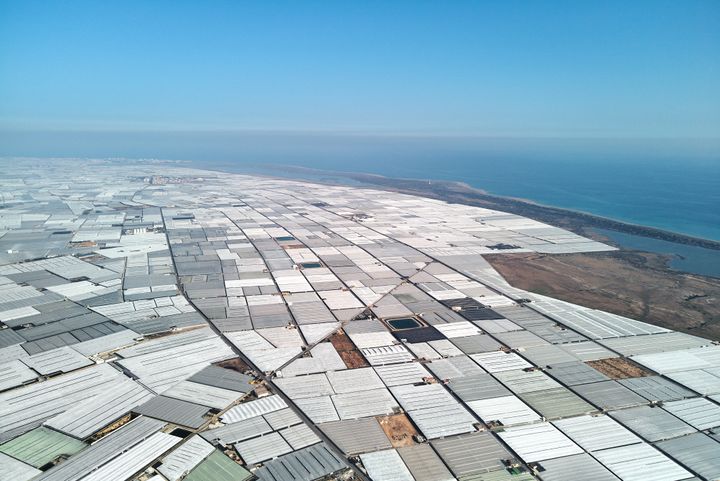
We have long since become accustomed to enjoying tomatoes, cucumbers, berries and melons year-round. In Europe, most of these imports come from Spain, where millions of tons of fruit and vegetables are grown under seas of white plastic that span the southern part of the country.
Globally, greenhouse cultivation is increasing rapidly, according to a new study from the University of Copenhagen that maps the global extent of greenhouses. But the majority of this boom is happening outside of Europe, it is taking place in low- and middle-income countries in the Global South.
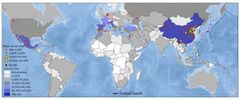
Using a combination of deep learning algorithms and modern sources of satellite imagery, the researchers mapped the amount of land used for greenhouse cultivation worldwide. Their mapping shows that greenhouse cultivation – whether it takes place in glass houses or open fields wrapped in plastic films – covers at least 1.3 million hectares of the Earth's surface. The new figure is nearly three times more than previous estimates.
China in first place, by far
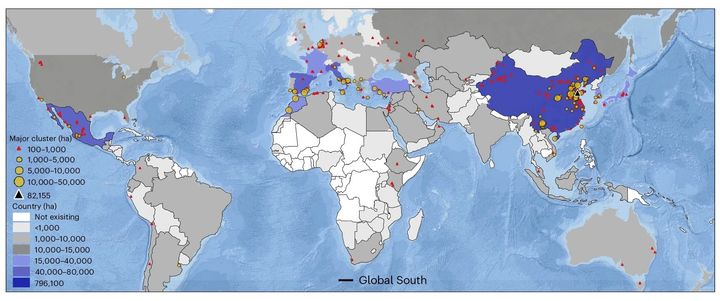
Greenhouse cultivation is spread over 119 different countries, of which China accounts for an entire 60.4% of the total area. Spain and Italy occupy second and third place with 5.6% and 4.1% of global greenhouse coverage respectively.
Whereas large clusters of greenhouses in the Global North were established in the 1970’s and '80s, they began to spring up in the Global South two decades later. And while there has been some stagnation in the Global North, the trajectory of growth continues in Asia, Africa and Central and South America. Indeed, greenhouses in the Global South account for 2.7 times as much area as in the Global North.
"Greenhouse cultivation has become a global phenomenon and there is every indication that it will continue to expand. Until now however, this phenomenon is rapidly rising under the radar and we have had large gaps in our knowledge of the dynamics that drive this phenomenon," says Xiaoye Tong, a postdoc at the Department of Geosciences and Natural Resource Management and first author of the research article published in Nature Food.
According to the researchers, China’s dominance in terms of area is probably tied to the country's socio-economic development. Here, the study also found that large clusters of greenhouses are located near metropolitan areas.
"The boom in China seems to be closely linked to its strong economic performance over the past decade and the rise of an urban population with purchasing power that demands tomatoes, cucumbers and other types of fresh fruit and vegetables. At the same time, farmers who would otherwise be unable to finance this form of cultivation receive government subsidies and support to build greenhouses and learn cultivation techniques," says Xiaoye Tong.
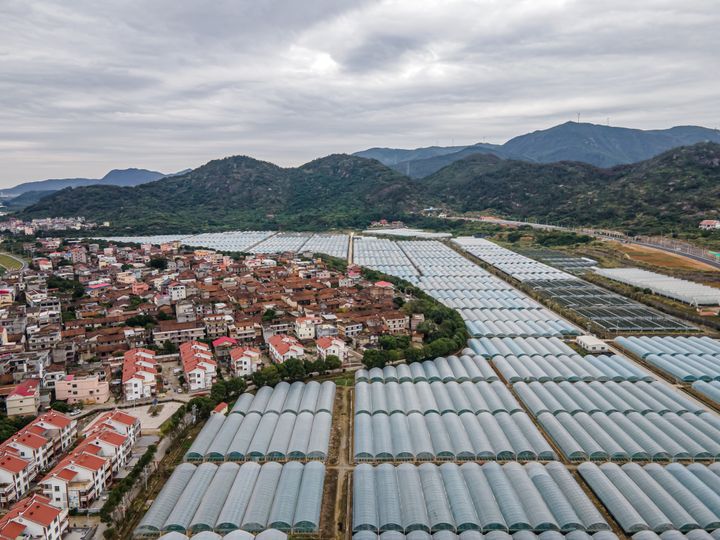
Huge benefits, as well as consequences
Government support for greenhouse growers doesn’t just exist in China – it is found in arid and semi-arid regions that have traditionally not been cultivated or seen intensive agriculture before. Indeed, half of all areas with greenhouse cultivation are located in regions with major resource limitations, such as water scarcity. As such, the researchers point out that greenhouse cultivation provides opportunities for local food security and the alleviation of poverty in the Global South.
Due to their controlled environments, greenhouses potentially offer a range of major advantages in the form of higher and more stable yields, efficient irrigation systems, the more precise dosing of fertilizers and nutrients, and an improved control of crop quality.
But there is a flip side to the coin as well – and we need to better understand it, argues associate professor and co-author Marianne Nylandsted Larsen from the Department of Geosciences and Natural Resource Management:
"We know very little about the environmental and social consequences of greenhouse cultivation in the Global South. But we do know that these can include the overexploitation of water resources, high energy consumption, the contamination of groundwater with pesticides and fertilizers, soil degradation and plastic pollution from greenhouses that make use of plastic film and sheeting. Furthermore, agricultural working conditions have often been criticized."
Consequently, the researchers believe that political regulation of the sector needs to be considered:
"In low- and middle-income countries, which account for 70-80% of the total area, there is a lack of regulation in greenhouse cultivation. This needs to be addressed," says Xiaoye Tong.
At the same time, there is a need for more research into the importance of greenhouse cultivation for countries in the Global South, concludes Marianne Nylandsted Larsen:
"I hope this mapping serves as a point of departure for studies related to the consequences of greenhouse cultivation. For example, has it alleviated rural poverty? Does greenhouse cultivation affect the demand and quality requirements for fruit and vegetables in both national and international markets? And what consequences does this have on the consumption of groundwater resources, fertilizers and chemicals? These types of questions are important to answer if we are to ensure sustainable and socially responsible development within the sector."
ABOUT THE STUDY
- In the study, the researchers mapped 1.3 million hectares of greenhouse infrastructure in 2019. According to the researchers, 1.3 million hectares is a conservative estimate, as seasonal production with a duration of less than a year is not included.
- Large and small greenhouse clusters distributed across 119 countries were included in the study. The two largest clusters are in Weifang, China and Almería, Spain. Overall, greenhouses cover 2.7 more land in the Global South than in the Global North.
- The researchers do not distinguish between different types of greenhouse cultivation, but define greenhouses as agricultural areas covered with semi-transparent materials such as polyethylene film, polycarbonate, glass, etc.
- The research article about the study has been published in Nature Food.
- The study’s contributing researchers are: Xiaoye Tong, Xiaoxin Zhang, Rasmus Fensholt, Sizhuo Li, Marianne Nylandsted Larsen, Florian Reiner and Martin Brandt from the Department of Geosciences and Natural Resource Management, University of Copenhagen; Peter Rosendal Dau Jensen from Lund University, Sweden and Feng Tian from Wuhan University, China.
TOP 10 COUNTRIES
The ten countries that account for the largest shares of greenhouse coverage:
- China (60.4%)
- Spain (5.6%)
- Italy (4.1%)
- Mexico (3.3%)
- Turkey (2.4%)
- Morocco (2.3%)
- South Korea (1.8%)
- Japan (1.7%)
- Netherlands (1.4%)
- France (1.3%)
Keywords
Contacts
Xiaoye Tong
Postdoc
Department of Geosciences and Natural Resource Management
University of Copenhagen
xito@ign.ku.dk
+45 35 33 12 39
Marianne Nylandsted Larsen
Associate Professor
Department of Geosciences and Natural Resource Management
University of Copenhagen
mnl@ign.ku.dk
+45 35 32 41 67
Maria Hornbek
Journalist
Faculty of Science
University of Copenhagen
maho@science.ku.dk
+45 22 95 42 83
Images

Links
ABOUT THE FACULTY OF SCIENCE
The Faculty of Science at the University of Copenhagen – or SCIENCE – is Denmark's largest science research and education institution.
The Faculty's most important task is to contribute to solving the major challenges facing the rapidly changing world with increased pressure on, among other things, natural resources and significant climate change, both nationally and globally.
Subscribe to releases from Københavns Universitet
Subscribe to all the latest releases from Københavns Universitet by registering your e-mail address below. You can unsubscribe at any time.
Latest releases from Københavns Universitet
Støtte fra A.P. Møller Fonden sætter gang i nyt formidlingsprojekt om Søren Kierkegaard17.9.2026 08:00:00 CEST | Pressemeddelelse
Københavns Universitet har modtaget en bevilling på 6,1 millioner kroner fra A.P. Møller og Hustru Chastine Mc-Kinney Møllers Fond til almene Formaal til at udvikle en ny formidlingsindsats om Søren Kierkegaard. Indsatsen skabes i et partnerskab mellem Københavns Universitet, Det Kgl. Bibliotek og Københavns Museum og skal gøre Kierkegaards liv, tanker og forfatterskab tilgængeligt for et bredt publikum.
Forskere finder genetiske spor, der kan afsløre aggressiv prostatakræft10.9.2026 07:00:00 CEST | Pressemeddelelse
Et internationalt forskerhold har kortlagt de biologiske mekanismer bag prostatakræft og identificeret otte forskellige genetiske ’fingeraftryk’, som kan forklare, hvorfor nogle mænd bliver alvorligt syge, mens andre ikke gør. Resultaterne kan på sigt gøre behandling af prostatakræft langt mere præcis.
Nyt studie: Psykiatere er kun enige om diagnosen i 55 procent af tilfældene9.9.2026 09:35:26 CEST | Pressemeddelelse
Når psykiatere skal vurdere den samme patient, er de kun enige om diagnosen i cirka halvdelen af tilfældene, viser nyt studie fra Københavns Universitet. Det kan føre til forkert behandling af patienter og fejl i forskningen i psykiske lidelser, påpeger forskerne bag studiet.
Grøn trepart: Disse ting står øverst på danskernes ønskeliste31.8.2026 13:00:00 CEST | Pressemeddelelse
Mere plads til vild natur, sundere indre farvande, bedre dyrevelfærd og klimagevinster er de goder, danskerne i særlig grad forbinder med den grønne trepart. Det viser en ny befolkningsundersøgelse fra Green Mandate. Samtidig peger undersøgelsen på et betydeligt potentiale for øget borgerinddragelse i implementeringen af aftalen.
Uskyldige bilejere straffes for vanvidskørsel – problematisk, siger jura-forskere31.8.2026 10:33:57 CEST | Pressemeddelelse
Når politiet beslaglægger vanvidsbilisters køretøjer, kan det være en krænkelse af den private ejendomsret. I nogle sager tilhører bilen nemlig ikke lovovertræderen, men en uskyldig tredjepart.
In our pressroom you can read all our latest releases, find our press contacts, images, documents and other relevant information about us.
Visit our pressroom