
Supernova or black hole? Ghost particles’ “flavor” may determine the fate of dying stars
24.9.2026 05:30:00 CEST | Københavns Universitet | Press release
New research from the University of Copenhagen suggests that previously overlooked property of ghost particles may be a key part of the explanation for why some stars explode, while others collapse into black holes.
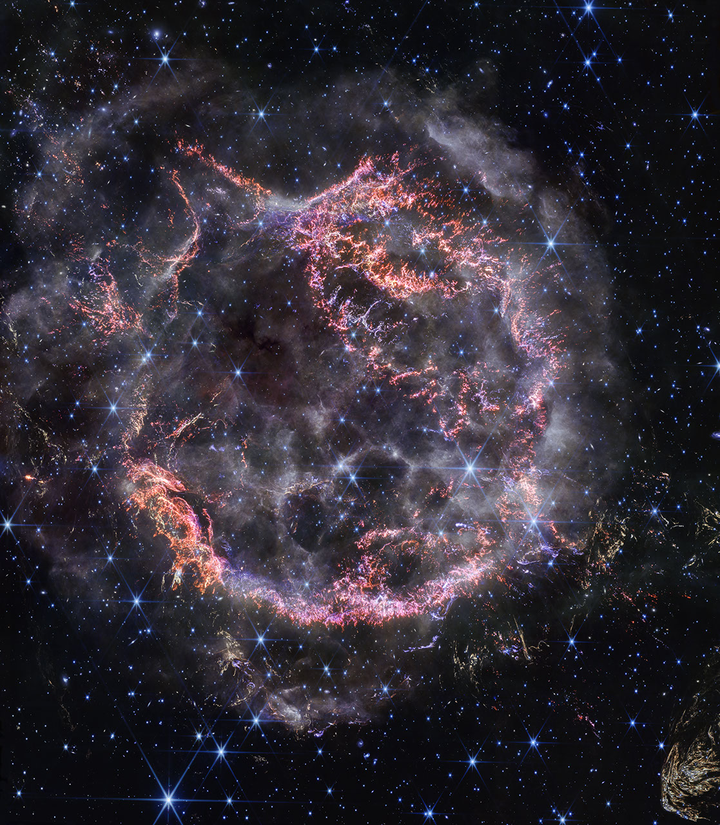
As a star nears the end of its life, it faces two very different fates: it can either explode as a supernova, leaving behind a neutron star, or it can collapse and become a black hole. But which of these two outcomes occurs remains one of astrophysics’ great unanswered questions.
Now, a new study from the University of Copenhagen shows that neutrinos – also known as ‘ghost particles’ – and their ability to change “flavor” may play a far greater role in determining the fate of the dying massive star.
This ‘flavor change’ – or neutrino flavor conversion – essentially means that the neutrino particles switch from one type to another. And their type or flavor is significant in terms of how they interact with the matter in the cores of dying stars.
“We have long known that neutrinos can switch between different flavors. But we generally assumed that this had no effect on the outcome of the explosion itself. Our new research findings suggest that this flavor can tell us something about the star’s fate,” says Mariam Gogilashvili, a postdoctoral researcher at the Niels Bohr Institute and lead author of the study.
195 simulations of dying massive stars
Although scientists have been aware of the phenomenon of neutrino flavor conversion for many years, it has been too computationally demanding to incorporate this physics into supernova simulations.
“Simulating the death of a massive star is something that is pretty much at the frontier of what we can do computationally at the moment. That is because it is a problem involving a great deal of physics and it is extremely expensive computationally,” says Irene Tamborra, professor at the Niels Bohr Institute, head of the Particle Astrophysics group, and the second author of the study.
The two astrophysicists therefore developed a simplified model to investigate the significance of neutrino flavor changes in supernova simulations.
The researchers simulated the collapse of 195 stars with masses between 9 and 120 times the mass of the Sun. In the simulations, they compared models with and without neutrino flavor conversion and investigated what happened when this process was triggered at different densities within the star.
They then measured whether the star exploded as a supernova or collapsed into a black hole. And here, the results showed that the behavior of neutrinos can significantly alter the outcome, particularly for stars with masses between 16 and 30 solar masses.
"It was a really exciting moment when we put all 195 simulations side by side and saw a whole range of stars flip from exploding to failing. Seeing such a clear pattern across so many stars told us that neutrino flavor conversion is something we simply cannot leave out when we try to understand how massive stars end their lives," says postdoctoral researcher Mariam Gogilashvili.
Closer to understanding astronomical mysteries
The results of Gogilashvili and Tamborras study suggest that the behavior of neutrinos may in fact help to explain some of the observations that have long posed a challenge to this field of research.
Among other things, this includes what is known as the ‘supernova rate problem’, whereby researchers observe significantly fewer supernovae in the universe than theoretical models predict.
“Normally, we detect a supernova because the explosion shines very brightly. But if a star collapses directly into a black hole without a visible explosion, or is obscured by dust, it can effectively ‘disappear’ from our counts. Our results therefore suggest that there is a mechanism that could make such ‘failed supernovae’ more likely,” says postdoctoral researcher Mariam Gogilashvili.
“This could therefore not only give us better tools to predict a dying star’s fate, but it may also help explain why observations do not always match theoretical predictions,” adds professor Irene Tamborra.
It’s all connected
Getting closer to an answer as to what happens to stars when they die is not just about black holes and neutron stars, theory and observations. It’s also about you and me.
Massive stars synthesize heavy elements during their lifetime. When a supernova explosion occurs, these elements are released in the universe from which planets and life are later formed.
“When we study how massive stars live and die, we are also investigating the origins of many of the elements that make up the universe and ourselves. In this way, questions about dying stars are linked to questions about our own origins,” concludes Professor Irene Tamborra.
----------------------------------------------------------------------------------------------------------------
WHAT IS A NEUTRINO?
- A neutrino is an elementary particle – one of the smallest building blocks of the universe.
- Neutrinos are invisible, extremely light, electrically neutral and rarely interact with matter.
- They are produced, amongst other things, in nuclear reactions within stars, in supernova explosions and other high-energy cosmic events.
- Trillions of neutrinos pass through your body every second without you even noticing.
- Because they are almost unaffected by other forces, neutrinos can provide direct information about processes deep within stars and about the origin of the universe.
- Neutrino flavor conversion is a process that occurs when neutrinos interact with different types of matter in the universe.
- Neutrinos can switch between three different flavors: the electron neutrino, the muon neutrino and the tau neutrino.
ABOUT THE STUDY
- The researchers behind the study are postdoctoral researcher Mariam Gogilashvili and professor Irene Tamborra, both from the Niels Bohr Institute at the University of Copenhagen.
- The study consists of simulations of the collapse of 195 stars with masses ranging from 9 to 120 times the mass of the Sun. The researchers compared models with and without the ability of neutrinos to change type (flavor conversion)
- The research shows that neutrino flavor change can influence whether a massive star explodes as a supernova or continues to collapse, forming a black hole. The effect is particularly pronounced for stars with masses between 16 and 30 solar masses.
- The results suggest that neutrino flavor conversion should be included in future models of supernovae, neutron stars and black holes.
- The study has just been published in Physical Review D.
Keywords
Contacts
Johanne Digebjerg TougaardCommunications consultant, UCPH
Tel:93 56 50 52joha@adm.ku.dkIrene TamborraProfessorNiels Bohr Institute, University of Copenhagen
Tel:+45 35333227tamborra@nbi.ku.dkMariam GogilashviliPostdoctoral researcherNiels Bohr Institute, University of Copenhagen
Tel:35337394mariam.gogilashvili@nbi.ku.dkLinks
Subscribe to releases from Københavns Universitet
Subscribe to all the latest releases from Københavns Universitet by registering your e-mail address below. You can unsubscribe at any time.
Latest releases from Københavns Universitet
Supernova eller sort hul? Spøgelsespartiklers ’smag’ kan afgøre døende stjerners skæbne24.9.2026 05:30:00 CEST | Pressemeddelelse
Ny forskning fra Københavns Universitet peger på, at en hidtil overset egenskab ved spøgelsespartikler kan være en vigtig del af forklaringen på, hvorfor nogle stjerner eksploderer, mens andre kollapser til sorte huller.
Støtte fra A.P. Møller Fonden sætter gang i nyt formidlingsprojekt om Søren Kierkegaard17.9.2026 08:00:00 CEST | Pressemeddelelse
Københavns Universitet har modtaget en bevilling på 6,1 millioner kroner fra A.P. Møller og Hustru Chastine Mc-Kinney Møllers Fond til almene Formaal til at udvikle en ny formidlingsindsats om Søren Kierkegaard. Indsatsen skabes i et partnerskab mellem Københavns Universitet, Det Kgl. Bibliotek og Københavns Museum og skal gøre Kierkegaards liv, tanker og forfatterskab tilgængeligt for et bredt publikum.
Forskere finder genetiske spor, der kan afsløre aggressiv prostatakræft10.9.2026 07:00:00 CEST | Pressemeddelelse
Et internationalt forskerhold har kortlagt de biologiske mekanismer bag prostatakræft og identificeret otte forskellige genetiske ’fingeraftryk’, som kan forklare, hvorfor nogle mænd bliver alvorligt syge, mens andre ikke gør. Resultaterne kan på sigt gøre behandling af prostatakræft langt mere præcis.
Nyt studie: Psykiatere er kun enige om diagnosen i 55 procent af tilfældene9.9.2026 09:35:26 CEST | Pressemeddelelse
Når psykiatere skal vurdere den samme patient, er de kun enige om diagnosen i cirka halvdelen af tilfældene, viser nyt studie fra Københavns Universitet. Det kan føre til forkert behandling af patienter og fejl i forskningen i psykiske lidelser, påpeger forskerne bag studiet.
Grøn trepart: Disse ting står øverst på danskernes ønskeliste31.8.2026 13:00:00 CEST | Pressemeddelelse
Mere plads til vild natur, sundere indre farvande, bedre dyrevelfærd og klimagevinster er de goder, danskerne i særlig grad forbinder med den grønne trepart. Det viser en ny befolkningsundersøgelse fra Green Mandate. Samtidig peger undersøgelsen på et betydeligt potentiale for øget borgerinddragelse i implementeringen af aftalen.
In our pressroom you can read all our latest releases, find our press contacts, images, documents and other relevant information about us.
Visit our pressroom