
New Study Pinpoints Europe’s Most Critical Wetlands for Climate Action
15.7.2026 17:00:00 CEST | Københavns Universitet | Press release
Europe must restore at least 30% of degraded wetlands within the next four years, but where should efforts be prioritised? Researchers from the University of Copenhagen now offer an answer with the first detailed map of Europe’s wetlands. The map fills a knowledge gap and shows where action could deliver the greatest benefits for climate and biodiversity.
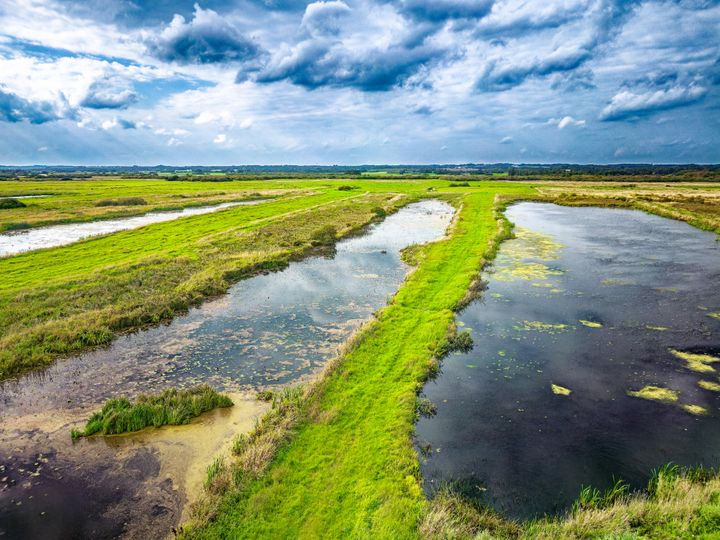
Wetlands have shaped human life in Europe since ancient times. These ecosystems provided essential resources and safe havens for plants and animals, and in many regions they also held spiritual and ritual significance. For millennia, wetlands covered vast parts of the European continent.
Today, the picture is very different. Half of Europe’s wetlands have disappeared due to drainage, cultivation, and resource extraction. Yet wetlands are not only part of our cultural and natural heritage — they are also among the most efficient carbon sinks in nature. But when disturbed, they may shift from storing carbon to emitting large quantities of greenhouse gases.
For this reason, the EU’s Nature Restoration Law requires all Member States to restore at least 30% of their wetlands not in “good condition” by 2030.
Until now, however, there has been no comprehensive overview of where Europe’s wetlands are located or what condition they are in. That gap is addressed by a new study, just published in Nature, led by researchers at the Global Wetland Center at the University of Copenhagen.
“To meet wetland restoration targets, we need a high-resolution map showing their extent, the different types, and what is disturbing them today. Without that insight, it’s difficult to assess their true climate impact. Until now, such a detailed map hasn’t existed—but we’ve succeeded in creating one which also shows how fragmented European wetlands are,” says postdoctoral researcher Gyula Máté Kovács from the Global Wetland Center at the University of Copenhagen and lead author of the study.
Map identifies priority areas
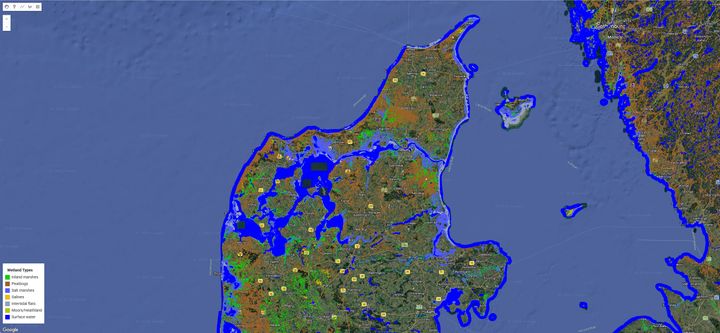
Using 10m satellite imagery and machine learning, the research team developed the new digital map European Wetland Types, covering six categories of wetlands across 38 European countries. The map provides a basis for assessing where wetland restoration could deliver benefits for climate and biodiversity.
“The map shows the condition of wetlands and highlights areas with the largest restoration potential. Coastal marshes, for example, do not generally store as much CO₂ as peatlands. It enables policymakers to make an initial screening of potential suitable candidates,” says Associate Professor and co-author of the study Stéphanie Horion from the University of Copenhagen.
Across Europe the findings point to peatlands as the most critical type of wetland to restore, especially in terms of climate benefits. Peatlands are concentrated in Northern Europe and are highly effective carbon stores, but they are also the source of potentially significant carbon losses. More than one fifth of peatlands are currently degraded by human activity.
A resource for the EU and Member States
The new map offers a valuable tool for both the EU and individual Member States, the researchers say.
“Our work can directly support the implementation of the EU Nature Restoration Law. Each country must submit a national restoration plan, but several countries have yet not designated specific areas or set national targets. They could use this map as a starting point,” says Stéphanie Horion.
One of the map’s key strengths is that it harmonises the various definitions of what constitutes a wetland. This translates to a map that is universally applicable across Europe. This enables EU institutions to assess national reporting on a comparable basis.
“Wetlands are highly diverse and are defined differently across countries. What we classify as peatland in Denmark, may not be considered peatland in Scotland. Harmonised definitions are therefore essential for comparison across large regions,” says Gyula Máté Kovács.
Gyula Máté Kovács is now working on developing a global version of the map. Together with colleagues at the Global Wetland Center, they aim at improving global estimates of greenhouse gas emissions from wetlands.
WHAT THE MAP SHOWS
- The map identifies Europe’s six major types of natural and semi-natural wetlands (inland marshes, peatbogs, salt marshes, salines, intertidal flats and moors & heathlands) across 38 European countries at a spatial resolution of 10 metres.
- The mapping shows that Europe’s wetlands are highly fragmented into many small and separate areas. Around 27–33% of wetlands occur in contiguous areas smaller than 25 hectares, while 7–11% are found in very small patches under 1 hectare. This means that a significant share of the smallest wetlands is often missed in coarser mapping efforts, unlike in this new, more detailed map.
- The researchers estimate that around one fifth of Europe’s wetlands are highly affected by human activities, with inland marshes being the most heavily disturbed.
- At the same time, up to 5 billion tonnes of CO₂ equivalents of soil carbon may have been released compared to a scenario in which these areas had remained undisturbed. This is roughly equivalent to the total CO₂ emissions of the EU over one and a half years.
ABOUT THE STUDY
- The study has just been published in the scientific journal Nature.
- The European Wetland Types map is available open access and can be visualized here.
- The following researchers from the University of Copenhagen contributed to the study: Gyula Máté Kovács, Xiaoye Tong, Dimitri Gominski, Stefan Oehmcke, Stéphanie Horion, Christin Abel, Guy Schurgers, Bo Elberling, Alexander Prishchepov and Rasmus Fensholt.
- Additional contributors include: Eva Ivits (European Environment Agency); Susan Page (University of Leicester); and Sebastian van der Linden, Alexandre Barthelmes and Franziska Tanneberger (University of Greifswald).
Keywords
Contacts
Stéphanie Horion
Global Wetland Center
Department of Geosciences and Natural Resource Management
University of Copenhagen
smh@ign.ku.dk
+45 26 16 02 04 / +45 35 32 58 78
Gyula Mate Kovács
Global Wetland Center
Department of Geosciences and Natural Resource Management
University of Copenhagen
gmk@ign.ku.dk
+45 91 92 22 93
William Brøns Petersen
Communications Consultant
UCPH Communication
University of Copenhagen
william.petersen@adm.ku.dk
+45 93 56 55 80
Images
Links
Subscribe to releases from Københavns Universitet
Subscribe to all the latest releases from Københavns Universitet by registering your e-mail address below. You can unsubscribe at any time.
Latest releases from Københavns Universitet
Forskere finder genetiske spor, der kan afsløre aggressiv prostatakræft10.9.2026 07:00:00 CEST | Pressemeddelelse
Et internationalt forskerhold har kortlagt de biologiske mekanismer bag prostatakræft og identificeret otte forskellige genetiske ’fingeraftryk’, som kan forklare, hvorfor nogle mænd bliver alvorligt syge, mens andre ikke gør. Resultaterne kan på sigt gøre behandling af prostatakræft langt mere præcis.
Nyt studie: Psykiatere er kun enige om diagnosen i 55 procent af tilfældene9.9.2026 09:35:26 CEST | Pressemeddelelse
Når psykiatere skal vurdere den samme patient, er de kun enige om diagnosen i cirka halvdelen af tilfældene, viser nyt studie fra Københavns Universitet. Det kan føre til forkert behandling af patienter og fejl i forskningen i psykiske lidelser, påpeger forskerne bag studiet.
Grøn trepart: Disse ting står øverst på danskernes ønskeliste31.8.2026 13:00:00 CEST | Pressemeddelelse
Mere plads til vild natur, sundere indre farvande, bedre dyrevelfærd og klimagevinster er de goder, danskerne i særlig grad forbinder med den grønne trepart. Det viser en ny befolkningsundersøgelse fra Green Mandate. Samtidig peger undersøgelsen på et betydeligt potentiale for øget borgerinddragelse i implementeringen af aftalen.
Uskyldige bilejere straffes for vanvidskørsel – problematisk, siger jura-forskere31.8.2026 10:33:57 CEST | Pressemeddelelse
Når politiet beslaglægger vanvidsbilisters køretøjer, kan det være en krænkelse af den private ejendomsret. I nogle sager tilhører bilen nemlig ikke lovovertræderen, men en uskyldig tredjepart.
Unresolved jar mystery becomes a 2,000-year natural experiment28.8.2026 08:05:00 CEST | Press release
More than 2,000 years ago, massive stone jars were carved from bedrock and placed on a highland plateau in northern Laos. Today, they represent not only an archaeological mystery, but also a series of small, self‑contained ecosystems that now provide researchers from the University of Copenhagen with a unique opportunity to study how nature develops over millennia.
In our pressroom you can read all our latest releases, find our press contacts, images, documents and other relevant information about us.
Visit our pressroom