A decade after the Brexit referendum: Time for European pragmatism
22.6.2026 09:25:50 CEST | Bertelsmann Stiftung | Press release
On June 23, 2016, British voters chose to leave the European Union, sending shockwaves across the continent. To mark the anniversary, the Bertelsmann Stiftung is publishing exclusive data tracking public opinion in the UK and the EU over the past ten years. The findings suggest that Brexit has neither triggered further EU fragmentation nor driven British and European public opinion permanently apart. Instead, they point to a shared preference for pragmatic cooperation.
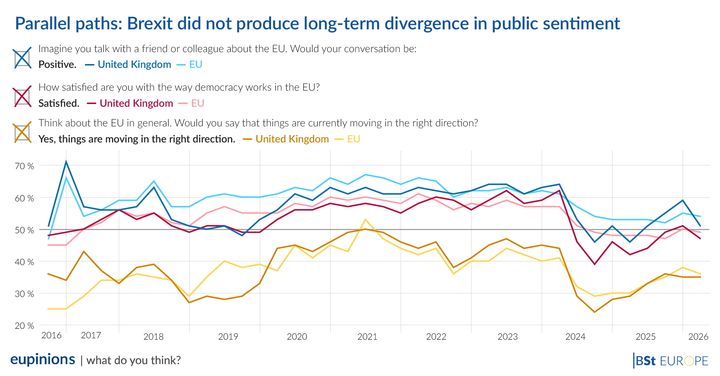
Gütersloh/Berlin, June 22, 2026 – Fears that Brexit would trigger a wider exodus from the EU never materialised. By March 2026, only 21 per cent of Britons and 18 per cent of EU citizens believed that other member states would follow the UK’s example and leave the Union; less than half the level recorded in March 2018. While the result of the Brexit referendum in 2016 was narrow, such a majority has not reappeared since. Asked how they would vote in a referendum on EU membership, more than 50% of Britons have consistently said they would vote to remain over the past ten years. The most recent figures, from March 2026, show a stable majority for Remain, at 57 per cent.
The populist promise that people would be better off after Brexit proved false. Shortly after the referendum, Britons were relatively optimistic about their future outside the EU. A decade later, this Brexit optimism collapsed. In March 2026, only 41 per cent of Britons said they felt positive about their personal outlook for the future; a decline of 27 percentage points. Only 23 per cent said their economic situation had improved over the previous two years, down 21 percentage points. Overall, early Brexit optimism has given way to a wave of pessimism in the UK.
Brexit has not created a lasting psychological divide between British and European public opinion. Ten years on, Britons and continental Europeans increasingly share common concerns and expectations about Europe’s future. By March 2026, attitudes were remarkably similar: support for a stronger EU role in world affairs stood at 66% in the UK and 71% across the EU, around half of respondents on both sides viewed the EU positively, and levels of satisfaction with EU democracy and perceptions of the EU’s direction were almost identical.
Jake Benford, Bertelsmann Stiftung’s UK expert, argues: " The public has moved on faster than politics. Citizens increasingly recognise that European fragmentation comes at a cost: less security, less resilience and less influence in the world. The question is whether politicians can move beyond the divisions of the past and respond to this growing public pragmatism."
Florian Kommer, Bertelsmann Stiftung’s Europe Expert, commented: “In 2016, many believed the Brexit referendum marked the beginning of the end for the European Union. A decade later, the picture looks very different. Our findings suggest that the space for EU–UK cooperation
may be wider today than is often assumed.”
The full dataset is available on our website: www.eupinions.eu.
Jake Benford, +49 173 7306478, jake.benford@berteslamnn-stiftung.de
Keywords
Images
Subscribe to releases from Bertelsmann Stiftung
Subscribe to all the latest releases from Bertelsmann Stiftung by registering your e-mail address below. You can unsubscribe at any time.
Latest releases from Bertelsmann Stiftung
Europeans call for greater independence: Support for U.S. as Europe’s Top Ally Drops Sharply7.5.2026 08:00:00 CEST | Press release
Europe is rethinking its place in the world. After decades of close cooperation with the United States, nearly three in four EU citizens now say the Union should ‘go its own way’. A clear majority of Europeans do not see the U.S. as a trustworthy partner any longer. A year and a half into the Trump presidency, the share of respondents identifying the U.S. as Europe’s most valuable ally has fallen by 20 percentage points. While China fails to gain ground as an alternative partner, Europeans are recalibrating alliances within the West. A new study by Bertelsmann Stiftung illustrates this shift.
More Autocracies Worldwide - But Democratic Resistance Is Growing26.3.2026 08:00:00 CET | Press release
Democracy is on the defensive. This is shown by the Bertelsmann Stiftung's Transformation Index 2026 (BTI). The BTI was first surveyed twenty years ago, when democracies were still in the majority. Today, 56 percent of the 137 countries surveyed by the BTI are ruled autocratically. However, this rarely leads to better governance. Autocracies are more susceptible to corruption, less capable of shaping the future, and less consensus-oriented. However, examples such as Poland and Brazil show that social resistance and political competition can pave the way back to democracy.
How the CO2 price will affect heating costs in Europe22.1.2026 08:00:00 CET | Press release
The EU-wide uniform CO2 price for the building and transport sectors planned from 2028 will change the heating costs of 100 million households. A study by the Bertelsmann Stiftung shows that in many countries, including Germany, the additional burdens are likely to be limited. In Scandinavia, households could even see some relief. But in some Central and Eastern European regions, heating costs would go up noticeably. The study also shows that if the money from CO2 pricing is used the right way, it is enough to ease the burden households facing the greatest burden.
European Network for Technological Resilience and Sovereignty (ETRS) to strengthen Europe’s Digital Future17.11.2025 10:00:00 CET | Press release
On the eve of the Summit on European Digital Sovereignty in Berlin, leading European think tanks and experts announce the creation of the European Network for Technological Resilience and Sovereignty (ETRS). This new initiative unites research, policy, and industry to boost Europe’s capacity for innovation and independence in key technologies like AI, cloud infrastructure, and semiconductors. ETRS aims to build the evidence base, foster collaboration, and shape policy for a resilient and values-driven digital future.
Germans would value more trustworthy online health information10.10.2025 12:35:50 CEST | Press release
Most people these days look online for answers to questions on health. However, many have doubts on the integrity and quality of the information provided by social media platforms and AI chatbots. The Bertelsmann Stiftung would like to contribute to promoting reliable sources and increasing confidence in digital information on health by means of its new "InfoCure" international initiative.