Europe’s IPO problem starts before the stock ex-change: New study calls for deeper markets, more investment and larger listings
15.9.2026 09:00:00 CEST | Bertelsmann Stiftung | Press release
Europe is losing the IPO race. Its companies are going public at too small a size. The number of new companies listing in Europe is behind that of the US and their value has dropped over the last decade. Europe faces a ‘scale-up gap’: while it produces innovative startups, they struggle to grow across Europe and access capital for their expansion. Strong public equity markets provide capital to promising firms and an ‘exit’ for venture capital and private equity investors.
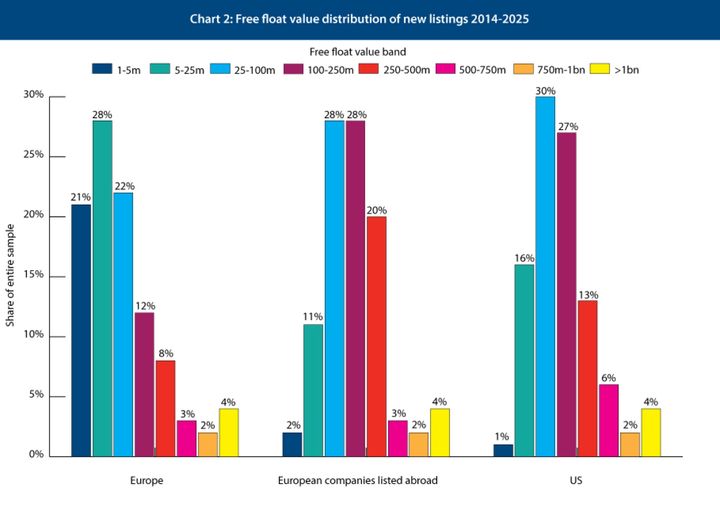
Berlin, September 15, 2026. The new study ‘How to revive Europe’s stock market listings’ by the Bertelsmann Stiftung, the Centre for European Reform and the Jacques Delors Centre, lays out how Europe could revive its equity markets. Between 2014-2025, 72 per cent of European listings issued shares with a value below €100 million, compared with 49 per cent in the US. And only 12 per cent achieve a market capitalization of at least €1 billion at the time of their initial public offering (IPO), compared with 29 per cent in the US.
Rather than relying on shortcuts such as lowering listing requirements or creating a single European exchange, the EU and its member states should focus on three areas:
- Putting Europe’s savings to work: pension reform and greater retail investment should shift more household wealth into equities, improving valuations and liquidity.
- Reducing fragmentation: market-driven integration of European stock markets would help attract larger listings. Policy-makers should consider a pan-European growth market for promising, young companies.
- Strengthening the pipeline of firms ready to list. That means completing the single market, expanding late-stage growth capital and encouraging larger, higher-quality IPOs.
Claudia-Dominique Geiser, Senior Expert on EU Economic Policy, explained: “To improve European public equity markets, the diagnosis matters: Europe’s companies reach public markets too small. Incentivising more listings and lowering listing requirements will not necessarily generate more liquidity and attract institutional investors. Europe needs to help its firms grow first.”
Reviving Europe’s IPO market should be a priority as leaders reconvene this autumn. Europe needs to complete the innovation flywheel: from founding to scaling, listing and reinvestment.
James Green, Research Fellow at the Centre for European Reform in Brussels, said: “Talent and training may be foundation for innovation, but a healthy risk-capital ecosystem is its fuel. As policy-makers work to strengthen Europe’s tech ecosystem, which is vital for its competitiveness and sovereignty, they cannot forget a major piece of the puzzle: well-functioning public equity markets.”
Marlene Schörner, Policy Fellow for EU Financial Markets at the Jacques Delors Centre in Berlin and co-author of the report, said: “Trying to forcibly create a pan-European stock exchange to pool liquidity is tempting but would be putting the cart before the horse. The root of the problem is the fragmented regulatory environment and associated infrastructure barriers that make cross-border trading costly.”
Europe’s IPO problem is a scale-up problem made visible on the stock exchange.
Keywords
Contacts
Claudia-Dominique GeiserSenior Expert on EU Economic Policy
Tel:+49 30 275788-163claudia-dominique.geiser@bertelsmann-stiftung.deImages
About the Bertelsmann Stiftung: Inspiring people. Shaping the future.
The Bertelsmann Stiftung is committed to enabling social participation for everyone – politically, economically and culturally. Our programs include Education and the Next Generation, Democracy and Social Cohesion, Digitalization and the Common Good, Europe’s Future, Health, and Sustainable Social Market Economies. In our work, we focus on people, since only they can change the world and make it better. We share knowledge, promote expertise and develop solutions. A nonprofit foundation, the Bertelsmann Stiftung was established in 1977 by Reinhard Mohn.
For more information, please visit: www.bertelsmann-stiftung.de
Subscribe to releases from Bertelsmann Stiftung
Subscribe to all the latest releases from Bertelsmann Stiftung by registering your e-mail address below. You can unsubscribe at any time.
Latest releases from Bertelsmann Stiftung
A decade after the Brexit referendum: Time for European pragmatism22.6.2026 09:25:50 CEST | Press release
On June 23, 2016, British voters chose to leave the European Union, sending shockwaves across the continent. To mark the anniversary, the Bertelsmann Stiftung is publishing exclusive data tracking public opinion in the UK and the EU over the past ten years. The findings suggest that Brexit has neither triggered further EU fragmentation nor driven British and European public opinion permanently apart. Instead, they point to a shared preference for pragmatic cooperation.
Europeans call for greater independence: Support for U.S. as Europe’s Top Ally Drops Sharply7.5.2026 08:00:00 CEST | Press release
Europe is rethinking its place in the world. After decades of close cooperation with the United States, nearly three in four EU citizens now say the Union should ‘go its own way’. A clear majority of Europeans do not see the U.S. as a trustworthy partner any longer. A year and a half into the Trump presidency, the share of respondents identifying the U.S. as Europe’s most valuable ally has fallen by 20 percentage points. While China fails to gain ground as an alternative partner, Europeans are recalibrating alliances within the West. A new study by Bertelsmann Stiftung illustrates this shift.
More Autocracies Worldwide - But Democratic Resistance Is Growing26.3.2026 08:00:00 CET | Press release
Democracy is on the defensive. This is shown by the Bertelsmann Stiftung's Transformation Index 2026 (BTI). The BTI was first surveyed twenty years ago, when democracies were still in the majority. Today, 56 percent of the 137 countries surveyed by the BTI are ruled autocratically. However, this rarely leads to better governance. Autocracies are more susceptible to corruption, less capable of shaping the future, and less consensus-oriented. However, examples such as Poland and Brazil show that social resistance and political competition can pave the way back to democracy.
How the CO2 price will affect heating costs in Europe22.1.2026 08:00:00 CET | Press release
The EU-wide uniform CO2 price for the building and transport sectors planned from 2028 will change the heating costs of 100 million households. A study by the Bertelsmann Stiftung shows that in many countries, including Germany, the additional burdens are likely to be limited. In Scandinavia, households could even see some relief. But in some Central and Eastern European regions, heating costs would go up noticeably. The study also shows that if the money from CO2 pricing is used the right way, it is enough to ease the burden households facing the greatest burden.
European Network for Technological Resilience and Sovereignty (ETRS) to strengthen Europe’s Digital Future17.11.2025 10:00:00 CET | Press release
On the eve of the Summit on European Digital Sovereignty in Berlin, leading European think tanks and experts announce the creation of the European Network for Technological Resilience and Sovereignty (ETRS). This new initiative unites research, policy, and industry to boost Europe’s capacity for innovation and independence in key technologies like AI, cloud infrastructure, and semiconductors. ETRS aims to build the evidence base, foster collaboration, and shape policy for a resilient and values-driven digital future.