
Scientists stunned: Volcano cleans up after itself by removing methane from the air
7.5.2026 11:01:00 CEST | Københavns Universitet | Press release
A violent volcanic eruption in the South Pacific has revealed a surprising natural mechanism that could potentially help slow global warming. The finding provides entirely new insights into atmospheric chemistry and may inspire new methods to remove methane emissions from the air.
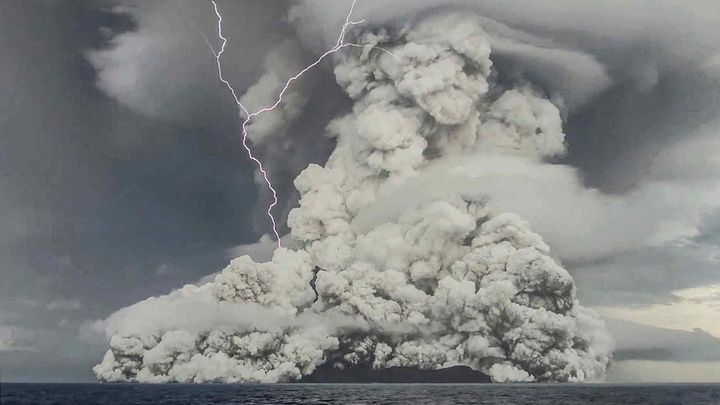
When the submarine volcano Hunga Tonga–Hunga Ha’apai in the South Pacific erupted in January 2022, it was not only one of the most violent volcanic eruptions in modern times. The volcano also did something completely unexpected: it helped clean up some of the methane pollution it released. This phenomenon could potentially be key to how humans can slow global warming.
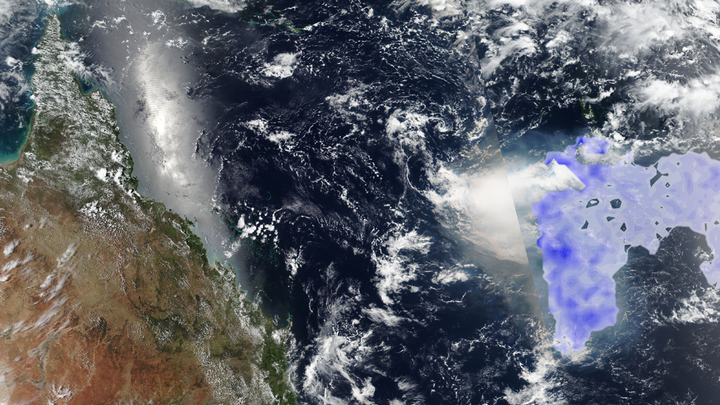
Using advanced satellite measurements, researchers observed unusually high concentrations of formaldehyde in the massive volcanic plume following the eruption. This was crucial evidence: when methane is destroyed in the atmosphere, formaldehyde forms as a short-lived intermediate.
“When we analysed the satellite images, we were surprised to see a cloud with a record-high concentration of formaldehyde. We were able to track the cloud for 10 days, all the way to South America. Because formaldehyde only exists for a few hours, this showed that the cloud must have been destroying methane continuously for more than a week,” explains Dr. Maarten van Herpen from Acacia Impact Innovation BV, first author of the study, which has just been published in Nature Communications.
“It is known that volcanoes emit methane during eruptions, but until now it was not known that volcanic ash is also capable of partially cleaning up this pollution,” he adds.
Salt, sunlight and new chemistry
According to the researchers, everything points to a very special process taking place—one they first discovered in 2023, but in a completely different part of the world.
They found that when dust from the Sahara is blown over the Atlantic Ocean, it mixes with sea salt from sea spray, forming small particles known as iron salt aerosols. When sunlight hits these aerosols, chlorine atoms are produced. These chlorine atoms react with methane and help break it down in the atmosphere. This discovery changed scientific understanding of tropospheric chemistry.
“What is new—and completely surprising—is that the same mechanism appears to occur in a volcanic plume high up in the stratosphere, where the physical conditions are entirely different,” says Professor Matthew Johnson from the Department of Chemistry at the University of Copenhagen, one of the researchers behind both discoveries.
The 2022 eruption hurled enormous amounts of salty seawater into the stratosphere along with volcanic ash. The theory is that when sunlight hit this mixture, highly reactive chlorine was formed, helping to break down the methane released during the eruption. The visible evidence of this methane breakdown was the large amounts of formaldehyde detected in satellite images.
Methane is currently responsible for one third of global warming. Over a 20-year period, methane is about 80 times as potent as CO2. However, methane breaks down relatively quickly in the atmosphere — typically within about 10 years.
This means that if we reduce methane emissions now it could have a noticeable impact on the climate within a decade. For this reason, researchers sometimes refer to methane reduction as an “emergency brake” on climate change—one that may help prevent climate tipping points in the coming decades. However, reducing CO₂ emissions remains essential to stabilise temperatures in the long term.
Inspiration for future solutions
The researchers behind the new study believe their findings could inform a growing field working on solutions to reduce methane emissions by artificially accelerating its breakdown in the atmosphere - similar to how the volcano effectively cleaned up after itself. Various methods are currently under investigation, but a key challenge is measuring and verifying how much methane is actually removed.
“How do you prove that methane has been removed from the atmosphere? How do you know your method works? It’s very difficult. But here we address that problem by showing that methane breakdown can in fact be observed using satellites,” says Dr Jos de Laat from the Royal Netherlands Meteorological Institute, senior author of the study.
The research was conducted with the advanced TROPOMI instrument aboard the European Space Agency’s Sentinel-5P satellite, which monitors air pollution and greenhouse gases worldwide on a daily basis.
"Retrieving formaldehyde from TROPOMI in a stratospheric volcanic plume is far outside the instrument's standard operating conditions — we had to carefully correct the satellite's sensitivity for the unusual altitude of the signal and account for interference from the high sulfur dioxide concentrations. Getting these corrections right was essential to confirm that what we were seeing was real.", said Dr. Isabelle De Smedt, Royal Belgian Institute for Space Aeronomy.
The researchers believe the new findings will inspire engineers in industry:
“It’s an obvious idea for industry to try to replicate this natural phenomenon — but only if it can be proven to be safe and effective. Our satellite method could offer a way to help figure out how humans might slow global warming,” concludes Matthew Johnson.
*
[BOX] ABOUT THE STUDY
- According to the researchers’ calculations, the volcano emitted around 300 gigagrams (Gg) of methane during the eruption — equivalent to the annual methane emissions of more than two million cows. It removed approximately 900 megagrams (Mg) per day, equal to the daily emissions from two million cows.
- The scientific article has just been published in Nature Communications.
- The researchers behind the study are Maarten van Herpen (Acacia Impact Innovation BV, Netherlands); Isabelle De Smedt (Royal Belgian Institute for Space Aeronomy, Belgium); Daphne Meidan and Alfonso Saiz-Lopez (CSIC, Spain); Matthew Johnson (University of Copenhagen, Denmark); Thomas Röckmann (Utrecht University, Netherlands); and Jos de Laat (Royal Netherlands Meteorological Institute, Netherlands).
- The research was supported by Spark Climate Solutions.
[BOX] CHANGING THE METHANE BUDGET
According to the researchers, one of the implications of the new discovery is that the global methane budget needs to be revised.
“We now know that atmospheric dust—for example from a volcanic eruption—impacts the methane budget, meaning the budget of how much methane is added to the atmosphere and how much is removed. Because dust has not previously been taken into account, it is important that we correct the data on which these estimates are based,” says Matthew Johnson.
Keywords
Contacts
Maarten van Herpen
Acacia Impact Innovation BV
maarten@acacia-ii.com
+31 631026459
Jos de Laat
Royal Netherlands Meterological Institute
jos.de.laat@knmi.nl
Matthew Johnson
University of Copenhagen
msj@chem.ku.dk
+45 40 49 89 21
Isabelle De Smedt
Royal Belgian Institute for Space Aeronomy
isabelle.desmedt@aeronomie.be
Maria Hornbek
Communications Consultant
University of Copenhagen
maho@adm.ku.dk
+45 22 95 42 83
Images
Links
Subscribe to releases from Københavns Universitet
Subscribe to all the latest releases from Københavns Universitet by registering your e-mail address below. You can unsubscribe at any time.
Latest releases from Københavns Universitet
Researchers create a Little Big Bang: Bowling-pin-shaped nuclei shed new light on the Universe’s first moments20.8.2026 09:07:36 CEST | Press release
Researchers from the University of Copenhagen have succeeded in recreating the primordial matter that filled the Universe shortly after the Big Bang – by smashing much smaller atomic nuclei together than previously thought possible. These microscopic Big Bangs could provide new insights into the Universe’s earliest moments while also helping researchers understand one of the fundamental questions in nuclear physics.
Forskere skaber et mini-Big Bang: Bowlingkegle-formede atomkerner giver nyt indblik i Universets første øjeblikke20.8.2026 07:22:00 CEST | Pressemeddelelse
Det er lykkedes forskere fra Københavns Universitet at genskabe det urstof, som Universet bestod af lige efter Big Bang – men ved at smadre langt lettere atomkerner mod hinanden end man hidtil har troet muligt. Disse mikroskopiske Big Bangs kan give os nye indsigter i Universets fødsel og samtidig hjælpe os til at forstå et af kernefysikkens grundmysterier.
Calcium supplements may slow bone loss in postmenopausal women18.8.2026 09:45:19 CEST | Pressemeddelelse
A new study from the University of Copenhagen shows that daily calcium supplementation in the years following menopause may help prevent loss of bone mass. Further it can help reduce the risk of osteoporosis. The researcher behind the study believes the results should have implications for future recommendations for women in this age group.
Calciumtilskud kan bremse knogletab hos kvinder efter overgangsalderen18.8.2026 09:41:50 CEST | Pressemeddelelse
Et nyt studie fra Københavns Universitet viser, at dagligt calciumtilskud i årene efter overgangsalderen kan være med til at forebygge tab af knoglemasse. Videre kan det bidrage til at mindske risikoen for knogleskørhed. Forsker bag mener, at resultaterne bør få betydning for fremtidige anbefalinger til kvinder i den aldersgruppe.
Constipation is common in astronauts – blood tests provide new answers17.8.2026 06:00:00 CEST | Pressemeddelelse
Many things are different in space – including how the intestines work. Constipation is a known side effect of space travel, but until now we have known little about why it happens. Now, researchers from the University of Copenhagen, in collaboration with NASA, have examined blood samples from astronauts and have suggestions as to why the intestines slow down in space. This may provide useful information both for astronauts and for patients on Earth.
In our pressroom you can read all our latest releases, find our press contacts, images, documents and other relevant information about us.
Visit our pressroom