
Intergalactic experiment: Researchers hunt for mysterious dark matter particle with clever new trick
15.8.2025 11:01:00 CEST | Københavns Universitet | Press release
Physicists from the University of Copenhagen have begun using the gigantic magnetic fields of galaxy clusters to observe distant black holes in their search for an elusive particle that has stumped scientists for decades.
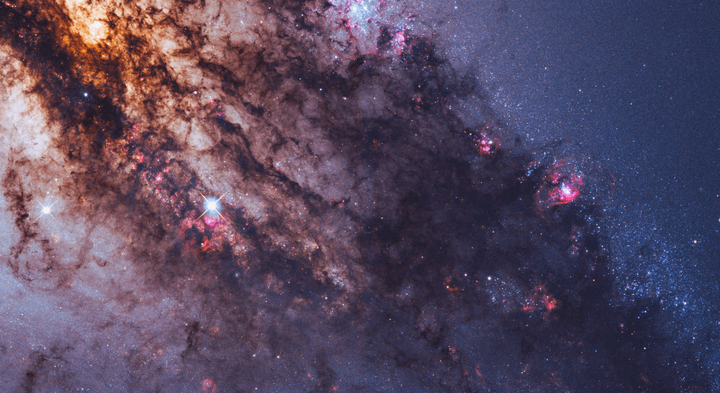
It is a story of extremes that are hard to fathom.
The heaviest structures in the universe, clusters of galaxies, are a quadrillion times more massive than the Sun. And axions, mysterious theoretical particles, are much, much lighter than even the lightest atom.
The axion is a hypothetical elementary particle that could hold the key to understanding dark matter, an unknown material that is believed to take up about 80 percent of the mass in our universe.
No one has yet proven the existence of axions, which has eluded researchers for decades. But with a clever trick involving faraway galaxies, physicists from the University of Copenhagen possibly came closer than ever before.
Instead of using a particle accelerator on Earth, like the one at CERN, the researchers turned to the cosmos and used it as a kind of gigantic particle accelerator. Specifically, they searched for electromagnetic radiation emitting from the cores of distant and very bright galaxies, each with a supermassive black hole at its center.
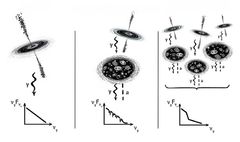
They then observed this radiation as it passed through the vast magnetic fields found in galaxy clusters, where some of it could hypothetically transform into axions. This transformation would leave behind tiny, random fluctuations in the data. But each signal is so faint that, on its own, it gets lost in the background noise of the universe.
So, the researchers introduced a novel concept. Instead, they observed a total of 32 supermassive black holes positioned behind galaxy clusters and then combined the data from their observations.
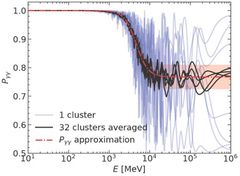
When the researchers examined the data, they were surprised to discover a pattern that resembled the signature of the elusive axion particle.
“Normally, the signal from such particles is unpredictable and appears as random noise. But we realized that by combining data from many different sources, we had transformed all that noise into a clear, recognizable pattern,” explains Oleg Ruchayskiy, Associate Professor at the Niels Bohr Institute of the University of Copenhagen and senior author of a new paper in Nature Astronomy that tries to study the axion. He adds:
“It shows up like a unique step-like pattern that shows what this conversion could look like. We only see it as a hint of a signal in our data, but it is still very tantalizing and exciting. You could call it a cosmic whisper, now loud enough to hear.”
Closer to discovering dark matter
While the pattern revealed by the scientists is not definite proof of the existence of axions, the research by Oleg Ruchayskiy and colleagues brings us closer to understanding what dark matter is.
“This method has greatly increased what we know about axions. It essentially enabled us to map a large area that we know does not contain the axion, which narrows down the space where it can be found,” says Postdoc Lidiia Zadorozhna, a Marie Curie fellow at the Niels Bohr Institute, who is one of the leading authors of the new paper.
While this experiment focused on a specific type of electromagnetic radiation known as gamma rays, the method can also be used on other types of radiation, like X-rays.
“We are so excited, because it is not a one-time advancement. This method allows us to go beyond previous experimental limits and has opened a new path to studying these elusive particles. The technique can be repeated by us, by other groups, across a broad range of masses and energies. That way we can add more pieces to the puzzle of explaining dark matter,” says Lidiia Zadorozhna.
Read the article:
“Constraints on axion-like particles from active galactic nuclei seen through galaxy clusters”.
*
Facts: Matter and energy in outer space
About 80 percent of the mass of the cosmos is thought to consist of dark matter. Scientists are not sure what it is, but believe that it could consist of unidentified, theoretical particles such as axions. The axion was originally proposed as a solution to an unexplained problem in the realm of particle physics known as the strong CP problem.
Galaxies are collections of stars, cosmic dust, planets, gas and dark matter often circling a supermassive black hole at the center. Galaxy clusters are groups of hundreds or thousands of galaxies bound together by gravity.
Sources: Nasa, Associate Professor Oleg Ruchayskiy
Facts: Finding the step-like pattern
Distant galaxies with a supermassive black hole at their center radiate magnitudes of energy and light. These galaxies are also powerful sources of a type of electromagnetic radiation known as gamma rays, which the researchers were interested in.
“We looked at these black holes through clusters of galaxies. Galaxy clusters are among the largest structures in the universe and reservoirs of enormous, widespread magnetic fields. They act as a sort of prism through which some of the gamma rays in theory would turn into axions,” explains Associate Professor Oleg Ruchayskiy.
By observing 32 different black holes positioned behind galaxy clusters and averaging the data from their observations, the researchers revealed the step-like signature.
Keywords
Contacts
Lidiia ZadorozhnaPostdocNiels Bohr Institute, University of Copenhagen
Tel:+45 35 33 73 81zadorozhna@nbi.ku.dkOleg RuchayskiyAssociate ProfessorNiels Bohr Institute, University of Copenhagen
Tel:+45 35 33 33 80oleg.ruchayskiy@nbi.ku.dkKristian Bjørn-HansenPress OfficerUCPH Communication, University of Copenhagen
Tel:+45 93516002kbh@adm.ku.dkWilliam Brøns PetersenCommunications AdviserUCPH Communication, University of Copenhagen
Tel:+45 93 56 55 80william.petersen@adm.ku.dkImages
Links
Subscribe to releases from Københavns Universitet
Subscribe to all the latest releases from Københavns Universitet by registering your e-mail address below. You can unsubscribe at any time.
Latest releases from Københavns Universitet
Researchers create a Little Big Bang: Bowling-pin-shaped nuclei shed new light on the Universe’s first moments20.8.2026 09:07:36 CEST | Press release
Researchers from the University of Copenhagen have succeeded in recreating the primordial matter that filled the Universe shortly after the Big Bang – by smashing much smaller atomic nuclei together than previously thought possible. These microscopic Big Bangs could provide new insights into the Universe’s earliest moments while also helping researchers understand one of the fundamental questions in nuclear physics.
Forskere skaber et mini-Big Bang: Bowlingkegle-formede atomkerner giver nyt indblik i Universets første øjeblikke20.8.2026 07:22:00 CEST | Pressemeddelelse
Det er lykkedes forskere fra Københavns Universitet at genskabe det urstof, som Universet bestod af lige efter Big Bang – men ved at smadre langt lettere atomkerner mod hinanden end man hidtil har troet muligt. Disse mikroskopiske Big Bangs kan give os nye indsigter i Universets fødsel og samtidig hjælpe os til at forstå et af kernefysikkens grundmysterier.
Calcium supplements may slow bone loss in postmenopausal women18.8.2026 09:45:19 CEST | Pressemeddelelse
A new study from the University of Copenhagen shows that daily calcium supplementation in the years following menopause may help prevent loss of bone mass. Further it can help reduce the risk of osteoporosis. The researcher behind the study believes the results should have implications for future recommendations for women in this age group.
Calciumtilskud kan bremse knogletab hos kvinder efter overgangsalderen18.8.2026 09:41:50 CEST | Pressemeddelelse
Et nyt studie fra Københavns Universitet viser, at dagligt calciumtilskud i årene efter overgangsalderen kan være med til at forebygge tab af knoglemasse. Videre kan det bidrage til at mindske risikoen for knogleskørhed. Forsker bag mener, at resultaterne bør få betydning for fremtidige anbefalinger til kvinder i den aldersgruppe.
Constipation is common in astronauts – blood tests provide new answers17.8.2026 06:00:00 CEST | Pressemeddelelse
Many things are different in space – including how the intestines work. Constipation is a known side effect of space travel, but until now we have known little about why it happens. Now, researchers from the University of Copenhagen, in collaboration with NASA, have examined blood samples from astronauts and have suggestions as to why the intestines slow down in space. This may provide useful information both for astronauts and for patients on Earth.
In our pressroom you can read all our latest releases, find our press contacts, images, documents and other relevant information about us.
Visit our pressroom