
Intergalactic experiment: Researchers hunt for mysterious dark matter particle with clever new trick
15.8.2025 11:01:00 CEST | Københavns Universitet | Press release
Physicists from the University of Copenhagen have begun using the gigantic magnetic fields of galaxy clusters to observe distant black holes in their search for an elusive particle that has stumped scientists for decades.
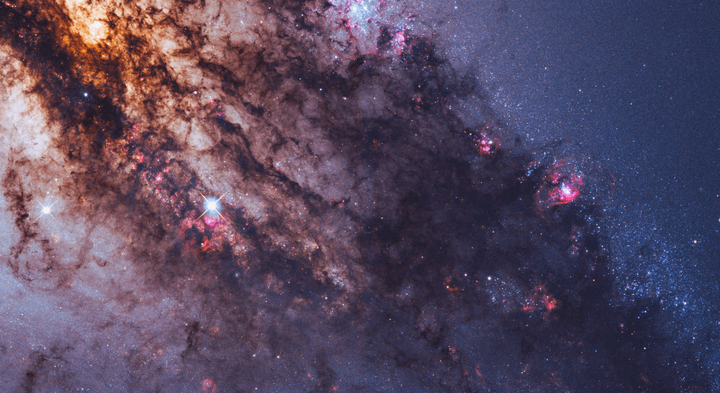
It is a story of extremes that are hard to fathom.
The heaviest structures in the universe, clusters of galaxies, are a quadrillion times more massive than the Sun. And axions, mysterious theoretical particles, are much, much lighter than even the lightest atom.
The axion is a hypothetical elementary particle that could hold the key to understanding dark matter, an unknown material that is believed to take up about 80 percent of the mass in our universe.
No one has yet proven the existence of axions, which has eluded researchers for decades. But with a clever trick involving faraway galaxies, physicists from the University of Copenhagen possibly came closer than ever before.
Instead of using a particle accelerator on Earth, like the one at CERN, the researchers turned to the cosmos and used it as a kind of gigantic particle accelerator. Specifically, they searched for electromagnetic radiation emitting from the cores of distant and very bright galaxies, each with a supermassive black hole at its center.
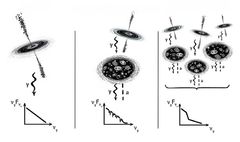
They then observed this radiation as it passed through the vast magnetic fields found in galaxy clusters, where some of it could hypothetically transform into axions. This transformation would leave behind tiny, random fluctuations in the data. But each signal is so faint that, on its own, it gets lost in the background noise of the universe.
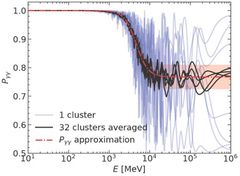
So, the researchers introduced a novel concept. Instead, they observed a total of 32 supermassive black holes positioned behind galaxy clusters and then combined the data from their observations.
When the researchers examined the data, they were surprised to discover a pattern that resembled the signature of the elusive axion particle.
“Normally, the signal from such particles is unpredictable and appears as random noise. But we realized that by combining data from many different sources, we had transformed all that noise into a clear, recognizable pattern,” explains Oleg Ruchayskiy, Associate Professor at the Niels Bohr Institute of the University of Copenhagen and senior author of a new paper in Nature Astronomy that tries to study the axion. He adds:
“It shows up like a unique step-like pattern that shows what this conversion could look like. We only see it as a hint of a signal in our data, but it is still very tantalizing and exciting. You could call it a cosmic whisper, now loud enough to hear.”
Closer to discovering dark matter
While the pattern revealed by the scientists is not definite proof of the existence of axions, the research by Oleg Ruchayskiy and colleagues brings us closer to understanding what dark matter is.
“This method has greatly increased what we know about axions. It essentially enabled us to map a large area that we know does not contain the axion, which narrows down the space where it can be found,” says Postdoc Lidiia Zadorozhna, a Marie Curie fellow at the Niels Bohr Institute, who is one of the leading authors of the new paper.
While this experiment focused on a specific type of electromagnetic radiation known as gamma rays, the method can also be used on other types of radiation, like X-rays.
“We are so excited, because it is not a one-time advancement. This method allows us to go beyond previous experimental limits and has opened a new path to studying these elusive particles. The technique can be repeated by us, by other groups, across a broad range of masses and energies. That way we can add more pieces to the puzzle of explaining dark matter,” says Lidiia Zadorozhna.
Read the article:
“Constraints on axion-like particles from active galactic nuclei seen through galaxy clusters”.
*
Facts: Matter and energy in outer space
About 80 percent of the mass of the cosmos is thought to consist of dark matter. Scientists are not sure what it is, but believe that it could consist of unidentified, theoretical particles such as axions. The axion was originally proposed as a solution to an unexplained problem in the realm of particle physics known as the strong CP problem.
Galaxies are collections of stars, cosmic dust, planets, gas and dark matter often circling a supermassive black hole at the center. Galaxy clusters are groups of hundreds or thousands of galaxies bound together by gravity.
Sources: Nasa, Associate Professor Oleg Ruchayskiy
Facts: Finding the step-like pattern
Distant galaxies with a supermassive black hole at their center radiate magnitudes of energy and light. These galaxies are also powerful sources of a type of electromagnetic radiation known as gamma rays, which the researchers were interested in.
“We looked at these black holes through clusters of galaxies. Galaxy clusters are among the largest structures in the universe and reservoirs of enormous, widespread magnetic fields. They act as a sort of prism through which some of the gamma rays in theory would turn into axions,” explains Associate Professor Oleg Ruchayskiy.
By observing 32 different black holes positioned behind galaxy clusters and averaging the data from their observations, the researchers revealed the step-like signature.
Keywords
Contacts
Lidiia ZadorozhnaPostdocNiels Bohr Institute, University of Copenhagen
Tel:+45 35 33 73 81zadorozhna@nbi.ku.dkOleg RuchayskiyAssociate ProfessorNiels Bohr Institute, University of Copenhagen
Tel:+45 35 33 33 80oleg.ruchayskiy@nbi.ku.dkKristian Bjørn-HansenPress OfficerUCPH Communication, University of Copenhagen
Tel:+45 93516002kbh@adm.ku.dkWilliam Brøns PetersenCommunications AdviserUCPH Communication, University of Copenhagen
Tel:+45 93 56 55 80william.petersen@adm.ku.dkImages
Links
Subscribe to releases from Københavns Universitet
Subscribe to all the latest releases from Københavns Universitet by registering your e-mail address below. You can unsubscribe at any time.
Latest releases from Københavns Universitet
Less food waste: Supermarkets can save money by giving surplus food away23.4.2026 10:03:13 CEST | Press release
When supermarkets choose the right strategy for surplus food, they can both reduce food waste and improve their bottom line. An analysis from the University of Copenhagen shows that it is often more profitable to donate surplus food than to throw it away. In many cases, doing so leads to a direct financial gain.
Historiske analyser kan hjælpe kommunerne i mål med den grønne omstilling21.4.2026 10:07:05 CEST | Pressemeddelelse
Gamle konflikter og dårlige erfaringer med tidligere naturprojekter gør det svært for kommunerne at gennemføre store klimatiltag som udtagning af lavbundsjorde, viser ny forskning fra Københavns Universitet. De historiske erfaringer bør bruges til at forbedre dialogen med borgerne, når der skal planlægges nye klimaindsatser, mener forskerne.
Mindre madspild: Butikkerne kan spare ved at give madvarer væk21.4.2026 07:16:00 CEST | Pressemeddelelse
Når supermarkeder vælger den rigtige strategi for overskudsmad, kan de både reducere madspild og forbedre bundlinjen. En analyse fra Københavns Universitet peger på, at det oftest er mere rentabelt at donere madvarer bort frem for at smide dem ud. I mange tilfælde er det direkte en økonomisk gevinst.
Stenalderfolk forsvandt: Nyt DNA-studie afslører dramatisk befolkningsskifte for 5.000 år siden20.4.2026 06:00:00 CEST | Pressemeddelelse
DNA fra flere tusinde år gamle skeletter i Frankrig afslører pest, høj dødelighed og nye sociale strukturer, og kaster lys over, hvordan Europas befolkning blev formet.
Forskere: Chatbots er partiske og bør ikke bruges til politisk rådgivning16.4.2026 14:59:57 CEST | Pressemeddelelse
Populære chatbots som ChatGPT og Gemini er ikke neutrale, og de favoriserer bestemte partier, når man spørger dem, hvem man skal stemme på. Det gør dem uegnede til rådgivning i forbindelse med et valg, mener forskere fra Københavns Universitet, som står bag en ny analyse af chatbots’ politiske bias.
In our pressroom you can read all our latest releases, find our press contacts, images, documents and other relevant information about us.
Visit our pressroom