
Ox-eye daisy, bellis and yarrow: Flower strips with at least two sown species provide 70 percent more natural enemies of pests
22.5.2025 09:26:48 CEST | Københavns Universitet | Press release
Planting flower strips in a field with at least two species can increase the number of natural enemies of pests by 70 percent. The more flower species, the better the effect, according to a new meta-analysis from the University of Copenhagen.
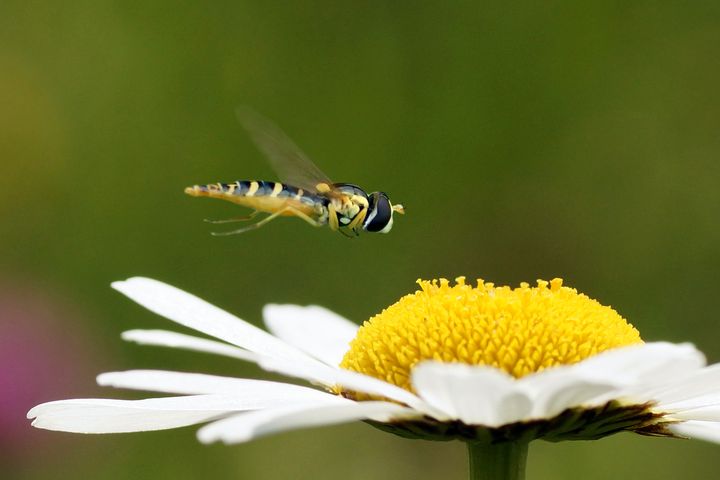
They may look good in the landscape, but are they, in fact, useful? This is a subject of frequent debate. In recent years, flower strips along fields and ditches have become popular both in Denmark and abroad. One of the purposes of the strips is to attract more predatory insects that can naturally control pests in the fields, rather than relying on pesticides. The EU aims to reduce pesticide use by 50 percent by 2030.
A meta-analysis from the University of Copenhagen shows that flower strips are effective. At least if they have two or more flower species. The analysis has reviewed a large number of studies that have measured the effects of flower strips on the abundance of natural enemies. And the overall picture is clear.
“Our study confirms that diversity pays off. The more species in the flower strip, the more natural enemies in the field,” says senior author of the study, Associate Professor Lene Sigsgaard from the Department of Plant and Environmental Sciences.
Overall, the results suggest that flower strips with just two different species increase the number of natural enemies by an average of 70 percent.
“Having high species diversity is clearly beneficial. If you only have one flower species, the difference is not significant. However, with just two species, there are 70 percent more natural enemies as if there were no flowers. And the abundance of natural enemies increases by 4.1 percent for each new flower species you add,” says Nika Jachowicz, lead author of the study and Industrial PhD fellow at the Department of Plant and Environmental Sciences. The study is part of Nika Jachowicz's recently completed PhD.
The likely explanation is that multi-species flower strips can feed natural enemies throughout the growing season because they flower at different times. In addition, the flowers most favoured by which beneficial insects vary.
“You can be lucky that one flower species performs well, but if you have only one species, it all depends on how it grows and whether it suits the beneficial insects in that field. It's more vulnerable. More flower species provide greater certainty of success and support a broader range of beneficials,” Lene Sigsgaard says.
More ladybirds and hoverflies
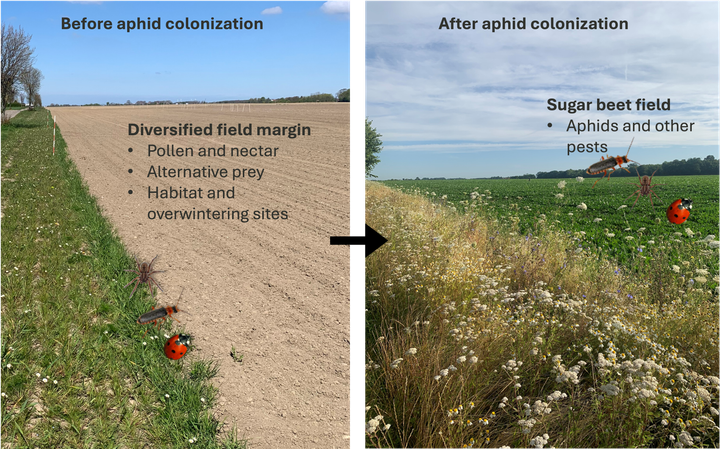
The meta-analysis demonstrates that flower strips primarily attract natural enemies that prey on plants, such as ladybirds, flower bugs, soldier beetles, hoverflies and green lacewings. This group of natural enemies eat aphids, thrips, spider mites as well as eggs and larvae of various pests.
However, it's not just the number of species in the strip that matters; it's also important to choose flower species with the right characteristics:
“Flowers such as yarrow, ox-eye daisy, bellis and various umbelliferous flowers are suitable for flower strips because they have open flowers with easy access to pollen and nectar, which is an advantage for predatory insects, parasitic wasps and solitary bees,” Nika Jachowicz says.
Pollen and nectar serve as food supplements, allowing natural enemies to survive in the absence of prey.
Lene Sigsgaard also recommends that farmers choose seed mixes with perennial native species such as yarrow and ox-eye daisy:
“Native species are those that, through evolution, have the best impact on the insects that live in Denmark. And if they are perennial species, you can have flower strips that last for many years if you look after them properly. Beneficial insects can overwinter here and build up their populations, benefiting biodiversity and plant production. In this way, you also strengthen the economic argument for having flower strips.”
Making it easier to receive funding
EU policy aims to reduce the need for pesticide spraying by promoting robust plant production with as high a level of self-defence as possible, that is, providing the best possible conditions for natural enemies and pollinators to be present in the fields. And this is where flower strips play a role.
Flower strips are one method for promoting ecological balance and reducing pesticide use. They can’t stand alone, but the great thing about them is that they can be easily combined with other preventive measures, such as crop rotation and biological control. And it doesn't harm that perennial flower strips contribute to biodiversity in the open countryside,” Lene Sigsgaard says.
In Europe, national subsidy schemes for flower strips have been in place since the 1990s. But, according to the researchers, strips could be even more widespread if it becomes easier for farmers to apply for subsidies to plant them:
“We hear from farmers that it's difficult to obtain subsidies for flower strips, partly because the rules regarding when to sow and mow them are complex. There are several boxes to tick that may not quite align with the purpose of attracting more natural enemies. So we encourage the authorities to make it easier to get funding for flower strips,” Nika Jachowicz ends.
FACT BOX: ABOUT THE REVIEW
- In the meta-analysis, the researchers reviewed 24 studies comprising 382 trials measuring the abundance of beneficial insects in flower strips.
- The meta-analysis has been published in the scientific journal Agriculture, Ecosystems and Environment.
FACT BOX: FLOWER STRIPS IN A DISTURBED SYSTEM
The meta-analysis is the first to exclusively examine the effect of flower strips in fields with annual crops.
“Other studies have shown many success stories with perennial crops, but there is a significant difference between how flower strips work in such a system and in a system that is disturbed every year by ploughing and machine traffic. Fields with annual crops present more challenging and complex conditions for flower strips. But here too, there is a clear effect of flower strips,” Nika Jachowicz says.
Keywords
Contacts
Lene Sigsgaard
Associate Professor
Department of Plant and Environmental Sciences
University of Copenhagen
les@plen.ku.dk
+ 45 21 15 18 27
Nika Jachowicz
Industrial PhD student
Department of Plant and Environmental Sciences
University of Copenhagen
nija@plen.ku.dk
+ 45 28 50 59 01
Maria Hornbek
Journalist
University of Copenhagen
maho@adm.ku.dk
+ 45 22 95 42 83
Images
Links
Subscribe to releases from Københavns Universitet
Subscribe to all the latest releases from Københavns Universitet by registering your e-mail address below. You can unsubscribe at any time.
Latest releases from Københavns Universitet
”Frivillig” isolation gør indsatte i danske fængsler syge25.5.2026 09:02:44 CEST | Pressemeddelelse
Otte procent af de indsatte i danske fængsler vælger såkaldt frivillig isolation for at undgå overgreb fra andre indsatte. Men den ”frivillige” isolation er ureguleret, og mange sårbare indsatte oplever de ofte langvarige isolationer som en stor lidelse og som en dobbeltstraf. Det viser ny forskning fra Københavns Universitet og Institut for Menneskerettigheder.
Henrik Plougmann Olsen bliver nyt bestyrelsesmedlem på Københavns Universitet22.5.2026 12:00:00 CEST | Pressemeddelelse
Med erfaring fra flere store offentlige selskaber indtræder Henrik Plougmann Olsen i Københavns Universitets bestyrelse som eksternt medlem fra 1. juli 2026. Han kommer med særlige kompetencer inden for byudvikling, infrastruktur og offentlig styring, som bliver vigtige i de kommende år.
Hvorfor er unges søvn og mentale helbred så dårligt? Forskere peger på ’onde spiraler’ som mulig årsag21.5.2026 07:59:00 CEST | Pressemeddelelse
Nyt studie fra Københavns Universitet kortlægger komplekst netværk af faktorer, der potentielt fastholder unge voksne i dårlige søvnmønstre og mental mistrivsel. Forskningen bruges allerede til at lave målrettede indsatser for unge i en kommune.
Forskere opdager en ny mekanisme, som kan udløse koraldød, når havet bliver varmere21.5.2026 06:00:00 CEST | Pressemeddelelse
Et nyt studie fra Københavns Universitet viser, at hedebølger i havet kan påvirke mikroskopiske, bevægelige strukturer på tropiske korallers overflade, som hjælper dem med at få tilstrækkelig ilt. Når havvandets temperatur overskrider en kritisk tærskel, kollapser denne iltforsyning, hvilket øger risikoen for koraldød.
Warming oceans can disrupt coral oxygen supply and trigger coral death21.5.2026 06:00:00 CEST | Press release
A new study from the University of Copenhagen shows that marine heatwaves can disrupt microscopic moving structures on the surface of reef-building corals that support their oxygen uptake. When seawater temperature crosses a critical threshold, this oxygen supply mechanism collapses, increasing the risk of coral death.
In our pressroom you can read all our latest releases, find our press contacts, images, documents and other relevant information about us.
Visit our pressroom