
Fungus gnat entombed in a 40-million-year-old piece of amber is a rare gem
30.8.2024 06:00:00 CEST | Københavns Universitet | Pressemeddelelse
A Danish amber collector’s find upon a wild North Sea shore in the 1960’s has proved to be of great and surprising significance. After having thoroughly examining the roughly 40-million-year-old piece of amber, University of Copenhagen researchers have discovered it to contain the first fossil of a predatory fungus gnat belonging to a rare genus. The research contributes new knowledge about the distribution of the gnat species and about biodiversity across space and time.
Are you fed up with the summertime onslaught of fruit flies, gnats, mosquitoes and other tiny winged insects? If so, be happy that you weren't around 40 million years ago. Back then, Europe’s climate was warmer and more humid, which provided favourable conditions for gnats, among other things.
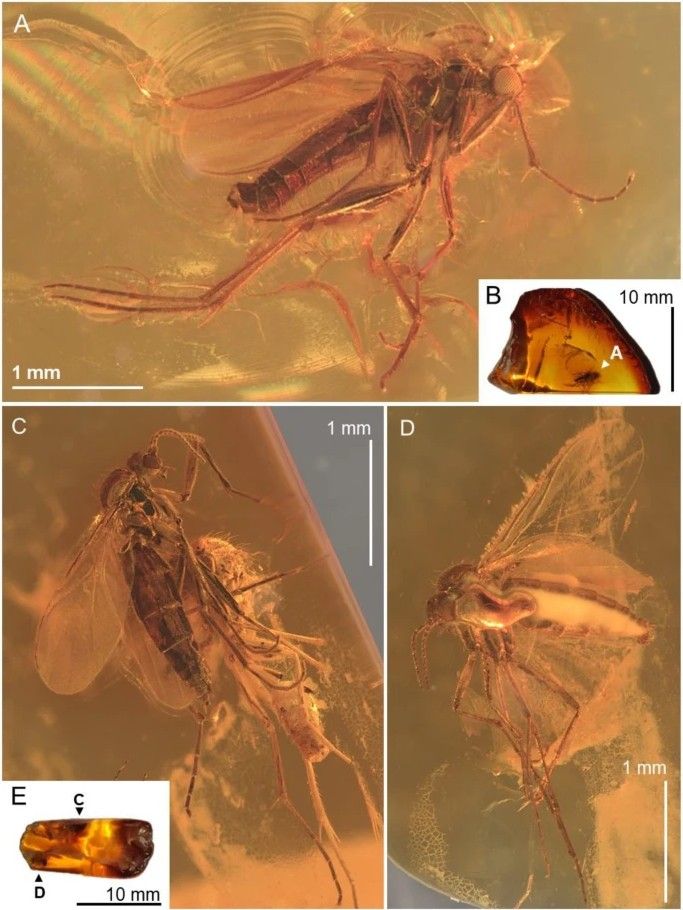
One of these gnats, which met its end after being trapped in a lump of pine resin, has given researchers from the Natural History Museum of Denmark the opportunity to add a new prehistoric gnat species to its family of insects. This first fossil of a rare and never before studied species of gnat, Robsonomyia henningseni, was found in a piece of Baltic amber along Denmark’s North Sea coast in the 1960’s.
For decades, the piece had been tucked away in the museum's 70,000-piece amber collection. Recently, it was retrieved from the drawers and subjected to a thorough examination by a team of Polish entomologists. The insect specialists were able to identify the gnat as an extinct species from a rare genus of predatory gnats. Today, living species of the genus are only found in Hokkaido, Japan and California.
"This is the first time that anyone has found a fossil gnat of this genus, which were only thought to live in Japan and North America. The finding demonstrates that this type of gnat was also widespread in Europe during past climates and gives us new knowledge about the gnat’s distribution on Earth," explains Alicja Pełczyńska, a PhD student at the University of Łódź and University of Copenhagen, who conducted the description of the gnat.
The researchers believe that the ancient gnat is a kind of "missing link" that connects its two rare and still living relatives in Japan and the United States. The overland distance between the living species has puzzled researchers, but the new fossil demonstrates that the species’ path may have traversed the European continent.
"Until now, the distribution of this genus of gnat has been strange, with many thousands of kilometres between species. Therefore, it makes sense to have found it in Europe, which is approximately halfway between Japan and North America," says Alicja Pełczyńska.
C.V. Henningsen – Danish amber collector and gnat namesake
To learn more about the amber-entombed gnat, the researchers began by polishing the ocean and sun-matted amber piece until it was glossy and transparent.
Once transparent, they used an advanced camera and spectrometer to take a chemical fingerprint of the amber. This confirmed that piece is from Baltic amber. Thereafter, they examined the fossil and determined the species of insect. This part of the process took place by closely studying the males' genitalia, where identifying characteristics often vary.
"Insects mate end to end, which places certain demands on their genitalia. The male has appendages, or forceps, next to the actual penis, which it uses to grasp the female gnat with while mating. We used the shape of these forceps to identify it," explains Lars Vilhelmsen, an associate professor and curator at the Natural History Museum of Denmark.
Based on the analysis, the researchers estimate that the gnat buzzed about in the enormous pine forests of what we now know as Scandinavia some 35-40 million years ago. Here, the gnat became trapped in a lump of resin upon a tree, which rivers, ocean currents and glaciers of the last ice age carried to the North Sea.
"An amber collector by the name of C.V. Henningsen found the piece of amber on the western coast of Jutland back in the 1960’s. Henningsen sold the piece, along with the rest of his collection, to the Natural History Museum of Denmark. Since the gnat species had never been described before, we named it after him, and it is now known as Robsonomyia henningseni," says Lars Vilhelmsen.
Unlike in Jurassic Park, there’s no DNA
Amber is an outstanding natural time capsule for scientists. With its protective lamination, it preserves ancient insects and plant remains and lets us learn about what Earth looked like up to 230 million years ago. But if released from its amber encasing, the insect will disappear.
According to Lars Vilhelmsen, there is no blood or DNA to suck out of the gnats so as to reanimate them in any way, as is done in the Jurassic Park films.
"Virtually all of the organic material in the gnat has long since decomposed, making it a hollow shell. If one tries to remove it from the amber, it crumbles. As such, the best thing we can do is to study it inside the amber. Insects trapped in amber can be studied almost as precisely as their living relatives using microCT scans," explains Lars Vilhelmsen.
The new discovery of the gnat fossil equips researchers with new knowledge about the general migrations of gnats across Earth and contributes to the larger picture of biodiversity through time.
Read the research article and see more photos
Facts about the gnat genus:
- The Robsonomyia henningseni gnat species belongs to the Keroplatidae family.
- In most genera of this gnat family, larvae are carnivorous and use a sticky web covered with acidic liquid to catch and kill tiny invertebrates.
- Furthermore, some of them use bioluminescence to lure insects attracted by light. The most famous example of this is Arachnocampa luminosa, the New Zealand Glowworm. In the caves where they live, these keroplatid larvae create an artificial 'night sky'. Arachnocampa luminosa - Wikipedia.
- In some genera, scavenging, cannibalism and even intestinal parasitism have been observed.
- The diet of adult insects in most genera remains unknown, although some have been observed feeding on flower nectar. Typically, adult insects don’t eat very much as they do not need proteins for growth. Instead, they rely on quick carb loading to fuel their flights, which is what makes a diet of sweet nectar an ideal form of nourishment.
Kontakter
Lars Vilhelmsen
Professor og kurator for ravsamlingen
Statens Naturhistoriske Museum
Københavns Universitet
lbvilhelmsen@snm.ku.dk
(+45) 35 32 11 10
Alicja Pełczyńnska
Ph.D.-studerende ved Łódź Universitet og Københavns Universitet
alicja.pelczynska@edu.uni.lodz.pl
Følg pressemeddelelser fra Københavns Universitet
Skriv dig op her, og modtag pressemeddelelser på e-mail. Indtast din e-mail, klik på abonner, og følg instruktionerne i den udsendte e-mail.
Flere pressemeddelelser fra Københavns Universitet
From flat moss to forests and flowers: New discovery may explain how plants conquered land2.6.2026 06:00:00 CEST | Pressemeddelelse
Researchers from the University of Copenhagen have identified a previously unknown protein that may help explain how plants managed to colonize land more than 400 million years ago. The protein was studied in moss, and the new findings contribute to our understanding of plant evolution and life on Earth.
Fra flad mos til skove og blomster: Nyt fund kan give svar på, hvordan planter kunne erobre landjorden2.6.2026 06:00:00 CEST | Pressemeddelelse
Forskere fra Københavns Universitet har identificeret et hidtil ukendt protein, som kan gøre os klogere på at forstå, hvordan det for over 400 millioner år siden lykkedes planter at kolonisere jorden. Proteinet er blevet undersøgt i mos, og det nye fund bidrager til historien om planter og menneskeliv på jorden.
”Frivillig” isolation gør indsatte i danske fængsler syge25.5.2026 09:02:44 CEST | Pressemeddelelse
Otte procent af de indsatte i danske fængsler vælger såkaldt frivillig isolation for at undgå overgreb fra andre indsatte. Men den ”frivillige” isolation er ureguleret, og mange sårbare indsatte oplever de ofte langvarige isolationer som en stor lidelse og som en dobbeltstraf. Det viser ny forskning fra Københavns Universitet og Institut for Menneskerettigheder.
Henrik Plougmann Olsen bliver nyt bestyrelsesmedlem på Københavns Universitet22.5.2026 12:00:00 CEST | Pressemeddelelse
Med erfaring fra flere store offentlige selskaber indtræder Henrik Plougmann Olsen i Københavns Universitets bestyrelse som eksternt medlem fra 1. juli 2026. Han kommer med særlige kompetencer inden for byudvikling, infrastruktur og offentlig styring, som bliver vigtige i de kommende år.
Hvorfor er unges søvn og mentale helbred så dårligt? Forskere peger på ’onde spiraler’ som mulig årsag21.5.2026 07:59:00 CEST | Pressemeddelelse
Nyt studie fra Københavns Universitet kortlægger komplekst netværk af faktorer, der potentielt fastholder unge voksne i dårlige søvnmønstre og mental mistrivsel. Forskningen bruges allerede til at lave målrettede indsatser for unge i en kommune.
I vores nyhedsrum kan du læse alle vores pressemeddelelser, tilgå materiale i form af billeder og dokumenter samt finde vores kontaktoplysninger.
Besøg vores nyhedsrum