
Spotted apex predator being pressured by spotted pack hunters – and it's our fault
2.7.2024 09:02:58 CEST | Københavns Universitet | Press release
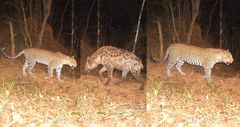
Leopards, who are already in decline, can’t keep up with hyenas when people are around. As we humans move into the their territories more and more, we are helping to disturb and unbalance ecosystems. This has been shown in a new University of Copenhagen study where researchers used camera traps to observe both large carnivore species.
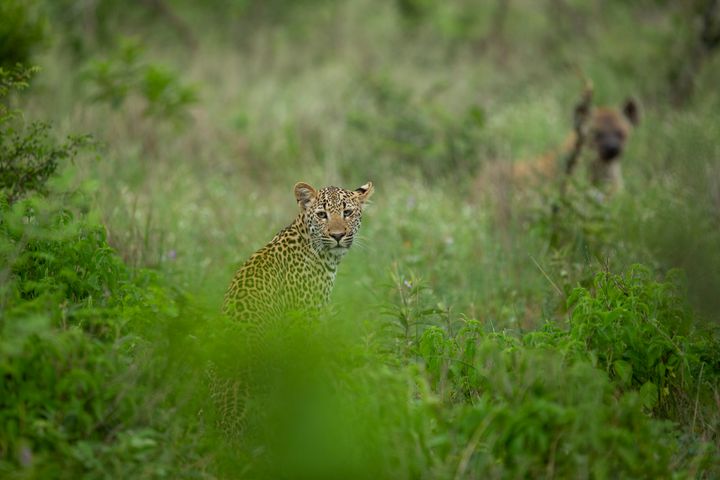
Who’s stronger? A solitary leopard or a cackle of hyenas? And which is best at getting along with humans?
University of Copenhagen researchers closely studied this in a large East African natural area surrounded by rural settlements. The study demonstrates that the presence of humans has a direct impact on the competitive relationship between the two large predator species: leopards (Panthera pardus) – the iconic spotted feline and the spotted hyena (Crocuta crocuta) – a kleptoparasite and pack hunter known for its comical appearance and characteristic 'laugh'.
"We humans continue eating our way into the little bit of wilderness left in the world. As we do, we impact wildlife. This study demonstrates that human disturbance upsets the balance between competing species and that this advantages hyenas," says Rasmus W. Havmøller, the study’s first author and a postdoc at the University of Copenhagen’s Natural History Museum of Denmark.
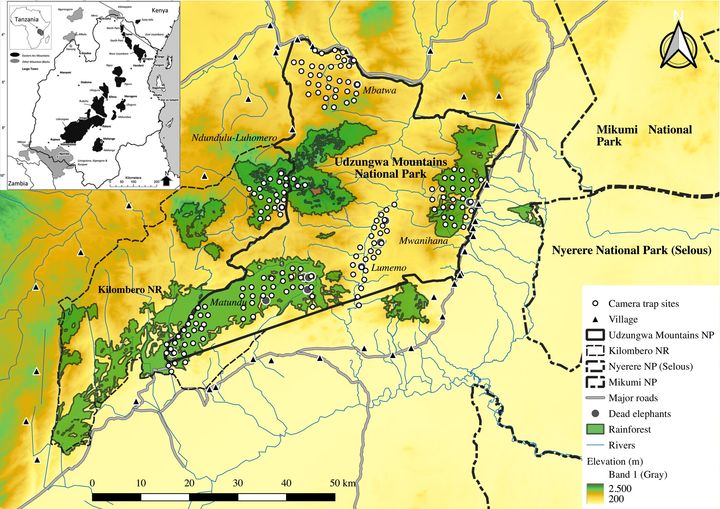
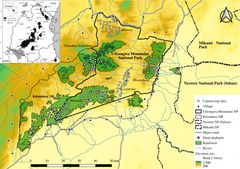
For months, Havmøller have been using camera traps to observe the dynamics between hyenas and leopards living in Tanzania’s Udzungwa Mountains – an approximately 2,000 km2 national park that is completely surrounded by agricultural and populated areas. The study is the first to combine camera observations of large predators over both time and space in a single analysis.
While the hyena as a species seems to be increasing in numbers, the population of leopards has been in significant decline for decades, both in Africa and worldwide. Since hyenas are the leopards' only competitor in this particular natural area, the ability of the two species to coexist is important for their survival. And here, the local population is an important factor:
"As the local people definitely don’t' like leopards, the leopards retreat as far away from humans as possible. Hyenas, on the other hand, benefit from the fact that humans don’t feel threatened by or pursue them. Consequently, hyenas live in close to human populations and may even exploit humans as shields against the leopards," says Havmøller.
"But the areas nearest to humans are also the areas with the most prey. And as hyenas assert dominance over these areas, it increases their ability to outcompete leopards and potentially threaten the leopard's adaptability," adds Havmøller.
Size matters
The researchers' observations confirm that size matters. While male leopards, which are larger, retain their dominance over hyenas, the situation is different for female leopards, which are smaller.
"Even though the male leopards are the ones in charge, the hyenas aren’t exactly scared off by them. They simply hang out in the background – probably to follow the leopards and steal their prey. But the physical inferiority of the hyenas seems to be compensated for in the areas closest to humans, because male leopards pull out," says Rasmus W. Havmøller, who continues:
"Female leopards, on the other hand, completely change their behavior when hyenas are in the area. They become diurnal, whereas hyenas are primarily nocturnal. This is probably because female leopards are smaller than hyenas, and that they will likely lose in any fight over prey."
Overall, the study shows that the hyenas benefit from living near humans.
"This suggests that the hyena's ability to adapt to areas of human activity may strengthen their overall success as a species and their competitive advantage over other large predators as we humans disturb more and more nature," says Havmøller.
When leopards are pressured, cascade effects may follow
According to the researcher, the shift in female leopard hunting patterns may have negative consequences:
"If you open up for more tourism and build more roads in the national park, the female leopards will be pressured immediately. They aren’t able to differentiate between safari tourists – who are most active during the day – and poachers. In time, they will probably learn that safari guests aren’t dangerous. But if there is a large and rapid influx into the area, you will probably see a decline in their population," says Rasmus W. Havmøller.
If leopards are seriously pressured out of the food chain, one should expect the emergence of what are known as cascade effects in the ecosystem:
"Plucking a large predator like leopards out of a food chain, which can be the ultimate consequence of human disturbances, may have very violent effects. Populations of other species, such as certain monkeys, whose populations are kept in check by leopards, will suddenly become too large and change the balance of the entire ecosystem," says the researcher.
As such, Havmøller hopes that the study will serve to encourage restraint when it comes to managing wilderness areas.
"Our results clearly indicate that human disturbances can change the competitive relationship between important predators. So, I hope that considerations will be made when expanding activities in wilderness areas, so as to roll them out slowly and give animals a chance to adapt. Furthermore, it would be good if the effects of human disturbances were monitored in more places using camera traps," concludes Rasmus W. Havmøller.
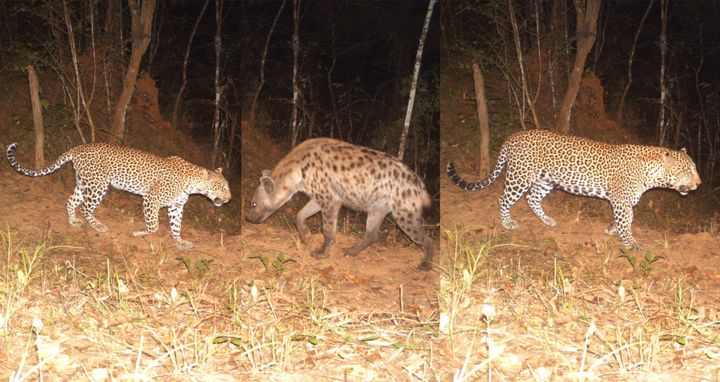
HYENAS VS. LEOPARDS
- Leopards are unpopular among local people in many places because they may hunt livestock and attack humans. Hyenas, on the other hand, "clean up" by eating sick or dead livestock and don’t pose a problem for humans.
- Female leopards (approx. 20-43 kg.) are about half the size of male leopards (approx. 51-72 kg). Hyenas are in the middle in terms of weight (approx. 48-56 kg).
- Leopards are solitary hunters, whereas hyenas hunt in large cackles (clans), which can be an advantage for hyenas in confrontations with leopards.
- Hyenas are kleptoparasites that regularly steal the prey of other carnivores – including leopards.
- Leopards on the other hand, are masterful tree-climbers, which allows them to protect their prey from hyenas.
ABOUT THE STUDY
- The researchers behind the study are: Rasmus W. Havmøller and Linnea W. Havmøller from the Natural History Museum of Denmark, University of Copenhagen; Arielle W. Parsons from Lincoln Park Zoo, USA and Roland Kays from North Carolina State University, USA.
- The study has been published in the scientific journal Ecosphere.
- The research is supported by the ERC under the EU’s Horizon 2020 programme.
Keywords
Contacts
Rasmus W. Havmøller
Postdoc
Natural History Museum of Denmark
University of Copenhagen
rasmus.havmoeller@snm.ku.dk
+45 35 32 14 59 / +45 22 41 04 31
Maria Hornbek
Journalist
Faculty of Science
University of Copenhagen
maho@science.ku.dk
+45 22 95 42 83
Images
Links
ABOUT THE FACULTY OF SCIENCE
The Faculty of Science at the University of Copenhagen – or SCIENCE – is Denmark's largest science research and education institution.
The Faculty's most important task is to contribute to solving the major challenges facing the rapidly changing world with increased pressure on, among other things, natural resources and significant climate change, both nationally and globally.
Subscribe to releases from Københavns Universitet
Subscribe to all the latest releases from Københavns Universitet by registering your e-mail address below. You can unsubscribe at any time.
Latest releases from Københavns Universitet
From flat moss to forests and flowers: New discovery may explain how plants conquered land2.6.2026 06:00:00 CEST | Pressemeddelelse
Researchers from the University of Copenhagen have identified a previously unknown protein that may help explain how plants managed to colonize land more than 400 million years ago. The protein was studied in moss, and the new findings contribute to our understanding of plant evolution and life on Earth.
Fra flad mos til skove og blomster: Nyt fund kan give svar på, hvordan planter kunne erobre landjorden2.6.2026 06:00:00 CEST | Pressemeddelelse
Forskere fra Københavns Universitet har identificeret et hidtil ukendt protein, som kan gøre os klogere på at forstå, hvordan det for over 400 millioner år siden lykkedes planter at kolonisere jorden. Proteinet er blevet undersøgt i mos, og det nye fund bidrager til historien om planter og menneskeliv på jorden.
”Frivillig” isolation gør indsatte i danske fængsler syge25.5.2026 09:02:44 CEST | Pressemeddelelse
Otte procent af de indsatte i danske fængsler vælger såkaldt frivillig isolation for at undgå overgreb fra andre indsatte. Men den ”frivillige” isolation er ureguleret, og mange sårbare indsatte oplever de ofte langvarige isolationer som en stor lidelse og som en dobbeltstraf. Det viser ny forskning fra Københavns Universitet og Institut for Menneskerettigheder.
Henrik Plougmann Olsen bliver nyt bestyrelsesmedlem på Københavns Universitet22.5.2026 12:00:00 CEST | Pressemeddelelse
Med erfaring fra flere store offentlige selskaber indtræder Henrik Plougmann Olsen i Københavns Universitets bestyrelse som eksternt medlem fra 1. juli 2026. Han kommer med særlige kompetencer inden for byudvikling, infrastruktur og offentlig styring, som bliver vigtige i de kommende år.
Hvorfor er unges søvn og mentale helbred så dårligt? Forskere peger på ’onde spiraler’ som mulig årsag21.5.2026 07:59:00 CEST | Pressemeddelelse
Nyt studie fra Københavns Universitet kortlægger komplekst netværk af faktorer, der potentielt fastholder unge voksne i dårlige søvnmønstre og mental mistrivsel. Forskningen bruges allerede til at lave målrettede indsatser for unge i en kommune.
In our pressroom you can read all our latest releases, find our press contacts, images, documents and other relevant information about us.
Visit our pressroom