
Straightening teeth? AI can help
13.3.2024 14:00:00 CET | Københavns Universitet | Pressemeddelelse
A new tool being developed by the University of Copenhagen and 3Shape will help orthodontists correctly fit braces onto teeth. Using artificial intelligence and virtual patients, the tool predicts how teeth will move, so as to ensure that braces are neither too loose nor too tight.
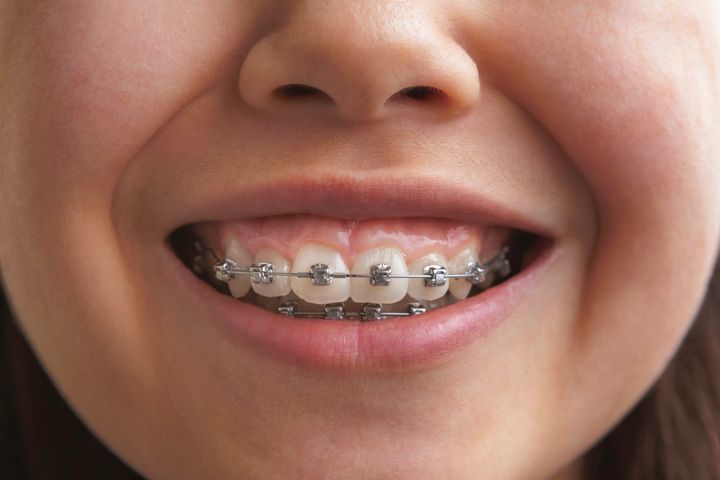
Many of us remember the feeling of having our braces regularly adjusted and retightened at the orthodontist’s office. And every year, about 30 percent of Danish youth up to the age of 15 wear braces to align crooked teeth. Orthodontists use the knowledge gained from their educations and experience to perform their jobs, but without the possibilities that a computer can provide for predicting final results.
A new tool, developed in a collaboration between the University of Copenhagen’s Department of Computer Science and the company 3Shape, makes it possible to simulate how braces should fit to give the best result without too many unnecessary inconveniences.
The tool has been developed with the help of scanned imagery of teeth and bone structures from human jaws, which artificial intelligence then uses to predict how sets of braces should be designed to best straighten a patient’s teeth.
"Our simulation is able to let an orthodontist know where braces should and shouldn’t exert pressure to straighten teeth. Currently, these interventions are based entirely upon the discretion of orthodontists and involve a great deal of trial and error. This can lead to many adjustments and visits to the orthodontist’s office, which our simulation can help reduce in the long run," says Professor Kenny Erleben, who heads IMAGE (Image Analysis, Computational Modelling and Geometry), a research section at UCPH’s Department of Computer Science.
Helps predict tooth movement
It's no wonder that it can be difficult to predict exactly how braces will move teeth, because teeth continue shifting slightly throughout a person’s life. And, these movements are very different from mouth to mouth.
"The fact that tooth movements vary from one patient to another makes it even more challenging to accurately predict how teeth will move for different people. Which is why we’ve developed a new tool and a dataset of different models to help overcome these challenges," explains Torkan Gholamalizadeh, from 3Shape and a PhD from the Department of Computer Science.
As an alternative to the classic bracket and braces, a new generation of clear braces, known as aligners, has gained ground. Aligners are designed as a transparent plastic cast of the teeth that patients fit over their teeth.
Patients must wear aligners for at least 22 hours a day and they need to be swapped for new and tighter sets every two weeks. Because aligners are made of plastic, a person’s teeth also change the contours of the aligner itself, something that the new tool also takes into account.
"As transparent aligners are softer than metal braces, calculating how much force it takes to move the teeth becomes even more complicated. But it’s a factor that we’ve taught our model to take into account, so that one can predict tooth movements when using aligners as well," says Torkan Gholamalizadeh.
Digital twins can improve treatment
Researchers created a computer model that creates accurate 3D simulations of an individual patient's jaw, and which dentists and technicians can use to plan the best possible treatment.
To create these simulations, researchers mapped sets of human teeth using detailed CT scans of teeth and of the small, fine structures between the jawbone and the teeth known as peridontal ligaments – a kind of fiber-rich connective tissue that holds teeth firmly in the jaw.
This type of precise digital imitation is referred to as a digital twin – and in this context, the researchers built up a database of 'digital dental patients'.
But they didn’t stop there. The researchers' database also contains other digital patient types that could one day be of use elsewhere in the healthcare sector:
"Right now, we have a database of digital patients that, besides simulating aligner designs, can be used for hip implants, among other things. In the long run, this could make life easier for patients and save resources for society," says Kenny Erleben.
The area of research that makes use of digital twins is relatively new and, for the time being, Professor Erleben's database of virtual patients is a world leader. However, the database will need to get even bigger if digital twins are to really take root and have benefit the healthcare sector and society.
"More data will allow us to simulate treatments and adapt medical devices so as to more precisely target patients across entire populations," says Professor Erleben.
Furthermore, the tool must clear various regulatory hurdles before it is rolled out for orthodontists. This is something that the researchers hope to see in the foreseeable future.
Digital twins
A digital twin is a virtual model that lives in the cloud, and is designed to accurately mirror a human being, physical object, system, or real-world process.
"The virtual model can answer what's happening in the real world, and do so instantly. For example, one can ask what would happen if you pushed on one tooth and get answers with regards to where it would move and how it would affect other teeth. This can be done quickly, so that you know what's happening. Today, weeks must pass before finding out whether a desired effect has been achieved," says Professor Kenny Erleben.
Digital twins can be used to plan, design and optimize – and can therefore be used to operate companies, robots, factories and used much more in the energy, healthcare and other sectors.
One of the goals of working with digital twins at the Department of Computer Science is to be able to create simulations of populations, for example, in the healthcare sector. If working with a medical product, virtual people must be exposed to and tested for their reactions in various situations. A simulation provides a picture of what would happen to an individual – and finally, to an entire population.
About the study
In their study, the researchers developed a simulation tool using CT scans of teeth, which can predict how a dental brace should best be designed and attached.
The research is described in the studies: “Deep-learning-based segmentation of individual tooth and bone with periodontal ligament interface details for simulation purposes” and “Open-Full-Jaw: An open-access dataset and pipeline for finite element models of human jaw”.
The research is part of the EU research project Rainbow, which conducts research into computer-simulated medicine across seven European universities in collaboration with government agencies and industry.
The research was conducted in collaboration with the company 3Shape, which manufactures intraoral scanners and provides medical software for digital dentistry purposes.
Kontakter
Kenny Erleben
Professor
Department of Computer Science
University of Copenhagen
kenny@di.ku.dk
+45 29 63 11 08
Michael Skov Jensen
Journalist and team coordinator
The Faculty of Science
University of Copenhagen
msj@science.ku.dk
+ 45 93 56 58 97
Billeder

Følg pressemeddelelser fra Københavns Universitet
Skriv dig op her, og modtag pressemeddelelser på e-mail. Indtast din e-mail, klik på abonner, og følg instruktionerne i den udsendte e-mail.
Flere pressemeddelelser fra Københavns Universitet
Forskere finder genetiske spor, der kan afsløre aggressiv prostatakræft10.9.2026 07:00:00 CEST | Pressemeddelelse
Et internationalt forskerhold har kortlagt de biologiske mekanismer bag prostatakræft og identificeret otte forskellige genetiske ’fingeraftryk’, som kan forklare, hvorfor nogle mænd bliver alvorligt syge, mens andre ikke gør. Resultaterne kan på sigt gøre behandling af prostatakræft langt mere præcis.
Nyt studie: Psykiatere er kun enige om diagnosen i 55 procent af tilfældene9.9.2026 09:35:26 CEST | Pressemeddelelse
Når psykiatere skal vurdere den samme patient, er de kun enige om diagnosen i cirka halvdelen af tilfældene, viser nyt studie fra Københavns Universitet. Det kan føre til forkert behandling af patienter og fejl i forskningen i psykiske lidelser, påpeger forskerne bag studiet.
Grøn trepart: Disse ting står øverst på danskernes ønskeliste31.8.2026 13:00:00 CEST | Pressemeddelelse
Mere plads til vild natur, sundere indre farvande, bedre dyrevelfærd og klimagevinster er de goder, danskerne i særlig grad forbinder med den grønne trepart. Det viser en ny befolkningsundersøgelse fra Green Mandate. Samtidig peger undersøgelsen på et betydeligt potentiale for øget borgerinddragelse i implementeringen af aftalen.
Uskyldige bilejere straffes for vanvidskørsel – problematisk, siger jura-forskere31.8.2026 10:33:57 CEST | Pressemeddelelse
Når politiet beslaglægger vanvidsbilisters køretøjer, kan det være en krænkelse af den private ejendomsret. I nogle sager tilhører bilen nemlig ikke lovovertræderen, men en uskyldig tredjepart.
Unresolved jar mystery becomes a 2,000-year natural experiment28.8.2026 08:05:00 CEST | Press release
More than 2,000 years ago, massive stone jars were carved from bedrock and placed on a highland plateau in northern Laos. Today, they represent not only an archaeological mystery, but also a series of small, self‑contained ecosystems that now provide researchers from the University of Copenhagen with a unique opportunity to study how nature develops over millennia.
I vores nyhedsrum kan du læse alle vores pressemeddelelser, tilgå materiale i form af billeder og dokumenter samt finde vores kontaktoplysninger.
Besøg vores nyhedsrum