
Reputation&Trust 2026 study: Tesla records the largest reputation gain in Nordic measurement history in Denmark
11.11.2026 13:15:50 CET | Reputation and Trust Analytics | Press release
The Reputation&Trust 2026 study, conducted by Reputation and Trust Analytics, shows that Lego continues its winning streak as Denmark’s most reputable company. The largest reputation gain in this year’s study – and in the entire Nordic measurement history of the study – was made by Tesla.
The Reputation&Trust study was carried out in early summer 2026 in Denmark, Norway, Sweden, Finland, Estonia and Germany, and for the first time also in the United Kingdom and France. The study is therefore based on the most extensive comparable national dataset to date.
In Denmark, the study was conducted in May–June 2026 and involved 3,080 respondents, who gave a total of 8,165 organisation ratings.
“The Reputation&Trust research model measures reputation across eight dimensions that explain stakeholders’ trust in organisations. Trust, in turn, reflects people’s willingness to take risks in relation to a company: whether they want to apply for a job there and invest in it, and recommend and buy its products or services,” explains Riku Ruokolahti, Development Director at Reputation and Trust Analytics.
Lego still the most reputable – Novo Nordisk’s reputation fell the most
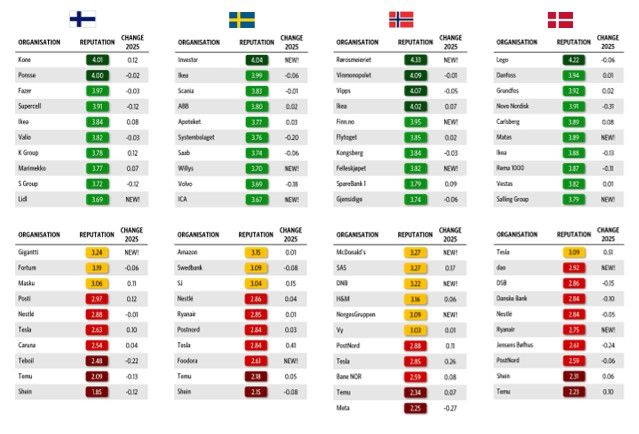
As last year, respondents rated Lego as Denmark’s most reputable company. With a score of 4.22, it is the only company in the country to reach the level of an excellent reputation. The threshold for an excellent reputation in the Reputation&Trust model is 4.00.
The largest fall in reputation in Denmark was recorded by last year’s runner-up, Novo Nordisk, whose score dropped by 0.31 points. At the same time, the company fell outside the top three most reputable companies for the first time in the history of the Reputation&Trust study.
“Novo Nordisk’s reputation score of 3.91 is still at a good level, but such a clear decline suggests that the company’s time as a national shooting star appears to be coming to an end,” says Riku Ruokolahti.
The Nordic countries’ most and least reputable companies
Tesla’s largest Nordic reputation gain in Denmark
The largest gain in reputation, on the other hand, can be seen on the list of the least reputable companies: Tesla, which was near the bottom of the list last year, improved its reputation by 0.51 points, moving from a weak to a moderate reputation. Tesla’s rise is the largest in the Nordic countries both in this year’s study and across the entire history of Reputation and Trust Analytics’ national measurements.
The threshold for a moderate reputation in the Reputation&Trust model is 3.00, and this year Tesla received a reputation score of 3.09. The company’s reputation has also begun to recover in the other Nordic countries, but the leap was greatest in Denmark. Tesla made the second-largest gain, 0.41 points, in Sweden, where its reputation had previously fallen particularly sharply. In Norway, Tesla improved its reputation by 0.26 points and in Finland by 0.10 points.
“Looking at the Nordic results, Tesla’s reputational recovery appears to be driven by a restored perception of its leadership and confidence in the company’s financial performance. The recovery of trust in Tesla’s leadership may be explained by the fact that the company’s founder, Elon Musk, was less visible in a political context during the measurement period”, says Riku Ruokolahti.
“In Denmark, Tesla’s score for the leadership dimension of reputation has improved by 0.73 points. This is an exceptionally large increase,” Ruokolahti continues.
Ultra-fast fashion retailers bring up the rear
As last year, Shein and Temu are at the bottom of the list of the least reputable companies in Denmark, both with a very weak reputation, below 2.50. Both have, however, seen a slight improvement: Shein’s reputation has risen by 0.06 points and Temu’s by 0.10 points.
Temu has also managed to improve its reputation in Sweden and Norway.
‘Although a slight rise can be seen, Temu’s reputation remains very weak in all the Nordic countries, unlike in the United Kingdom, for example, where Temu reaches a moderate reputation,’ Riku Ruokolahti points out.
Methodology
The aim of the Reputation&Trust 2026 study was to examine the reputation of companies operating in the Nordic countries among the general public. Data were collected using an online questionnaire in Denmark, Sweden, Norway, and Finland between 13 May and 24 June 2026.
Organisations were assessed using Reputation and Trust Analytics’ Reputation&Trust research model, in which an organisation’s reputation score is calculated as the average of eight dimensions: governance, financial performance, leadership, innovation, dialogue, products & services, workplace and responsibility. A five-point rating scale (1–5) was used.
A total of 21,625 people from Denmark, Sweden, Norway, and Finland took part in the study. The target group was citizens aged 15–65 nationwide (excluding Åland in Finland). The sample has been weighted by gender, age and region to be representative of the population.
The margin of error for the full dataset in Denmark is at most approximately ±1.77 percentage points.
Keywords
Contacts
Riku RuokolahtiDevelopment DirectorReputation and Trust Analytics
Tel:+358 400 512 200riku.ruokolahti@reptrust.comImages
Documents
Subscribe to releases from Reputation and Trust Analytics
Subscribe to all the latest releases from Reputation and Trust Analytics by registering your e-mail address below. You can unsubscribe at any time.