Seoul Semiconductor Ends Need for Rare Earths in White LEDs
28.10.2026 14:03:00 CET | Business Wire | Press release
Affiliate Seoul Viosys begins mass production of WICOP 3, which emits white light without rare earths from chips as small as 10 micrometers
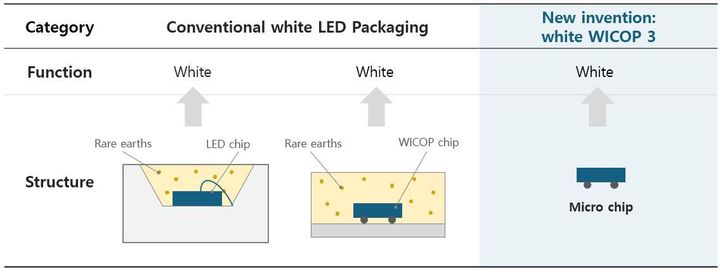
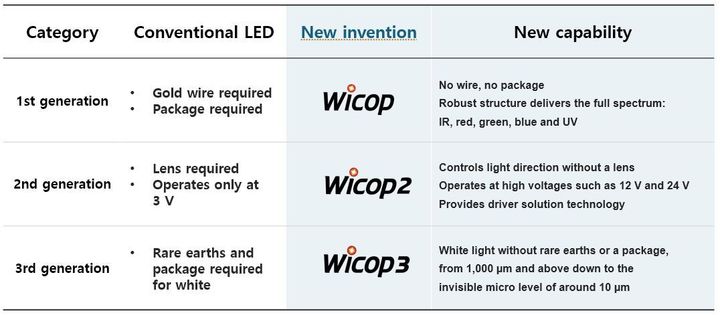
For three decades, white LEDs have depended on rare earth materials such as yttrium aluminum garnet (YAG) layered onto a blue LED chip (Figure 1). Seoul Viosys Co., Ltd. (KOSDAQ: 092190) today announced that it has broken that dependence. It has developed and begun mass producing a chip that emits white light without rare earths. The chip can be as small as 10 micrometers (µm).
This press release features multimedia. View the full release here: https://www.businesswire.com/news/home/20261028475699/en/
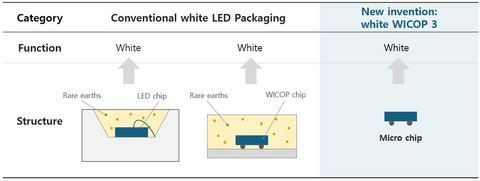
Figure 1. New invention: white WICOP 3 (source: Seoul Semiconductor Co., Ltd.)
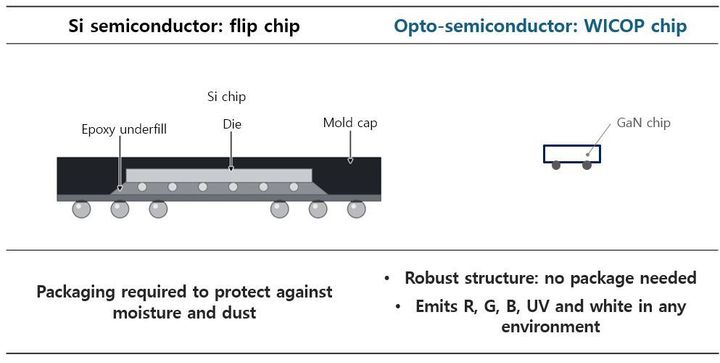
Seoul Viosys and its parent company Seoul Semiconductor Co., Ltd. (KOSDAQ: 046890) opened the micro LED market with WICOP. WICOP is a chip architecture that eliminates the package altogether. Doing away with the package is widely regarded in the industry as a revolution in six decades of semiconductor history. With WICOP, the two companies have already developed and mass produced ultraviolet, blue, green, red and infrared LEDs under 100 µm that are too small for the eye to see. WICOP 3 is the third generation of the technology. It now extends that capability to white light without rare earth elements (REEs).
Economic Impact
1) The White LED Market
White LEDs make up roughly $10 billion of the $15 billion global market for packaged LEDs. WICOP 3 can now replace them with a technology free of rare earths.
More significant still, WICOP 3 is the world's first white opto-semiconductor to achieve white light in a micro LED smaller than 100 µm. At that size, it is invisible to the naked eye.
WICOP 3 uses neither rare earths nor package. Rare earths are a major source of environmental pollution, and WICOP 3 contains none. It nor does contain the synthetic silicone resins, plastics and lead frames used in conventional LEDs. The result is a far more environmentally friendly product that costs about half as much to make as a conventional white LED.
2) Creating New Markets
The miniaturized transistor replaced the vacuum tube and created vast new markets in electronics. The company believes micro white opto-semiconductors can do the same. WICOP 3 generates white light from gallium nitride (GaN) alone. GaN is a natural material, and the chip contains no plastics, silicone or other synthetic organic materials. As a result, it is virtually permanent and can last for decades. In lighting, invisible micro opto-semiconductors could be embedded in wallpaper or window glass. They could light a space with no fixtures at all. This would end the inconvenience of replacing bulbs and the high cost of fixtures. The company expects this to create a new market tens of times larger than today's $10 billion white LED market.
Performance
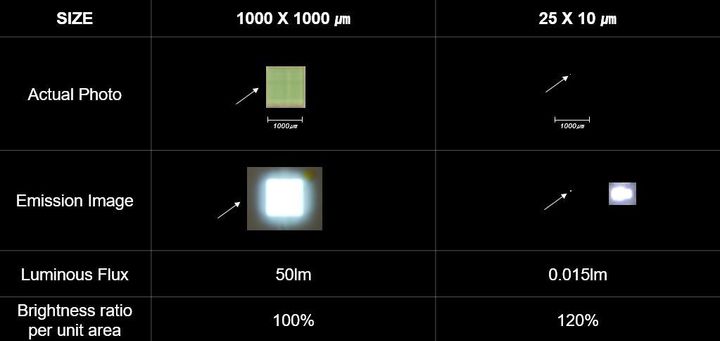
In its first mass production, a micro LED chip measuring just 25 µm by 10 µm produced 0.015 lumens of white light. Its chromaticity falls inside the CIE standard white region (Figure 2). Luminous efficacy is already close to 100 lumens per watt (lm/W). The company aims to reach 200 lm/W within two years. A conventional 1,000 µm by 1,000 µm chip achieves 50 lumens.
Technical Significance
Until now, WICOP could make chips smaller, but white light still required a package containing rare earths. White chips therefore could not go below 1,000 µm. This held back cost reduction. White micro LEDs under 100 µm (0.1 mm) were also out of reach. Removing rare earths changes that. White light is now possible both in large chips of 1,000 µm and above and in micro LEDs below 100 µm.
The company compares this advance to 1948. That year, Bell Laboratories in the United States moved electronics from the vacuum tube to the transistor. Seoul Semiconductor and Seoul Viosys have likewise moved beyond LEDs made to be seen. They have invented chips too small to see that emit red, green, blue, infrared, ultraviolet and now white light. The shift opens a broader era for opto-semiconductors that spans AR and AI communications.
Some products marketed as “flip chip” LEDs replicate WICOP's patented technology. Seoul Semiconductor continues to protect its intellectual property worldwide.
Development Background and Evolution
Since the 2010s, more than 10 major Korean groups and over 300 Chinese companies have entered the LED market. Price competition grew ever fiercer. Founder Chung Hoon Lee, who studied physics concluded that the company needed strategic, breakthrough technology to survive and grow. It has since invested about $100 million a year in R&D and new inventions, even in years when the business was not profitable. Silicon and opto-semiconductors are both made of soft materials that are vulnerable to dust and moisture. For that reason, both have been packaged for 60 years.
1) WICOP (First Generation)
WICOP began with a simple question Lee asked one night: “Why do semiconductors have to be packaged?” After years of research, Seoul Semiconductor developed WICOP in 2018 and brought it into high volume production. It was the first chip in semiconductor history that needs no package. Silicon semiconductors evolved from vacuum tubes to transistors and then to integrated circuits holding tens or hundreds of transistors. The company was convinced that WICOP could lead a similar evolution in opto-semiconductors and make invisible micro LEDs below 100 µm possible. The company has also conducted joint R&D with the University of California, Santa Barbara (UCSB) for 20 years. This work has produced devices on the 1 µm scale.
2) WICOP 2 (Second Generation)
LEDs once needed a lens to control the direction of their light. Lee questioned that too: “Why must we use a lens?” He also asked, “Why must semiconductors operate only at 3 volts when household power is 110 or 220 volts?” The answers produced WICOP 2. It directs light without a lens and operates at higher voltages, of 12 or 24 volts. Electric and hybrid vehicles run on high voltage batteries. In these vehicles, high voltage opto-semiconductors can cut power consumption by 20%. WICOP 2 is now supplied to global customers including Tesla.
3) WICOP 3 (Third Generation)
The third generation grew from the question “Why must white light require rare earths?” “We have now successfully developed WICOP 3, which produces white light, and have begun mass production,” said Lee, founder of Seoul Semiconductor.
Future Plans
Seoul Group comprises Seoul Semiconductor and Seoul Viosys. The group will start mass production of WICOP 3 in the fourth quarter. It will supply first those customers that have respected its intellectual property and relied on its products. WICOP 3 makes white light without rare earths. It is also the ultimate white light source: semipermanent even at invisible sizes of 100 µm or less. Even so, the group will hold to its “Keeping Principle” of never competing with its customers. It will instead open new application markets together with its key customers.
Seeking Supply Chain Partners
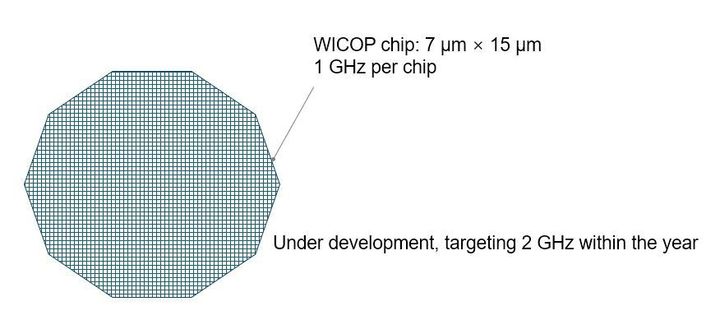
Seoul Viosys is an affiliate of Seoul Semiconductor. It uses WICOP to produce micro opto-semiconductors below 100 µm. Micro LEDs built on WICOP can now carry high volumes of AI data over distances from under 1 cm to tens of meters. Over short distances, data has long traveled through copper wire as electrons. Electrons have mass. Under the data loads of the AI era, copper links slow down, generate heat and consume sharply more power. The company instead sends data as light. Photons have no mass. It arranges 1,000 WICOP chips of about 10 µm each in a grid within 1 square millimeter or less (Figure 5). This array transmits data 10 times faster at one tenth of the power. Market research firms including Omdia forecast that this technology and AR together will create a new $60 billion market within five years. That is equal to half of today's DRAM memory market.
Lee said the company intends to use WICOP 1, 2 and 3 to help people around the world live better lives through AR glasses and AI data communications. These technologies work at invisible sizes of 10 µm or less. To that end, it is seeking trusted upstream and downstream micro LED supply chain partners in AR displays and AI transmitters to build the new $60 billion market together.
About Seoul Semiconductor
Seoul Semiconductor is a global LED company. Holding more than 15,000 patents and backed by a differentiated product portfolio, the company researches, develops, and mass-produces LED products for every application—including indoor and outdoor lighting, automotive, IT (mobile phones, computers, etc.), and ultraviolet (UV) and supplies them to customers worldwide. Its world-first products have become standards in the LED industry, and innovative products such as WICOP, a package-free LED; Acrich, an AC and high-voltage LED; nPola, more than 10 times brighter than conventional LEDs; Violeds, a cutting-edge UV sterilization technology; filament LED technology that emits light in all directions; and SunLike, a natural-spectrum LED, are leading the global market. For more information, visit the company website (http://www.seoulsemicon.com/) and its social media channels (YouTube, LinkedIn).
About Seoul Viosys
Seoul Viosys has the technological capability to produce optical semiconductor chips across the full wavelength range from 200 nm to 1,400 nm, backed by 6,000 patents, and can also manufacture VCSELs (Vertical Cavity Surface Emitting Lasers) and laser diodes. The company also mass-produces WICOP Pixel, the world's first chip to integrate R, G, and B for displays in a single chip. Founded in 2002, Seoul Viosys currently holds the world's No. 1 market share in UV LEDs and, in collaboration with its parent company Seoul Semiconductor, which holds 15,000 patents, has secured a technological lead in the global market. For more information, visit the company website (www.seoulviosys.com).
View source version on businesswire.com: https://www.businesswire.com/news/home/20261028475699/en/
Subscribe to releases from Business Wire
Subscribe to all the latest releases from Business Wire by registering your e-mail address below. You can unsubscribe at any time.
Latest releases from Business Wire
Belkin Introduces Infinity Folio for iPad mini, Available Now28.10.2026 19:21:00 CET | Press release
With a precision-engineered hinge that allows flexible viewing angles, all-around drop protection, and a frosted translucent back panel, Infinity Folio is the perfect companion for iPad mini from day one Belkin, a global leader in consumer electronics accessories trusted by more than 1 billion customers worldwide, today introduced Infinity Folio, a beautifully crafted protective case exclusively designed for iPad mini. The Infinity Folio is engineered to protect without compromise. A thin, lightweight and translucent back lets the new iPad mini design shine through with 360° of protection against drops of up to 2 meters*. The ingeniously engineered detachable cover transforms into a stand with multiple viewing angles. Whether it's streaming a favorite show, joining a video call, or reading an exciting book, Infinity Folio adapts to every moment. Designed specifically for iPad mini, Infinity Folio is available at launch through Apple stores and online in select markets worldwide, with a
DEWA Signs Three Agreements With Global Partners During WETEX 202628.10.2026 15:50:00 CET | Press release
Dubai Electricity and Water Authority (DEWA) signed three agreements with leading global entities during the 28th Water, Energy, Technology and Environment Exhibition (WETEX 2026). This press release features multimedia. View the full release here: https://www.businesswire.com/news/home/20261028187355/en/ DEWA signs three agreements with global partners during WETEX 2026 (Photo: AETOSWire) In the presence of HE Saeed Mohammed Al Tayer, MD&CEO of DEWA, the agreements were signed by Hussain Lootah, Executive Vice President of Transmission Power at DEWA, and concluded through Moro Hub, a subsidiary of Digital DEWA, the digital arm of DEWA. Al Tayer said: “We are committed to strengthening our strategic partnerships with leading global organisations and leveraging the latest technologies, solutions and best practices. This enables us to enhance the efficiency, resilience and future-readiness of our critical infrastructure, while keeping pace with advancements in cyber security, digital tra
Ras Al Khaimah Signs Landmark Friendship Agreement & 10 MoUs during Historic High-Level Tour of South China28.10.2026 14:48:00 CET | Press release
His Highness Sheikh Saud bin Saqr Al Qasimi, UAE Supreme Council Member and Ruler of Ras Al Khaimah, witnesses the signing of a historic agreement between Ras Al Khaimah and Fujian Province, China, concluding a six-day China visit. This press release features multimedia. View the full release here: https://www.businesswire.com/news/home/20261028878989/en/ His Highness Sheikh Saud bin Saqr Al Qasimi, UAE Supreme Council Member and Ruler of Ras Al Khaimah, witnessed the signing of a landmark agreement between Ras Al Khaimah and Fujian Province, alongside 10 Memoranda of Understanding between entities from the Emirate and their Chinese counterparts, reflecting a shared commitment to broadening cooperation and translating longstanding relations into meaningful opportunities for the future. (Photo: AETOSWire) Signed in Fuzhou, the agreement establishes a framework for strengthening economic, maritime and cultural ties, including cooperation in green supply chains, port logistics, sustainabl
Media Release: Further Up – Allianz Reaches Highest-Ever Brand Value of $30.7 Billion28.10.2026 14:08:00 CET | Press release
Interbrand’s Best Global Brands 2026 ranking: For the eighth consecutive year, Allianz is the world’s most valuable insurance brand and now ranks No. 26 among all brands.Financial performance and continuous brand management underpin brand strength, reflected in a record first-half 2026 operating profit.In 2026 Allianz helped deliver safe Winter Olympic and Paralympic Games in Milano Cortina, established a partnership with tennis player Jannik Sinner and founded the Allianz School for Life to foster financial literacy. A steady climb to a new high: For the eighth consecutive year, Allianz is the world’s most valuable insurance brand and has reached a record $30.7 billion in brand value, lifting it one place to No. 26 in Interbrand’s Best Global Brands 2026 ranking. This press release features multimedia. View the full release here: https://www.businesswire.com/news/home/20261028268225/en/ #1 Global Insurance Brand This 9% increase on 2025 further narrows the gap to the world’s most valu
Gurobi’s 2026 State of Mathematical Optimization Report Reveals Growing Convergence of AI and Optimization28.10.2026 14:00:00 CET | Press release
Survey finds GenAI use is on the rise as organizations embed optimization deeper into everyday operations. Gurobi Optimization, LLC, the leader in decision intelligence technology, today announced the release of its 2026 State of Mathematical Optimization Report. Based on a survey of 382 non-academic professionals across industries, the report examines how businesses are putting optimization to work, and how its use is evolving alongside other AI technologies. In a notable shift, 79% of respondents now use GenAI or large language models (LLMs) in their optimization work, up from 30% in 2025, with 37% using these tools systematically in their development workflows. Respondents see the greatest potential for this combined approach in code generation and debugging (68%), model formulation (67%), and natural-language interaction with optimization models (62%). Other key findings include: Optimization is becoming part of everyday operations: 52% of respondents say optimization supports ongo
In our pressroom you can read all our latest releases, find our press contacts, images, documents and other relevant information about us.
Visit our pressroom