Momentum Grows for Miro MCP as Users Embrace the Canvas for AI Collaboration
29.9.2026 15:00:00 CEST | Business Wire | Press release
Calls to Miro’s MCP server surge past 16 million; MCP jumps the developer niche with individuals in non-engineering roles now among the majority embracing the technology
Miro®, the collaboration and context layer for the AI era, has reported more than 16 million calls to its MCP server since its launch in February 2026, with usage more than doubling since May. In September alone, MCP calls are on track to reach 6 million*.
This press release features multimedia. View the full release here: https://www.businesswire.com/news/home/20260929837812/en/
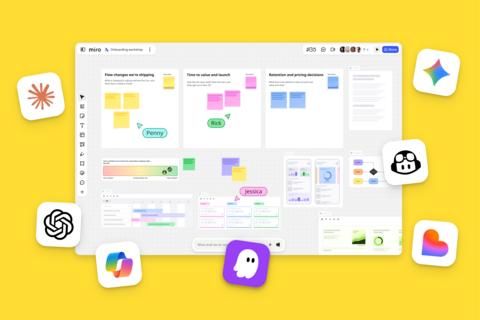
Miro's MCP server is a Model Context Protocol integration letting AI tools connect to Miro boards—creating diagrams, tables, and canvas content, and reading existing board data programmatically.
Teams increasingly rely on AI to accelerate work—from discovery and planning to design and code. Yet most AI interactions happen in chat windows or static outputs that exist separately from the team's actual workspace. Miro's MCP server changes this by giving users a way to make the output from their AI tools visual, immediately editable, and accessible to the whole team on a shared canvas.
Miro user data shows Claude Desktop and Claude Code represent almost two-thirds of usage in August (65%). ChatGPT has become the second-largest client, growing 71% in users between August and September. In total, 15 different AI clients have now connected via the MCP integration; others include Microsoft Copilot, Gemini Enterprise, and Grok Build. Further analysis of the data also demonstrates that the Canvas is being leveraged as both an input and output for AI agents. 57% of August calls were Miro-to-code, where an agent reads a board and acts on it, and 41% were code-to-Miro, where agents generate boards, diagrams and layouts directly.
The data also indicates that the demographic of users adopting MCP has shifted. MCP has jumped the developer niche. Users in engineering and developer roles account for under a quarter of MCP users—product, design, marketing, operations and project management together outnumber engineers roughly two to one.
"The explosive user adoption of Miro's MCP server is showing the true demand for bringing your agents closer to the work teams are actively doing," said Jeff Chow, Chief Product and Technology Officer at Miro. “By leveraging MCP tools with Miro, teams can visualize complex ideas across multiple formats on a collaborative canvas. What's most exciting is the growth we're seeing across all disciplines, showing Miro is well positioned to be the collaboration layer in the agentic era."
“The Miro MCP server changed how our product team thinks and ships,” said Dominic Le Garsmeur, Chief Product Officer at Fincore Ltd. “It gives our PMs the freedom to be bold on the canvas knowing Claude will help turn that thinking directly into the requirements our developers build from. Better ideas reach engineering faster.”
Teams are adopting Miro as the central interface for AI-assisted work. With 16 million MCP calls since its launch and adoption spreading across all job functions, the pattern is clear: AI agents need a workspace that supports how teams actually work—visual, shared, and endlessly editable.
Notes to editors
What is Miro’s MCP server?
Miro's MCP server is a Model Context Protocol integration letting AI tools connect to Miro boards—creating diagrams, tables, and canvas content, and reading existing board data programmatically.
For further information visit: https://miro.com/ai/mcp/
How was this data measured?
*Figures are drawn from Miro's internal product analytics and count tool calls made to Miro's MCP server by connected AI clients between the server's public launch to the time of publication, excluding usage by Miro employees.
About Miro
Miro is the collaborative workspace where agents and teams converge to think, decide, and build together. As AI accelerates work, the challenge for organizations isn’t doing more; it’s turning individual output into scaled impact. Serving more than 100 million users across 250,000 customers, Miro’s shared, secure canvas surfaces the context that empowers teams to solve harder problems, make better decisions, and move work forward faster. Founded in 2011, Miro currently employs 1,600 people in 13 hubs around the world. To learn more, visit miro.com.
Miro and the Miro logo are trademarks or registered trademarks of RealtimeBoard, Inc., in the United States and/or other countries. Other product and company names mentioned herein may be the trademarks of their respective owners.
View source version on businesswire.com: https://www.businesswire.com/news/home/20260929837812/en/
Subscribe to releases from Business Wire
Subscribe to all the latest releases from Business Wire by registering your e-mail address below. You can unsubscribe at any time.
Latest releases from Business Wire
Lattice to Showcase AI-Driven Low Power FPGA Innovation at FPGA Horizons Conference29.9.2026 22:00:00 CEST | Press release
Lattice Semiconductor (NASDAQ: LSCC), the low power programmable and platform firmware leader, today announced its participation in the upcoming FPGA Horizons conference, taking place on October 6 – 7, 2026 in London. As part of the conference’s technical program, Lattice will deliver a Tech Talk presentation and a hands-on workshop, and host a demo showcase focused on how its low power FPGA solutions are advancing AI at the edge. Who: Lattice Semiconductor What / When (GMT+2): Oct. 6, 2026 Demo showcase including Lattice Holoscan Sensor Bridge solution and Lattice Prompt™ AI-driven FPGA design tool Tech Talk (10:10 – 10:30 a.m.), Shaw Theater: Practical Security Fundamentals for FPGA Engineers Oct. 7, 2026 Workshop (1:30 – 4:40 p.m.), Hyde Park room Lattice Nexus™-based FPGA hands-on Lattice Prompt™ agentic AI workflow Where: FPGA Horizons Conference, Pullman London St Pancras, Euston Road, London NW1 FPGA Horizons is a UK-based conference for FPGA industry specialists. Supporting Res
NetApp Delivers Secure, Zero-Copy Data Activation for the Agentic Enterprise29.9.2026 19:30:00 CEST | Press release
Enterprises will be empowered to accelerate AI innovation to machine speed NetApp® (NASDAQ: NTAP), the Intelligent Data Infrastructure company, today announced new capabilities that enable enterprises to accelerate their adoption of agentic AI with secure, in-place, zero-copy data activation. The heterogeneous metadata capability of NetApp AI Data Engine (AIDE) helps organizations discover, understand, govern, and operationalize data where it lives, while an expanded integration with Commvault connects the NetApp Platform with Commvault recovery orchestration workflow to help customers detect attacks earlier and recover cleaner data faster. As AI agents move from experimentation into production, enterprise data infrastructure has become a critical business dependency. Agents can read, retrieve, and act on data at machine speed, but most enterprise data estates were built for human-paced workflows: fragmented across file, object, cloud, on-premises, and sovereign environments; governed
NetApp to Expand Partnership with SAP to Support SAP Cloud Infrastructure29.9.2026 19:30:00 CEST | Press release
NetApp to explore integrating NetApp capabilities with SAP Cloud Infrastructure storage architecture, to support secure, resilient, high-performance infrastructure for SAP and customer workloads NetApp, the intelligent Data Infrastructure company, today announced its intent to expand its long-standing partnership with SAP, with plans to explore deeper cloud-native integration of NetApp capabilities into SAP Cloud Infrastructure, SAP’s Infrastructure-as-a-Service platform. The NetApp Platform supports key elements of the SAP Cloud Infrastructure storage architecture, delivering reliable, highly available and high-performance file and block storage services. The NetApp Platform also provides built-in proactive data protection capabilities and data replication to support SAP’s global availability model. “SAP and NetApp share a long-standing commitment to empower the world’s most mission-critical enterprise environments,” said Álvaro Celis, Senior Vice President, Chief Commercial, Partner
NetApp Removes Storage Bottleneck for AI Factories29.9.2026 19:30:00 CEST | Press release
New architecture delivers fastest storage on the planet, designed to maximize GPU utilization and architected for up to 100 TB per second aggregate throughput NetApp® (NASDAQ: NTAP), the Intelligent Data Infrastructure company, today announced NetApp Novus™, the fastest storage on the planet designed for AI infrastructure providers operating large GPU environments. Built to support a zettabyte-scale file system, this next-generation architecture will allow AI factories to keep millions of GPUs continuously fed with data, maximizing the efficiency, utilization, and profitability of their investments. Neoclouds and GPU-as-a-Service providers are building AI factories at a scale that traditional storage architectures were never designed to support, creating bottlenecks that reduce GPU utilization and increase infrastructure costs. Under traditional architectures, GPU utilization can drop below 30 percent when AI factories cannot feed enough data to their GPUs to generate the results they
NetApp Empowers Enterprises to Build Anything, Anywhere29.9.2026 19:30:00 CEST | Press release
New hybrid multi-cloud capabilities remove borders between on-premises and cloud operations NetApp® (NASDAQ: NTAP), the Intelligent Data Infrastructure company, today announced new hybrid multi-cloud capabilities with autonomous controls to maximize enterprise flexibility and efficiency for any workload. Enterprises can now more easily adopt modern data strategies across on-premises and cloud environments leveraging new capabilities for consistent operations that account for sovereignty, governance, and controlled consumption. As enterprise applications and AI workloads increasingly span on-premises environments, public clouds, sovereign regions, and emerging AI Factory architectures, organizations need more than infrastructure flexibility. They need a consistent operating model that can keep pace with machine-speed demand while meeting requirements for governance, resilience, efficiency, and jurisdictional control. Traditional manual administration, fragmented tooling, and disconnecte
In our pressroom you can read all our latest releases, find our press contacts, images, documents and other relevant information about us.
Visit our pressroom