
Researchers create a Little Big Bang: Bowling-pin-shaped nuclei shed new light on the Universe’s first moments
20.8.2026 09:07:36 CEST | Københavns Universitet | Press release
Researchers from the University of Copenhagen have succeeded in recreating the primordial matter that filled the Universe shortly after the Big Bang – by smashing much smaller atomic nuclei together than previously thought possible. These microscopic Big Bangs could provide new insights into the Universe’s earliest moments while also helping researchers understand one of the fundamental questions in nuclear physics.
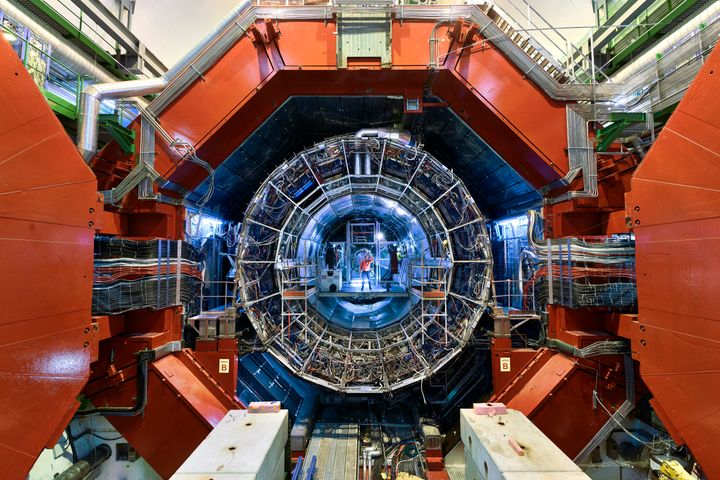
What happened in the first moments of the Universe – before the building blocks of life and the world we know today came into existence?
Physicists at the CERN research facility in Switzerland are trying to answer this question by recreating some of the extreme conditions that prevailed in the Universe during its earliest history. Now, researchers from the Niels Bohr Institute, together with colleagues from the international ALICE collaboration, have come one step closer to understanding them.
At CERN, researchers can make atomic nuclei collide at almost the speed of light, creating tiny droplets of the primordial matter that filled the Universe during its first millionth of a second. This matter is known as quark-gluon plasma and is thought to have been the earliest form of matter in the Universe.
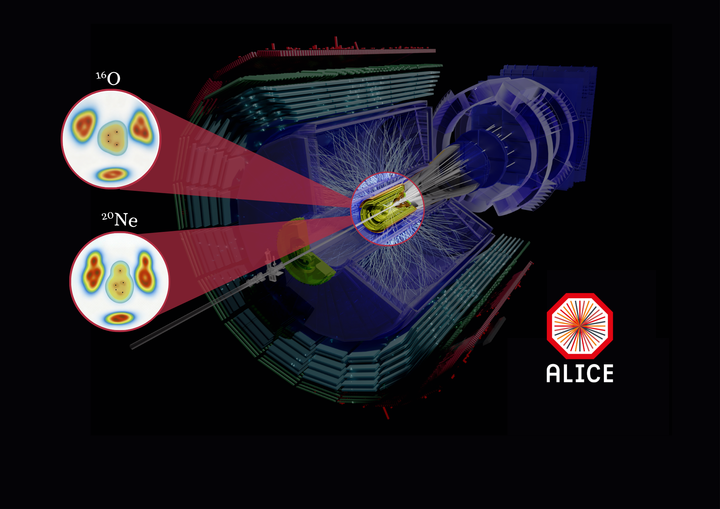
For many years, scientists have assumed that creating this plasma required collisions between very heavy atomic nuclei such as lead. But the physicists from the Niels Bohr Institute have now succeeded in creating the primordial matter by smashing the much smaller nuclei oxygen-16 and neon-20 together.
“We have pushed the boundary for how small the atomic nuclei can be while still recreating this primordial matter – what you could call a Little Big Bang. We now know more about the fundamental conditions required for matter to transition into this extreme state,” says Associate Professor You Zhou, who led the experiment and until recently was employed at the Niels Bohr Institute at the University of Copenhagen.
He adds:
“Hopefully, this will help us better understand how the plasma behaved during the first moments of the Universe – and how it later evolved into the forms of matter that everything around us is made of.”
The research findings, produced as part of the international ALICE experiment, have just been published in the prestigious journal Physical Review Letters.
A microscopic Big Bang shaped like a bowling pin
When the atomic nuclei collide, their constituents are transformed into a tiny droplet of quark-gluon plasma that exists for a tiny fraction of a second. The droplet of extremely hot matter then expands. Researchers cannot observe the plasma directly, but they can measure the particles that the matter turns into shortly afterwards.
Here, it turns out that the movement pattern of the particles reveals the shape of the atomic nucleus. While collisions between two oxygen nuclei produce a more rounded pattern, collisions involving neon produce a bowling-pin-shaped pattern.
“The particles from the primordial matter are directly governed by the geometric shape of the atomic nucleus. If the two nuclei we smash together are spherical, we get one pattern. If they are shaped like bowling pins, we get another. By studying how the particles move after the collision, we can gain insights into atomic nuclei that are otherwise difficult for physicists to obtain,” explains Postdoctoral Researcher Emil Gorm Dahlbæk Nielsen from the Niels Bohr Institute, who is a co-author of the study.
He elaborates:
“It is a bit like shining light on an object and seeing its shadow. You cannot see the object directly, but its shadow reveals its shape. In the same way, the movement of the particles reveals the geometric shape of the atomic nuclei that was present at the beginning of the collision.”
Deep roots at the Niels Bohr Institute
The question of the shape and structure of atomic nuclei has occupied physicists for more than 70 years and has deep roots at the Niels Bohr Institute. Indeed, it was Aage Bohr’s work on the structure of the atomic nucleus that earned him the Nobel Prize in Physics in 1975.
The shape of an atomic nucleus is not merely a matter of geometry. It reveals how protons and neutrons are organised and provides important information about the strong force – one of nature’s four fundamental forces, which scientists are still working to fully understand.
Until now, researchers have primarily investigated nuclear structure at low energies, for example by studying the rotation and vibrations of atomic nuclei.
“A precise understanding of nuclear structure helps us understand the strong force. But instead of carefully investigating nuclei at low energies, we smash them together at the highest energies we can create and can now read their shape from the imprint they leave behind,” says You Zhou.
The researchers describe the potential of the approach as a possible paradigm shift. If the method can be further developed, it could provide a new way of investigating other atomic nuclei whose structures are not yet well understood.
Researchers still do not know the exact boundary for when quark-gluon plasma can be created. The next step is therefore to carry out experiments with even lighter nuclei, such as helium-4.
“What is fascinating is that we can use the same experiment both to learn about the structure of atomic nuclei and to gain a better understanding of what happened during the birth of the Universe. These two things turn out to be much more closely connected than one might initially think,” You Zhou concludes.
WHAT IS QUARK-GLUON PLASMA?
Quark-gluon plasma is an extremely hot and dense state of matter that existed during the first millionth of a second after the Big Bang. At that time, the Universe was so hot that protons and neutrons had not yet formed. Instead, their building blocks – quarks and gluons – moved freely in a kind of hot “soup”.
As the Universe expanded and cooled, quarks and gluons gradually became bound together to form, among other things, protons and neutrons. These later became the building blocks of atomic nuclei and, ultimately, the ordinary matter that makes up stars, planets and ourselves.
ABOUT THE STUDY
- The study was carried out as part of the international ALICE collaboration at CERN and has been published in Physical Review Letters as an Editors’ Suggestion.
- You Zhou, Emil Gorm Dahlbæk Nielsen and Zhiyong Lu from the Niels Bohr Institute played central roles in the work.
- The study was supported by the ERC project InitialConditions.
Keywords
Contacts
You Zhou
Associate Professor
Niels Bohr Institute, University of Copenhagen /
Department of Physics and Astronomy, Aarhus University
you.zhou@cern.ch
(+45) 93 56 36 56
Emil Gorm Dahlbæk Nielsen
Research Fellow
Niels Bohr Institute, University of Copenhagen & CERN
emil.gorm.nielsen@cern.ch
(+33) 07 68 17 53 95
Maria Hornbek
Communications Consultant
UCPH Communication
University of Copenhagen
maho@adm.ku.dk
(+45) 22 95 42 83
Images
Links
Subscribe to releases from Københavns Universitet
Subscribe to all the latest releases from Københavns Universitet by registering your e-mail address below. You can unsubscribe at any time.
Latest releases from Københavns Universitet
Forskere skaber et mini-Big Bang: Bowlingkegle-formede atomkerner giver nyt indblik i Universets første øjeblikke20.8.2026 07:22:00 CEST | Pressemeddelelse
Det er lykkedes forskere fra Københavns Universitet at genskabe det urstof, som Universet bestod af lige efter Big Bang – men ved at smadre langt lettere atomkerner mod hinanden end man hidtil har troet muligt. Disse mikroskopiske Big Bangs kan give os nye indsigter i Universets fødsel og samtidig hjælpe os til at forstå et af kernefysikkens grundmysterier.
Calcium supplements may slow bone loss in postmenopausal women18.8.2026 09:45:19 CEST | Pressemeddelelse
A new study from the University of Copenhagen shows that daily calcium supplementation in the years following menopause may help prevent loss of bone mass. Further it can help reduce the risk of osteoporosis. The researcher behind the study believes the results should have implications for future recommendations for women in this age group.
Calciumtilskud kan bremse knogletab hos kvinder efter overgangsalderen18.8.2026 09:41:50 CEST | Pressemeddelelse
Et nyt studie fra Københavns Universitet viser, at dagligt calciumtilskud i årene efter overgangsalderen kan være med til at forebygge tab af knoglemasse. Videre kan det bidrage til at mindske risikoen for knogleskørhed. Forsker bag mener, at resultaterne bør få betydning for fremtidige anbefalinger til kvinder i den aldersgruppe.
Constipation is common in astronauts – blood tests provide new answers17.8.2026 06:00:00 CEST | Pressemeddelelse
Many things are different in space – including how the intestines work. Constipation is a known side effect of space travel, but until now we have known little about why it happens. Now, researchers from the University of Copenhagen, in collaboration with NASA, have examined blood samples from astronauts and have suggestions as to why the intestines slow down in space. This may provide useful information both for astronauts and for patients on Earth.
Astronauters maver går i stå i rummet – blodprøver giver nyt svar17.8.2026 06:00:00 CEST | Pressemeddelelse
Alt er anderledes i rummet – også hvordan tarmene fungerer. Forstoppelse er en kendt bivirkning ved rumfart, men indtil nu har vi vidst utroligt lidt om, hvorfor det sker. Nu har forskere fra Københavns Universitet i et samarbejde med NASA undersøgt blod fra astronauter og har et bud på, hvorfor tarmene går i stå. Det kan være nyttig viden både for astronauter og for patienter på Jorden.
In our pressroom you can read all our latest releases, find our press contacts, images, documents and other relevant information about us.
Visit our pressroom