Central Council calls for prevention through education and awareness-raising
3.8.2026 09:01:44 CEST | Zentralrat Deutscher Sinti und Roma | Press release
Commemorative event to mark the European Holocaust Remembrance Day for Sinti and Roma on 2 August 2026 in Auschwitz-Birkenau
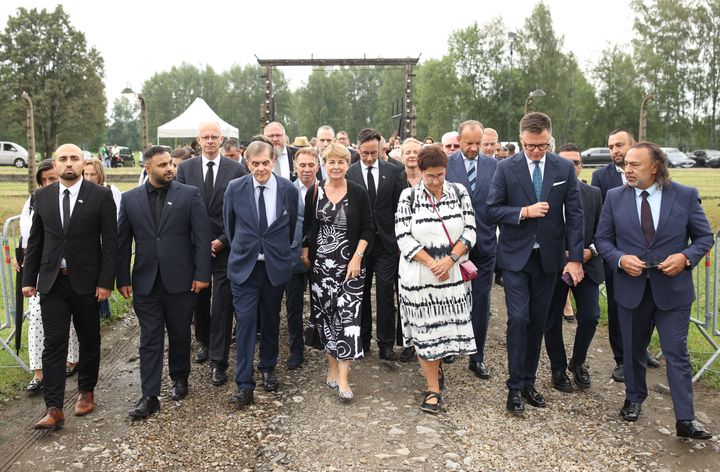
Auschwitz - The children, the sick and the elderly had no chance of survival: on the night of 2 August 1944, the 4,300 Sinti and Roma in the Auschwitz-Birkenau concentration and extermination camp were forced into the gas chambers by the SS – despite fierce resistance – and murdered. To mark the 82nd anniversary of the dismantling of the section of the camp where members of this minority had been crammed together, the Central Council and the Documentation and Cultural Centre of German Sinti and Roma, together with the Association of Roma in Poland and the Auschwitz-Birkenau State Museum, commemorated the victims on 2 August at the site of this crime against humanity.
In 2015, the European Parliament declared 2 August the European Holocaust Remembrance Day for Sinti and Roma, in memory of the 500,000 members of this minority who were murdered in Nazi-occupied Europe.
“When I look at the world today, I am at a loss for words to express my despair that we, as human beings, have learnt nothing from history,” said Romani Rose, Chairman of the Central Council of German Sinti and Roma, at the main commemorative event. “For even today, international law is once again being violated: in Ukraine, in the Middle East and in many other places around the world.”
But not only that: “Our minority is horrified to witness the rise of a resurgent and violent form of antigypsyism in Germany, but also in other European countries. This development is not taking place in a vacuum. Across Europe, we are seeing electoral successes for far-right and nationalist parties that are making hatred and incitement socially acceptable once again.”
Romani Rose emphasised that the figures from the independent Antigypsyism Reporting and Information Centre also bear out the threatening situation facing Sinti and Roma in Germany.
It is alarming that this hate-driven antigypsyism against the minority is not only coming from the far right, but also from state institutions, such as police authorities in Lower Saxony, which are once again criminalising and registering Sinti and Roma on the basis of the Nazi-coined concept of race. “I expect the German constitutional state to put an end to this scandalous practice – 82 years after Auschwitz!” demanded the Chairman of the Central Council.
However, he added, antigypsyism must be tackled not only through criminal law, but also through prevention via education and awareness-raising.
“It is a scandal that Europe’s largest minority, numbering between 10 and 12 million people, is barely mentioned in the school textbooks of their home countries.” For this reason, at the commemorative event, Romani Rose presented an appeal to the member states of the Council of Europe and the European Union, in which the Central Council asks them
to provide information in educational institutions about the centuries-old history of Sinti and Roma in their home countries and to highlight their contributions to art, music and culture.
Holocaust survivor Dieter Flack remembers his relatives, who were deported to Auschwitz-Birkenau in May 1943 and gassed a few weeks later. His family managed to save themselves by fleeing from the Nazi henchmen and hid in the woods for months. In his speech, the 85-year-old addressed young people in particular: “Take every opportunity to further your education; above all, learn languages and get to know other countries and cultures. For this helps to break down prejudices and create a climate of tolerance and acceptance.” In light of the electoral successes of far-right parties in Germany and Europe, the Sinto called for “anti-gypsy stereotypes must be replaced by the knowledge of our history and our cultural achievements. Otherwise, ‘Never again’ will remain nothing more than an empty slogan.”
Speaking on behalf of the German Federal Government, Parliamentary State Secretary Michael Brand, in his capacity as the Federal Government Commissioner against Antigypsyism
and for the Lives of Sinti and Roma in Germany, emphasised: “We accept responsibility for the Holocaust suffered by over 500,000 Sinti and Roma under the terror of the Nazi regime in Europe. This includes actively combating discrimination at all levels and working to ensure that the positive examples of Sinti and Roma living alongside their respective societies are highlighted more strongly. The way a society treats its minorities reflects the attitude and strength of an open society. Better integration and coexistence lead to a stronger sense of community. In this way, we keep the memory alive, take action and strengthen our sense of community for the future.”
Isabelle Berro-Amadei, President of the Committee of Ministers of the Council of Europe and Minister for Foreign Affairs and Cooperation of Monaco, highlighted the European perspective: “Preserving memory only makes sense if it inspires our actions in the present. The Monegasque Chairmanship of the Committee of Ministers has placed human dignity, dialogue and the defense of fundamental European values at the heart of its priorities. In an international context marked by the resurgence of hate speech, extremism and attempts to rewrite history, it is up to us, collectively, to reaffirm the principles upon which our democracies are built.”
And Petra Bayr, President of the Parliamentary Assembly of the Council of Europe, added: “Roma and Sinti remain Europe’s largest minority. And in far too many countries, they continue to face discrimination. In housing. In schools. In the labour market. In access to justice. They are often the first to be blamed. And the last to be heard. Antigypsyism
did not end in the 20th century. It is still here. Sometimes it is vocal. More often, however, it is silent, hidden within our institutions.”
That is why she also calls on the Council of Europe to fulfil its responsibilities: “An institution founded on human dignity must not turn its back on one of its largest communities.”

Keywords
Contacts
Heidrun HelwigDocumentation and Cultural Centre for German Sinti and Roma
Tel:+49 6221 98 11 24Heidrun.Helwig@sintiundroma.deImages

Subscribe to releases from Zentralrat Deutscher Sinti und Roma
Subscribe to all the latest releases from Zentralrat Deutscher Sinti und Roma by registering your e-mail address below. You can unsubscribe at any time.