
LLMs Are Getting Smarter, But Not Safer: Veracode 2026 GenAI Code Security ReportFinds AI-Generated Code Security Has Stalled at 56% Pass Rate
28.7.2026 13:50:00 CEST | Business Wire | Press release
AI Models Built for Software Coding Are No More Secure Than General-Purpose ModelsDespite Major Gains in AI Speed, Capability, and Reasoning, Veracode Report Reveals Nearly Half of AI-Generated Code Still Fails Security Tests
Veracode, the global leader in application risk management, today released its 2026 GenAI Code Security Report which reveals that, despite rapid advances in AI coding capabilities, security has stalled. Across four testing snapshots and more than 100 models tracked since the program began, the average security pass rate sits at 56 percent — virtually unchanged since last year’s report. Each model was evaluated on code-generation tasks spanning multiple programming languages and vulnerability categories, under standardized conditions with no security-specific prompting. AI now generates roughly half of all committed code, but the security gap isn’t narrowing.
This press release features multimedia. View the full release here: https://www.businesswire.com/news/home/20260728207685/en/
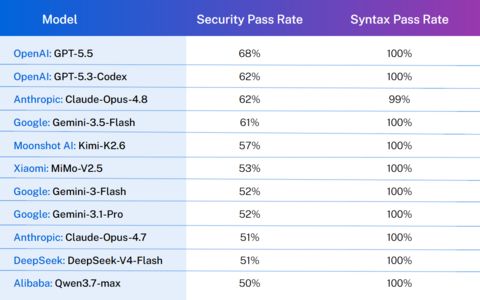
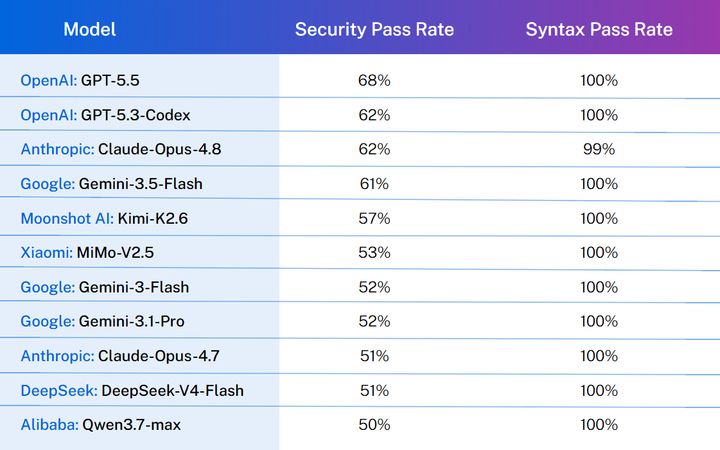
Fig. 1: The GenAI Code Security Report Leaderboard: Summer 2026
The contrast is stark: models generate compilable code at a near-universal syntax pass rate of ~100 percent. When it comes to security, they fail nearly 44 percent of the time when given no security-specific guidance.
“As AI-fueled code velocity increases, developers are becoming inundated with compliance risks, security alerts, and quality issues,” said Chris Wysopal, Co-founder and Chief Security Evangelist at Veracode. “We’re seeing a rapid increase in the adoption of AI-powered tools to write code and build software. But the root problem remains: models may be almost syntactically perfect, but they are still failing on nearly half of all tasks where security is needed. That number should be a red flag for any organization.”
The GenAI Code Security Report Leaderboard: Summer 2026
OpenAI’s GPT-5.5 leads this year’s report at 68 percent, while six of the 11 models cluster between 50 percent and 53 percent. Alibaba’s Qwen3.7-max comes last at 50 percent, generating vulnerable code every other output in this test. The best model available today still fails nearly one in three security tasks. Notably, previous editions of the report were dominated by Western AI models. That's no longer the case, with Kimi-K2.6 and MiMo-V2.5 outperforming several Western models. For enterprise security teams, model provenance is one more factor worth weighing in for procurement decisions, alongside security pass rate.
Models Built for Coding and Larger LLMs Aren’t Safer
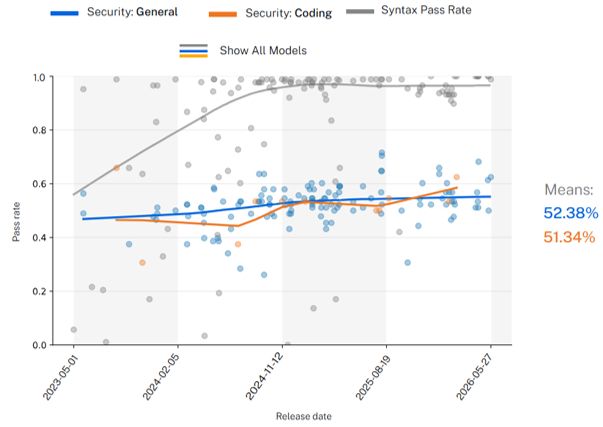
Two widely held assumptions don’t survive the data. First, models built specifically for writing software code are no more secure than general-purpose AI. Coding-specialized models averaged a 51 percent security pass rate, compared with 52 percent for general-purpose models. The tests were run against the raw models and not agents or production environments with additional tooling, guardrails, or human review in the loop. This means, developers who opt for coding-optimized tools on the assumption they’ll minimize security risk are actually shipping vulnerable code at the same rate as everyone else.
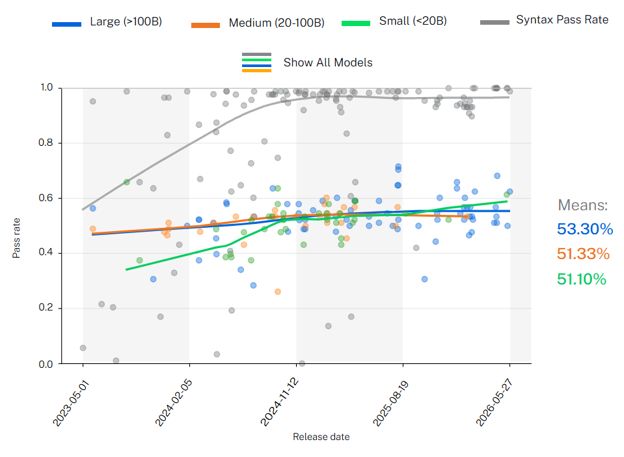
Second, model size has no impact on security performance. Large models (more than 100 billion parameters) average 53 percent, medium models average 51 percent, and small models average 51 percent. The one architectural factor that does help: reasoning models maintain a consistent security edge over non-reasoning models, at 56 percent versus 51 percent. This suggests extended reasoning functions as a form of internal code review.
Java Is Still Last — But It’s Moving in the Right Direction
Security pass rates by language range from Python at 63 percent down to Java at only 30 percent. Java remains the riskiest language for AI code generation by a significant margin. Despite sub-optimal performance, it is the only language with a clear, consistent upward trend over the past year.
“I’ve been vocal about making advanced AI models, like Claude Fable and Mythos, available to developers and defenders alike — and I stand by that position,” Wysopal closed. “The right answer is not restricting access; it’s transparent, evidence-based safety. What this research makes clear is that AI-generated code needs to be treated like any unreviewed code: scan it, fix it, and never ship it blind. Until LLMs reason about security the way they reason about syntax, guardrails in the development workflow aren’t optional.”
Managing Risk in the AI Era
Veracode recommends organizations take the following steps to address the security gap in AI-generated code:
- Integrate AI-powered tools like Veracode Fix into developer workflows to remediate security risks in real time.
- Embed security in agentic workflows to enforce secure coding standards automatically.
- Use Software Composition Analysis (SCA) to detect vulnerabilities from third-party and open-source dependencies in AI-generated code.
- Deploy Package Firewall to block vulnerable, malicious or non-compliant packages before they reach the development environment.
To download the full 2026 GenAI Code Security Report, visit the Veracode website. Attendees at Black Hat in Las Vegas August 4-7 are invited to visit booth #4927 to learn more about AI code security and the report’s findings.
About Veracode
Veracode is a global leader in Application Risk Management for the AI era. Powered by trillions of lines of code scans and a proprietary AI-assisted remediation engine, the Veracode platform is trusted by organizations worldwide to build and maintain secure software from code creation to cloud deployment. Thousands of the world’s leading development and security teams use Veracode every second of every day to get accurate, actionable visibility of exploitable risk, achieve real-time vulnerability remediation, and reduce their security debt at scale. Veracode is a multi-award-winning company offering capabilities to secure the entire software development life cycle, including Veracode Fix, Static Analysis, Dynamic Analysis, Software Composition Analysis, Container Security, Application Security Posture Management, Malicious Package Detection, Package Firewall, and Penetration Testing.
Learn more at www.veracode.com, on the Veracode blog, and on LinkedIn and X.
Copyright © 2026 Veracode, Inc. All rights reserved. Veracode is a registered trademark of Veracode, Inc. in the United States and may be registered in certain other jurisdictions. All other product names, brands, or logos belong to their respective holders. All other trademarks cited herein are property of their respective owners.
View source version on businesswire.com: https://www.businesswire.com/news/home/20260728207685/en/
Subscribe to releases from Business Wire
Subscribe to all the latest releases from Business Wire by registering your e-mail address below. You can unsubscribe at any time.
Latest releases from Business Wire
Nexo Reaffirms EU Compliance28.7.2026 16:00:00 CEST | Press release
The digital assets wealth platform announces sustained operations across the European Economic Area in the MiCA era Nexo, a leading digital assets wealth platform, today reaffirmed product compliance across the European Economic Area (EEA), achieved ahead of MiCAR’s entry into force. The company operates with a local setup through two MiCAR-licensed partners bringing technical depth and operational maturity to Nexo's client-facing platform in the region. This press release features multimedia. View the full release here: https://www.businesswire.com/news/home/20260728038475/en/ Nexo's setup pairs its global wealth platform with dedicated, licensed European infrastructure — splitting custody and brokerage across two regulated partners: Tangany, licensed under MiCAR, provides institutional-grade custody infrastructure for digital assets. Meanwhile, DLT Finance, licensed under MiCAR and authorized under MiFID II, provides brokerage infrastructure for digital assets and financial instrumen
Estée Lauder Announces New Fragrance, Glimmer, with Global Campaign Starring Hailee Steinfeld28.7.2026 16:00:00 CEST | Press release
Today, Estée Lauder announces the launch of Glimmer, a new prestige fragrance created for a new generation of consumers. An amber floral fragrance with a gourmand twist, Glimmer transforms the power of everyday "glimmers” - small moments of joy, hope, and connection - into a sensorial fragrance experience designed to inspire optimism, foster community, and leave a lasting impression. This press release features multimedia. View the full release here: https://www.businesswire.com/news/home/20260727469772/en/ Hailee Steinfeld stars as the face of Glimmer Acclaimed actress and singer Hailee Steinfeld stars as the face of Glimmer. Rooted in the belief that one spark can ignite many, the campaign positions Hailee and her singing voice as catalysts for the joy, optimism, and connection that are at the heart of Glimmer. “Hailee is the embodiment of what Glimmer represents; she is confident, has a contagious sense of joy, and understands the power of connecting with her community,” said Justin
Interactive Brokers Opens AI Connectivity to Any Tool Built on the MCP Standard28.7.2026 16:00:00 CEST | Press release
Clients can now connect their accounts to the AI tools they already use, built on the open Model Context Protocol standard Interactive Brokers (Nasdaq: IBKR), an automated global broker, today announced that clients can now connect their accounts to nearly any AI tool they already use. Previously limited to the certified marketplaces for ChatGPT, Claude, and Grok, clients can now also connect from a growing range of tools that support the Model Context Protocol (MCP), including Claude Code, Cursor, Perplexity, and Windsurf. MCP has become the common standard for connecting AI applications to outside services. Interactive Brokers' AI Integration has been built on MCP since launch, and clients can now connect from any MCP-compatible tool in addition to the certified marketplaces. “Interactive Brokers has long offered open APIs that let clients connect their accounts to the tools and systems they choose,” said Milan Galik, Chief Executive Officer of Interactive Brokers. “Supporting AI too
Mindbreeze InSpire Reduces Token Maxxing, Turning Runaway AI Costs Into Predictable Enterprise Value28.7.2026 15:03:00 CEST | Press release
By grounding generative AI in precise, governed enterprise knowledge, Mindbreeze InSpire cuts the wasted tokens that inflate AI budgets and erode answer quality. Mindbreeze, a leading global provider of AI-based knowledge management solutions, today announced that Mindbreeze InSpire reduces token maxxing, the costly overconsumption of large language model (LLM) tokens that is straining enterprise AI budgets. By retrieving only the most relevant, grounded content and passing it to LLMs with precision, Mindbreeze InSpire lowers the tokens required per answer while improving accuracy, giving enterprises a path to scalable AI with predictable economics. Token maxxing has become one of the most underestimated risks in enterprise AI. As organizations connect generative AI to their data, many default to injecting large volumes of undifferentiated context into every prompt, repeatedly, across thousands of queries. Industry analysis has warned that tokens are becoming the true unit of AI cost,
Uptime Institute 16th Annual 2026 Global Data Center Survey: Deployment of High Density Racks Rising Fast, Operators Face Continued Recruiting and Retention Pressures28.7.2026 15:02:00 CEST | Press release
Uptime Institute today released the findings of its 16th Annual Global Data Center Survey, the most comprehensive study of the digital infrastructure sector. The 2026 results reveal an industry navigating workforce constraints, escalating outage expenses, even as rising costs remain the top concern for management teams. Financial Pressure and Resource Constraints Intensify: While high costs continue to be a primary concern for data center leaders, the 2026 survey also highlights escalating concerns over capacity forecasting, power availability, and supply chain disruptions. Power efficiency gains remain gradual. The industry saw minor improvements in average Power Usage Effectiveness (PUE) levels this year. While newer facilities may boast highly efficient designs, overall global progress is slowed by legacy infrastructure. The AI and Density Reality Check: Despite market enthusiasm for Artificial Intelligence, expectations for AI in data center operations cooled slightly in 2026. Oper
In our pressroom you can read all our latest releases, find our press contacts, images, documents and other relevant information about us.
Visit our pressroom