
Village Enterprise
10.6.2026 14:00:00 CEST | Globenewswire | Press release
Pioneering evidence shows how entrepreneurship model can reduce extreme poverty among refugees
Pioneering evidence shows how entrepreneurship model can reduce extreme poverty among refugees
- New studies show DREAMS program boosts incomes, savings, and resilience in refugee communities across East Africa
- The IKEA Foundation has committed $7.4m to fund the next stage of DREAMS in Ethiopia while the Conrad N. Hilton Foundation has granted $3.5m in funding for the next stage of DREAMS in Uganda
NAIROBI, Kenya, June 10, 2026 (GLOBE NEWSWIRE) -- New evidence released today shows that a combined approach of entrepreneurship support and market access can significantly reduce extreme poverty among refugees and host communities in East Africa.
Two randomized controlled trials (RCTs) of the DREAMS (Delivering Resilient Enterprises and Market Systems) program—implemented by Village Enterprise and Mercy Corps—found that participating households saw meaningful economic gains within a year, even in some of the world’s most challenging refugee settings.
The studies, conducted by independent evaluator IDinsight, found that compared to a control group, DREAMS participants increased:
- Monthly household consumption by 17% in Uganda and 9% in Ethiopia
- Savings by over 90% in both countries, strengthening financial buffers and resilience to economic and climate shocks
- Household assets by 20–24%, as participants acquired livestock, built homes, and invested in tools.
The program reached more than 22,000 households across some of the largest refugee settlements in the world—Rhino Camp and Bidi Bidi in Uganda’s West Nile region and three refugee settlements in Dollo Ado, Ethiopia.
DREAMS combines Village Enterprise’s 12-month poverty graduation program—which equips ultra-poor households with the skills, financial capital, and mentoring needed to start businesses—with market systems development (MSD), delivered by the global humanitarian and development organization Mercy Corps. MSD promotes connections with local private sector actors in key industries to strengthen local markets.
At a time of unprecedented cuts to humanitarian aid, the findings point to a highly cost-effective, scalable model that supports refugees and host communities to move beyond aid dependence, create sustainable livelihoods, and provide for their families and children.
Jjumba Martin for Village Enterprise
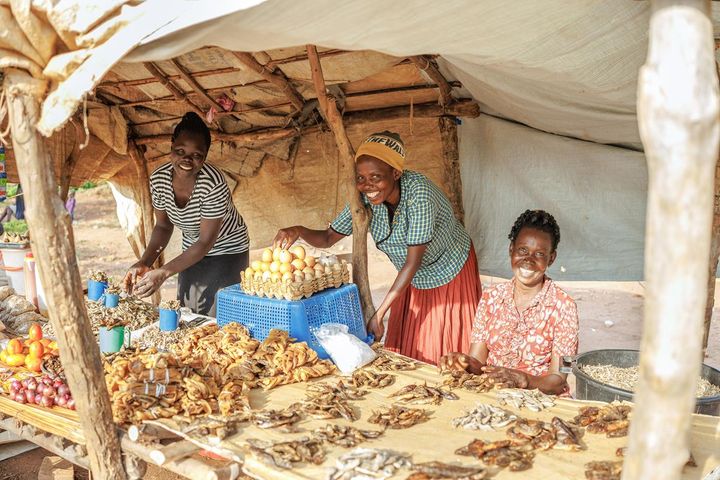
People participating in DREAMS reported meaningful changes in their lives such as being able to buy more nutrient-rich foods such as beef, fish, and milk, as well as pay for the costs of sending their children to school, including paying for fees, books, and transportation. Viola first arrived in the Bidi Bidi refugee settlement from South Sudan and now owns a hair salon. “I had to carry my one-year-old daughter, and our hunger and fatigue made the journey even harder. We arrived in Uganda with nothing,” she said. “I didn’t know that I could change like this. I think of the day I fled my home and how far I’ve come, and I’m amazed.”
Nurina, a refugee from Somalia who now lives in Ethiopia, said: “Because of my disability, I used to prefer to stay in one place. I felt isolated. My neighbors used to underestimate me, and I wasn’t perceived as important. But now they see that I can earn a living, save money, and provide for my children. They come to me for advice. They ask me to explain what I’ve learned from Village Enterprise. This program was a turning point for my entire family.”
The boost to household assets—20% higher than control groups in Uganda and 24% higher in Ethiopia—included livestock, agricultural tools, and investments in housing and solar panels, as well as furniture such as mattresses, beds, and tables.
A development blueprint
The RCTs have measured the impact of the program in Uganda and Ethiopia, but demonstrate the potential of this solution for the 8.7 million people living in refugee settlements globally.
Recognizing the success of DREAMS, the program will continue to be supported:
- In Ethiopia—by the IKEA Foundation, which has committed $7.4 million to fund the next stage of DREAMS and further embed the program into local government systems. A key focus of the grant will be to evaluate why the program works in different contexts, and optimizing the approach to be able to scale in these complex settings.
- In Uganda—by the Conrad N. Hilton Foundation’s commitment of $3.5 million for DREAMS’ next stage through March 2029, as well as an evaluation of how DREAMS can embed into existing early childhood development programs across Uganda, Kenya, Tanzania, and Mozambique.
As climate change and conflict drive increased mass displacement, DREAMS showcases how host countries can support refugees to generate income, create sustainable livelihoods, and contribute to local economies. In both Ethiopia and Uganda, the RCTs found DREAMS is projected to yield twice the value of its costs through increased household consumption and asset accumulation if effects are sustained for five years.
Sazini Mojapelo, CEO of Village Enterprise, said: “At a time when humanitarian budgets are shrinking, we need solutions that deliver real, lasting results for the millions of refugees worldwide. DREAMS shows that with the right support, refugees and host communities living in extreme poverty can build businesses, grow their incomes, and provide for their families—ultimately, reducing their reliance on aid. We’re grateful to the IKEA Foundation and the Hilton Foundation for their continued support of this work and helping bring DREAMS to more communities and refugees in Ethiopia and Uganda.”
Tjada McKenna, CEO of Mercy Corps, said: “Lasting change doesn’t come from aid alone; it comes from access to opportunity. This evidence shows that when refugees are connected to functioning markets, supply chains, and customers, they build, earn, and contribute. If we want a future where everyone can prosper, we need to invest in the systems that make that possible.”
Alison Connor, Chief Impact Officer at IDinsight, said: “Rigorous evidence on what works for refugees remains scarce, and this evaluation adds meaningfully to that gap. We tested what happens when poverty graduation and market systems development are combined in refugee settings. Across Uganda and Ethiopia, participating households saw meaningful gains in consumption, income, savings, and assets within months of program completion, at returns that compare favorably to other livelihood programs in the region. As the humanitarian sector faces difficult funding decisions, findings like these can help direct resources toward approaches with a credible evidence base.”
Rediet Abiy Kassaye, Programme Manager at the IKEA Foundation, said: “These results show what is possible when refugees and host communities are given the opportunity to rebuild their lives with dignity, stability, and hope. We are proud to support the next phase of DREAMS in Ethiopia and to continue working alongside Village Enterprise and Mercy Corps to help families recover from displacement and create new opportunities for themselves and their communities. Together, we see the potential for small businesses and vibrant local markets to create lasting opportunities for families and communities for generations to come.”
Barri Shorey, Senior Program Officer, Refugees, Disasters and Aviation at the Conrad N. Hilton Foundation, said: “DREAMS demonstrates the power of investing in long-term economic solutions for refugees and host communities. We’re proud to support the next phase of this work in Uganda because the model helps families build sustainable livelihoods, strengthen household stability, and create healthier futures for their children—a true two generation approach! Integrating DREAMS with early childhood development efforts across East Africa creates an opportunity to support caregivers and young children together, helping families build more secure and productive futures.”
Notes to Editors
- About the DREAMS program
- As part of Village Enterprise’s poverty graduation model, participating households were organized into business savings groups of 30 households, designed to encourage them to pool savings, support each other, and issue small loans.
- Mercy Corps connected the businesses with private sector actors in key industries including poultry, sunflower, soybean, sesame, and sheep and goat fattening.
- Households were encouraged to set up multiple businesses across the key industries, allowing them to be more resilient against setbacks caused by common threats such as crop failure, extreme weather, poultry mortality due to disease, and theft.
- While the control groups in both Uganda and Ethiopia did not receive any funding, and remained reliant on previous income avenues, some experienced indirect benefits from the program. Some control households informally accessed funding by borrowing money or getting goods on credits through friends and neighbors enrolled in the program.
- About the RCT in Uganda
- Village Enterprise equipped 12,000 households with business training, $204 in seed capital (in two installments), and ongoing mentorship to start and sustain businesses.
- The seed capital was shared between business groups of three households, which in turn were included in the business savings groups.
- 6,560 households participated in the RCT, which was conducted between 2022 and 2025, and the 12-month DREAMS program was rolled out to staggered cohorts throughout this time.
- To ensure the program did not contribute to local inflation, cohorts were staggered to begin four months after the start of the cohort before. You can read the RCT results in full here.
- These results are based on the findings from the first endline survey, conducted between April and July 2025, capturing outcomes short to medium term results approximately six to 18 months after the participants had finished the program.
- A second survey is planned to take place one year later, in 2026, to measure the longer-term impacts of the program.
- About the RCT in Ethiopia
- Village Enterprise equipped 10,800 participants in Dollo Ado with business training, $500 in seed capital, and mentoring to start and sustain businesses.
- The seed capital was shared between business groups of three households, which in turn were included in business savings groups.
- The RCT in Ethiopia was conducted by IDinsight between 2023 and 2026 and evaluated the impact of the poverty graduation model in communities where Mercy Corps was strengthening market systems development, as well as the full DREAMS program, on household economic productivity and welfare, perceived well-being, and women’s empowerment among refugee and host households.
- 6,151 households participated in the RCT, of which 2,050 received the full DREAMS program.
- These results are based on the findings from the first endline survey, with data collected between October and December 2025, capturing outcomes approximately six to 18 months after implementation.
- You can read the RCT results in full here.
About Village Enterprise
Village Enterprise’s mission is to end extreme poverty in rural Africa through entrepreneurship, innovation, and collective action. We work with vulnerable women, refugees, and youth who are most impacted by climate change, conflict, and displacement, and equip them with skills and resources to launch climate-smart businesses, build savings, and put themselves and their families onto a sustainable path out of extreme poverty. Village Enterprise has started over 119,000 businesses and positively transformed the lives of over 2.3 million people in Ethiopia, Kenya, Rwanda, Uganda, Congo-Brazzaville, the Democratic Republic of the Congo, Madagascar, Mozambique, Nigeria, and Tanzania.
About Mercy Corps
Mercy Corps is a global team of nearly 4,300 humanitarians working to create a world where everyone can prosper. 95% of our team members are from the countries where they work. In 46 countries affected by conflict, disaster, poverty, and climate change, we work alongside communities, local governments, forward-thinking corporations, and social entrepreneurs to meet urgent needs and develop long-term solutions to make lasting change possible. In 2025, Mercy Corps reached over 36.5 million people. Learn more at www.mercycorps.org.
About IDinsight
IDinsight is a global nonprofit that equips leaders with the data, evidence, and technology to improve lives at scale. We partner with governments, NGOs, and funders to support decisions at every stage of the impact journey – from bold pilots to nationwide scale-ups. Our teams bring rigorous evidence, cutting-edge methods, and practical insights, so leaders can design and deliver programs that truly change lives.
Media contact:
villageenterprise@wearesevenhills.com
+44 7388 003595
A photo accompanying this announcement is available at https://www.globenewswire.com/NewsRoom/AttachmentNg/6044f789-0bf6-4524-9715-9f9f68a92f53
Subscribe to releases from Globenewswire
Subscribe to all the latest releases from Globenewswire by registering your e-mail address below. You can unsubscribe at any time.
Latest releases from Globenewswire
Urteste S.A.10.6.2026 15:20:25 CEST | Press release
Urteste S.A. enrolls the first patient in the Panuri test clinical study
Aduro Clean Technologies Inc.10.6.2026 15:17:34 CEST | Press release
Aduro Clean Technologies Announces Pricing of US$15.64 Million Underwritten Public Offering and Concurrent Private Placement of up to US$7.17 Million
GetYourGuide10.6.2026 15:12:34 CEST | Press release
GetYourGuide joins Sagrada Família for the blessing of the Tower of Jesus Christ as an official collaborator
Newcap Holdings10.6.2026 15:10:27 CEST | Pressemeddelelse
Indberetning af ledende medarbejderes og disse nærtståendes transaktioner med NewCap Holding A/S aktier
Newcap Holdings10.6.2026 15:04:49 CEST | Pressemeddelelse
Gennemførelse af kapitalforhøjelse, nom. kr. 321.800 / Implementation of capital increase, nom. DKK 321.800
In our pressroom you can read all our latest releases, find our press contacts, images, documents and other relevant information about us.
Visit our pressroom