
Europeans call for greater independence: Support for U.S. as Europe’s Top Ally Drops Sharply
7.5.2026 08:00:00 CEST | Bertelsmann Stiftung | Press release
Europe is rethinking its place in the world. After decades of close cooperation with the United States, nearly three in four EU citizens now say the Union should ‘go its own way’. A clear majority of Europeans do not see the U.S. as a trustworthy partner any longer. A year and a half into the Trump presidency, the share of respondents identifying the U.S. as Europe’s most valuable ally has fallen by 20 percentage points. While China fails to gain ground as an alternative partner, Europeans are recalibrating alliances within the West.
A new study by Bertelsmann Stiftung illustrates this shift.
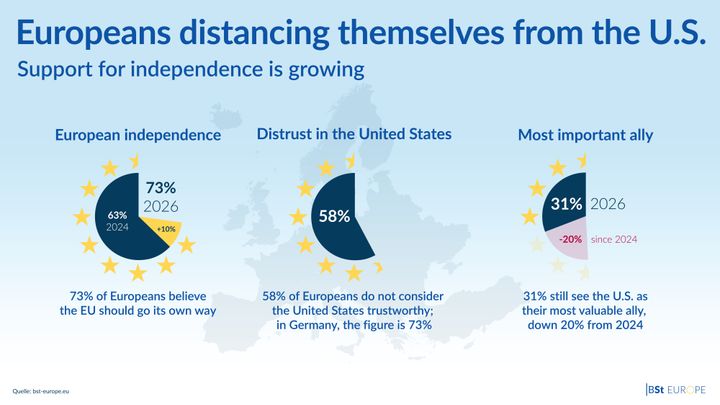
Gütersloh/Berlin – Ahead of this year’s Europe Day on May 9, Europeans are edging towards a strategic reset. A new study by Bertelsmann Stiftung, based on surveys conducted between September 2024 and March 2026, shows a continent willing to stand on its own feet. 73 percent of EU citizens now say the Union should go its own way after decades of close alignment with the United States; up from 63 percent in 2024. The shift cuts across all demographic groups, with particularly strong gains among older Europeans.
The Trump presidency has left deep scars on the transatlantic relationship. Trust in the United States is low, with 58 percent of Europeans now saying they do not see Washington as a trustworthy partner. While the U.S. remains the EU’s most important ally in relative terms (31 percent), its standing has fallen by 20 percentage points since 2024. A polarizing American president and mounting geopolitical tensions have pushed European public opinion towards a more self-reliant stance.
Yet, Europe’s search for independence does not translate into a shift towards Beijing. China is viewed with persistent skepticism. Large majorities support reducing dependencies; even at economic costs. Instead, preferences are shifting within the existing alliance system. The United Kingdom and Canada are gaining importance as strategic partners, suggesting that Europeans are rebalancing rather than abandoning the transatlantic framework. Support for NATO remains solid, with clear majorities seeing it as a cornerstone of security (63 percent).
Florian Kommer, Senior Expert for European Strategic Issues at the Bertelsmann Stiftung, argues: “The message ahead of this year’s Europe Day is unmistakable: Europeans want to become more independent from the United States. Trust has eroded, America’s standing as Europe’s central partner has fallen. The partnership is not beyond repair, but our data point to a deeper, structural rift in transatlantic relations. European citizens are calling for greater independence, notably in foreign and security policy. Policymakers need to translate this call into detailed policies and a real investment in Europe’s own capabilities.”
Brandon Bohrn, Senior Expert for Transatlantic Relations at the Bertelsmann Stiftung, adds: “In this context, building a stronger and more self-reliant Europe goes hand in hand with expanding its partnerships to ensure greater resilience and strategic stability.”
For more information: www.eupinions.eu.
Keywords
Contacts
Brandon Bohrn
Tel:+49 30 275788-174brandon.bohrn@bertelsmann-stiftung.deImages
Subscribe to releases from Bertelsmann Stiftung
Subscribe to all the latest releases from Bertelsmann Stiftung by registering your e-mail address below. You can unsubscribe at any time.
Latest releases from Bertelsmann Stiftung
Europe’s IPO problem starts before the stock ex-change: New study calls for deeper markets, more investment and larger listings15.9.2026 09:00:00 CEST | Press release
Europe is losing the IPO race. Its companies are going public at too small a size. The number of new companies listing in Europe is behind that of the US and their value has dropped over the last decade. Europe faces a ‘scale-up gap’: while it produces innovative startups, they struggle to grow across Europe and access capital for their expansion. Strong public equity markets provide capital to promising firms and an ‘exit’ for venture capital and private equity investors.
A decade after the Brexit referendum: Time for European pragmatism22.6.2026 09:25:50 CEST | Press release
On June 23, 2016, British voters chose to leave the European Union, sending shockwaves across the continent. To mark the anniversary, the Bertelsmann Stiftung is publishing exclusive data tracking public opinion in the UK and the EU over the past ten years. The findings suggest that Brexit has neither triggered further EU fragmentation nor driven British and European public opinion permanently apart. Instead, they point to a shared preference for pragmatic cooperation.
More Autocracies Worldwide - But Democratic Resistance Is Growing26.3.2026 08:00:00 CET | Press release
Democracy is on the defensive. This is shown by the Bertelsmann Stiftung's Transformation Index 2026 (BTI). The BTI was first surveyed twenty years ago, when democracies were still in the majority. Today, 56 percent of the 137 countries surveyed by the BTI are ruled autocratically. However, this rarely leads to better governance. Autocracies are more susceptible to corruption, less capable of shaping the future, and less consensus-oriented. However, examples such as Poland and Brazil show that social resistance and political competition can pave the way back to democracy.
How the CO2 price will affect heating costs in Europe22.1.2026 08:00:00 CET | Press release
The EU-wide uniform CO2 price for the building and transport sectors planned from 2028 will change the heating costs of 100 million households. A study by the Bertelsmann Stiftung shows that in many countries, including Germany, the additional burdens are likely to be limited. In Scandinavia, households could even see some relief. But in some Central and Eastern European regions, heating costs would go up noticeably. The study also shows that if the money from CO2 pricing is used the right way, it is enough to ease the burden households facing the greatest burden.
European Network for Technological Resilience and Sovereignty (ETRS) to strengthen Europe’s Digital Future17.11.2025 10:00:00 CET | Press release
On the eve of the Summit on European Digital Sovereignty in Berlin, leading European think tanks and experts announce the creation of the European Network for Technological Resilience and Sovereignty (ETRS). This new initiative unites research, policy, and industry to boost Europe’s capacity for innovation and independence in key technologies like AI, cloud infrastructure, and semiconductors. ETRS aims to build the evidence base, foster collaboration, and shape policy for a resilient and values-driven digital future.