
AI-driven Bot Attacks Surged 12.5x According to Thales Bad Bot Report
29.4.2026 09:00:00 CEST | Business Wire | Press release
AI-driven automation is accelerating machine activity online as bots outpace humans and redefine how the internet operates Bots now dominate the internet, accounting for over half of all traffic, with 40% classified as malicious. AI is erasing the line between legitimate and malicious activity, making intent - not identity - the new security challenge. APIs and identity systems are primary targets, with attackers bypassing front-end defenses to exploit core business logic at scale.
Thales today released the 2026 Bad Bot Report: Bad Bots in the Agentic Age, revealing a fundamental shift in how the internet operates, as AI-accelerated automation becomes a defining feature of modern digital infrastructure.
This press release features multimedia. View the full release here: https://www.businesswire.com/news/home/20260428783532/en/
©Thales
The findings highlight three major structural changes: the emergence of AI agents as a new category of internet traffic, the dominance of automated activity over human interaction, and the rapid expansion of attacks targeting APIs and identity systems that serve as the backbone of digital business.
AI Is Redefining Internet Traffic and Security
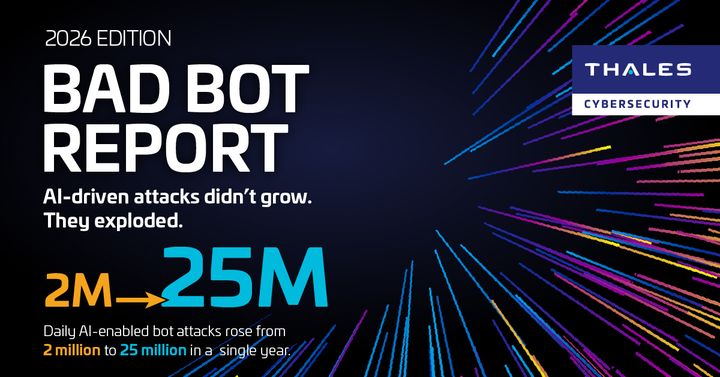
The report shows that AI is not just increasing the volume of bot activity, but fundamentally changing its nature. In 2025, AI-driven bot attacks surged 12.5x compared to the previous year.
More significantly, AI agents are now emerging as a third category of traffic, alongside traditional “good” and “bad” bots, interacting directly with applications and APIs to retrieve data and perform tasks. This shift is blurring the line between legitimate and malicious automation, making it increasingly difficult for organizations to determine intent.
“AI is transforming automation from something organizations try to block into something they must also manage,” Tim Chang, Global Vice President and General Manager, Application Security at Thales, said. “The challenge is no longer identifying bots. It’s understanding what the bot, agent, or automation is doing, whether it aligns with business intent, and how it interacts with critical systems.”
This evolution is creating a growing visibility gap. Much of today’s AI-driven activity remains unverified or indistinguishable from legitimate traffic, meaning organizations are operating with an incomplete view of the risks they face.
Bots Increasingly Outnumber Humans Online
The report shows automation tightening its grip on the internet, with bots continuing to outpace human activity. In 2025, bots made up more than 53% of all web traffic, up from 51% the previous year, while human activity fell to 47%. This reflects a structural shift rather than a temporary trend, with bots no longer tied to specific events like scraping or credential stuffing campaigns, but instead operating as a persistent and expected presence across digital environments.
APIs and Identity Systems Become the Primary Attack Surface
As digital services increasingly rely on APIs to power core functionality, attackers are following suit. The report finds that 27% of bot attacks now target APIs, where bots can bypass user interfaces and interact directly with backend systems at machine speed.
These attacks often appear legitimate, using valid authentication and well-formed requests, but exploit business logic, extract sensitive data, or manipulate workflows at scale. The impact is especially pronounced in high-value sectors. Financial services accounted for 24% of all bot attacks and 46% of account takeover incidents, underscoring how automation is being used to directly monetize cyberattacks.
A New Era of Machine-Driven Interaction
As AI adoption accelerates, the report reveals that the internet is now fundamentally machine driven. Bots are no longer simply tools used by attackers; they are active participants in digital systems, shaping traffic patterns, influencing business metrics, and interacting with systems in real time. In this environment, the ability to manage automation at scale with precision is critical to maintaining security, performance, and trust.
Confronting the Rise of Uncontrolled Automation
The report concludes that traditional security approaches focused on identifying and blocking bots are not sufficient in an environment where automation is both pervasive and often legitimate. Organizations must move toward a governance-based model, combining visibility, policy enforcement, and behavioral analysis to distinguish between acceptable and harmful automation. This includes defining which AI agents are allowed to interact with systems, implementing controls at the API and identity layer, and designing defenses that can adapt as bots evolve.
For more information and recommendations, please download the full report and join our webinar to learn more about technologies that can be deployed against malicious bots.
Methodology
The 2026 Thales Bad Bot Report analyzes full-year 2025 bot activity using data from Thales Threat Research and Security Analyst Services teams. The report examines how automation, powered by AI, is reshaping application security, API exposure, and digital infrastructure globally.
About Thales
|
PLEASE VISIT
Thales Group
Cybersecurity Products | Thales Group
Cybersecurity Solutions | Thales Group
View source version on businesswire.com: https://www.businesswire.com/news/home/20260428783532/en/
Subscribe to releases from Business Wire
Subscribe to all the latest releases from Business Wire by registering your e-mail address below. You can unsubscribe at any time.
Latest releases from Business Wire
Phase 3 RAINIER Results Supporting Best-in-Class Potential of Povetacicept in IgA Nephropathy Published in the New England Journal of Medicine and Presented at the American Society of Nephrology Kidney Week 202623.10.2026 19:42:00 CEST | Press release
- Vertex is on track for the U.S. FDA Prescription Drug User Fee Act (PDUFA) date of November 30 for potential accelerated approval of povetacicept –- Data published in NEJM and presented at ASN highlight povetacicept’s unique trifecta of efficacy, favorable safety, and the simplicity of dosing at-home every 4 weeks with a low-volume autoinjector –- Data presented at ASN include a qualitative study examining patient perspectives on current and emerging IgAN therapies, showing that 96% of participants preferred an autoinjector over a prefilled syringe, and 80% of participants preferred dosing every 4 weeks versus weekly dosing - - New clinical studies of povetacicept underway including a study evaluating patient experience on povetacicept administered via autoinjector - Vertex Pharmaceuticals Incorporated (Nasdaq: VRTX) today announced the publication of Phase 3 RAINIER results for povetacicept in the New England Journal of Medicine (NEJM), presentation of these data at the American Soc
BeOne Medicines Reports Sustained Survival Benefit with TEVIMBRA-ZIIHERA Combination in First-Line HER2+ Gastroesophageal Cancer23.10.2026 16:15:00 CEST | Press release
New data from HERIZON-GEA-01 Phase 3 trial show 36-month overall survival of nearly 40% with TEVIMBRA plus ZIIHERA and chemotherapy, and median OS reaching 27 monthsTEVIMBRA-containing arm was associated with a four-month longer median OS compared with ZIIHERA plus chemotherapy BeOne Medicines Ltd. (Nasdaq: ONC; HKEX: 06160; SSE: 688235), a global oncology company, today announced new survival results from the planned second interim analysis (IA2) and final formal analysis of the Phase 3 HERIZON-GEA-01 trial, further confirming the benefit of TEVIMBRA® (tislelizumab) plus ZIIHERA® (zanidatamab) and chemotherapy as first-line treatment for patients with HER2-positive locally advanced or metastatic gastroesophageal adenocarcinoma (GEA). The results will be presented today as a late-breaking abstract during a rapid oral session at the European Society for Medical Oncology (ESMO) Congress 2026 in Madrid, Spain (LBA79). Mark Lanasa, M.D., Ph.D., Chief Medical Officer, Solid Tumors at BeOne,
Lifezone Metals Confirms Advanced Negotiations with Orion CMC on Kabanga Nickel Project23.10.2026 16:10:00 CEST | Press release
Lifezone Metals Limited (NYSE: LZM) notes comments made today by Oskar Lewnowski, Founder and Group Chief Executive of Orion Resource Partners, in an interview with Bloomberg Television regarding the Company’s Kabanga Nickel Project in Tanzania. In response to inbound inquiries from media outlets and investors following the interview, the Company can confirm that negotiations with Orion Critical Mineral Consortium (Orion CMC) regarding a significant equity investment into the Kabanga Nickel Project are at an advanced stage. The Orion CMC is a global investment platform launched by Orion Resource Partners in partnership with the U.S. International Development Finance Corporation (DFC) and Abu Dhabi's sovereign investor ADQ. As previously announced, the Company has been running a competitive process, led by Standard Chartered Bank, to secure a strategic investment into the Kabanga Nickel Project. Social Media LinkedIn | X | YouTube About Lifezone Metals Lifezone Metals (NYSE: LZM) is com
inDrive and Pony.ai Announce Collaboration to Explore Autonomous Mobility in Kazakhstan Built on NVIDIA Hyperion23.10.2026 15:00:00 CEST | Press release
Collaboration will establish the roadmap for bringing Pony.ai robotaxis to Kazakhstan on the inDrive ride-hailing platform, leveraging the NVIDIA Hyperion and the NVIDIA Halos safety system. inDrive, the global mobility and delivery platform, today announced it has signed a memorandum of understanding (MOU) with NVIDIA and Pony.ai, a global leader in the large-scale commercialization of autonomous driving technology, to explore the future of autonomous ride-hailing. Kazakhstan will serve as the first test market. This press release features multimedia. View the full release here: https://www.businesswire.com/news/home/20261023143469/en/ inDrive partners with Pony.ai and NVIDIA to explore autonomous mobility in Kazakhstan Kazakhstan was chosen first for its regulatory readiness following the creation of the country’s first structured legal framework for driverless transport, as part of its “Year of Digitalization and Artificial Intelligence.” Combined with Kazakhstan’s position as a lea
Brenus Pharma's Novel In Vivo Immunotherapy STC-1010 Shows Safety, Activating T Cells in First-Line MSS Metastatic Colorectal Cancers With 2 Complete Responses.23.10.2026 14:50:00 CEST | Press release
Phase Ia BreAK CRC-001 at ESMO 2026: 43% of patients, all initially unresectable, became eligible for surgery Poster 1023P – Developmental Therapeutics Brenus Pharma, a clinical-stage biotech company, announced first data from the Phase Ia dose escalation of BreAK CRC-001. Nine unresectable patients were treated; 89% had liver metastases and 89% KRAS-mutant tumors, a population refractory to immunotherapy. Median follow-up: 8 months (1–14; data cut-off 6/08/2026). 95% of metastatic colorectal cancers are pMMR/MSS tumors, poorly immunogenic and resistant to immunotherapy. STC-1010, the company’s lead in vivo DC-engager, is designed to make these “cold” tumors visible to immune cells. Safety: no dose-limiting toxicity, only grade 1–2 related adverse events. Clinical activity (seven evaluable patients, RECIST 1.1): 100% disease control, 57% objective response rate (4/7). 43% of patients became operable (3/7): two with no evidence of disease afterward. Molecular profile: ctDNA dropped by u
In our pressroom you can read all our latest releases, find our press contacts, images, documents and other relevant information about us.
Visit our pressroom