
Danish Drone Breakthrough: First Autonomous Inspection of Operational Offshore Wind Turbines Demonstrated
15.1.2026 10:00:00 CET | Energy Cluster Denmark | Press release
The Danish startup Quali Drone has in collaboration with the offshore wind developer and operator RWE and several other partners successfully inspected offshore wind turbine blade damages using autonomous drone technology, while the blades rotate. The solution significantly increases safety and reduces the cost and CO₂ emissions associated with blade inspections.
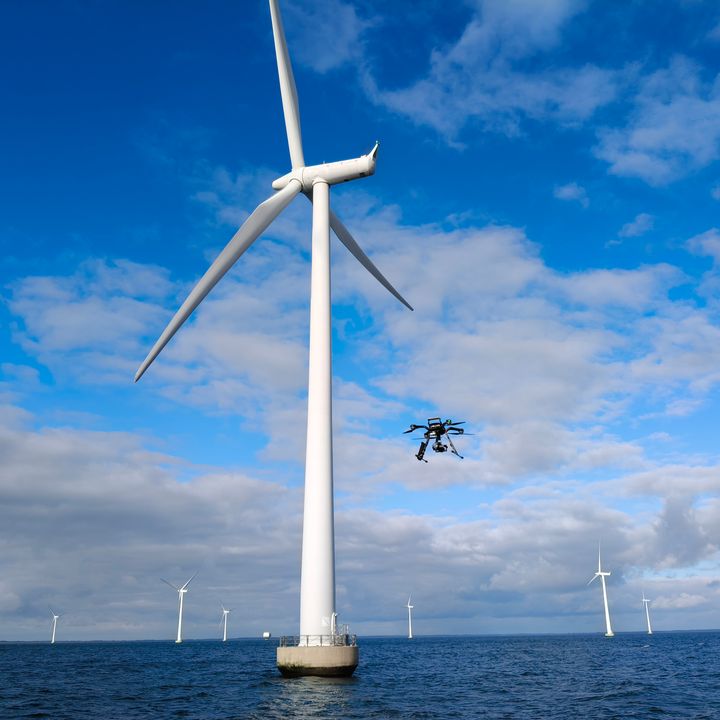
In order to examine the condition of wind turbine blades, inspections of blade damages are usually carried out when the turbine has been stopped. In the AQUADA-GO project, the partners have developed a drone technology for automated, contact-free, real-time blade damage detection, while the turbine is spinning. Inspections that are done without stopping the turbine’s normal operation can help save turbine downtime. Now, for the first time ever, the operational concept has been successfully demonstrated offshore.
“We have proven that it is possible to autonomously inspect offshore wind turbines with a drone of a certain size equipped with a visual camera, while the turbine is in operation. This is a major accomplishment for us. We have worked on everything from developing drone software and hardware to mission planning and online data infrastructure. Now, we have a commercially ready solution that can be tailored to wind farm operators’ needs and make inspections easier, faster and more cost-effective,” says Jesper Smit, CEO, Quali Drone.
Drone-based blade inspection delivers significant savings
The core idea of the project is to combine drone technology with thermography and computer vision, enabling detection of surface damage and potential subsurface fractures on operational offshore wind turbine blades. This saves wind farm operators considerable costs due to increased efficiency, while also reducing CO₂ emissions and improving inspection safety.
The new technology has been successfully demonstrated several times onshore by the project partners, which, in addition to Quali Drone and RWE, include Statkraft, TotalEnergies, DTU and Energy Cluster Denmark. Most recently, the solution has been demonstrated offshore with visual drone footage of blade damage on the surface at Rødsand 2 Offshore Wind Farm, operated by RWE since 2010 and located south off the coast of Lolland, Denmark.
“For the first time, we have successfully carried out a drone inspection of offshore wind turbines in operation. This is good news for the entire wind industry. Through the technology developed in AQUADA-GO, we can see the potential of monitoring blade conditions without stopping the offshore turbine. This could help to increase efficiency in our production of green electricity and to further improve safety for our employees. By using drones for autonomous inspections, we expect that downtimes and costs can be significantly reduced in the long run,” says Marcus Mejborn, General Manager of Rødsand 2 Offshore Wind Farm, RWE.
AQUADA-GO technology and AI model show great potential
The project is based on the AQUADA technology developed in DTU Wind Energy’s laboratory. DTU has developed an AI model that helps the drone automatically identify wind turbine blade abnormalities to indicate critical damage using AI algorithms and infrared imaging. The AI model, which is trained and improved with new inspection data each time the drone is deployed at wind farms, shows great potential.
“We have developed an AI model that uses deep learning algorithms and computer-vision technology based on thermomechanical models to assist the drone in detecting blade defects – both on the blade surface and below it. We have tested the technology multiple times at onshore wind farms operated by DTU, RWE and Statkraft, and each campaign has fed the AI model with new data that has made it better. We are very pleased with the results and see great potential for future implementation within the wind industry,” says Xiao CHEN, Associate Professor and Head of Section, DTU Wind and Energy Systems, and Project Technical Lead in AQUADA-GO.
Facts about the project
The AQUADA-GO innovation project runs from 2022 to March 2026 with a total budget of DKK 17,796,010 and is supported by EUDP – the Energy Technology Development and Demonstration Program. The project partners include Quali Drone, the Technical University of Denmark, RWE, Statkraft, TotalEnergies and Energy Cluster Denmark.
Read more about the project here: https://energycluster.dk/en/projects/aquada-go
Do you have questions? Contact Gitte Wad, Project Manager, Energy Cluster Denmark at gwa@energycluster.dk or +45 3152 7516.
Contacts
Michelle Amby DegnEnergy Cluster Denmark
Tel:+45 22278599mad@energycluster.dkImages
Links
About Energy Cluster Denmark:
Energy Cluster Denmark works with innovative solutions for the global energy system.
As the cluster organization for the entire energy sector, Energy Cluster Denmark serves as a neutral platform for innovative partnerships in development and demonstration projects that reduce global CO2 emissions and enhance the competitiveness of the energy sector.
Energy Cluster Denmark has more than 500 members, including small and large companies, knowledge institutions, utility companies, public authorities, and others who aim to make a green impact through effective innovation projects.
Subscribe to releases from Energy Cluster Denmark
Subscribe to all the latest releases from Energy Cluster Denmark by registering your e-mail address below. You can unsubscribe at any time.
Latest releases from Energy Cluster Denmark
Pyrolyse, droneinspektion og AI til vedligehold: Her er kandidaterne til Årets Innovationsprojekt 20269.4.2026 10:00:00 CEST | Pressemeddelelse
Tre innovationsprojekter fra Energy Cluster Denmark er nomineret til Årets Innovationsprojekt 2026. Temaerne spænder bredt mellem droner til vindmølleinspektion og pakkelevering, kunstig intelligens til tjek af offshore installationer og pyrolyseanlæg til CO2-fangst og grønne brændsler. Vinderen kåres på energiklyngens Årsmøde d. 13. maj 2026 i Aalborg.
Se programmet: Energy Cluster Denmarks Årsmøde 2026 samler energisektoren i Aalborg6.3.2026 14:05:05 CET | Pressemeddelelse
D.12.-13. maj 2026 samler Energy Cluster Denmark energisektoren i Aalborg til to dage med faglige oplæg, debatter og masser af netværk.
Fra havvind til komplette vedvarende energisystemer18.2.2026 08:45:00 CET | Pressemeddelelse
Aegir Insights udvider sin investeringssoftware og går hybrid. Nyudviklet software inkluderer flere vedvarende energikilder i porteføljen samt lagring og hybride energisystemer.
Gridturn får europæisk tech-grant for banebrydende løsning til genbrug af elbilbatterier12.2.2026 08:45:00 CET | Pressemeddelelse
1.107 kvindelige tech-iværksættere har søgt om at modtage det prestigefyldte Women TechEU-grant. Kun 40 startups nåede gennem nåleøjet – Louise Witt Sengeløv fra den danske deep tech-virksomhed Gridturn er en af dem.
PowerCell joins European GAMMA project to accelerate the green transition in shipping16.1.2026 08:34:09 CET | Pressemeddelelse
PowerCell Group has joined the European GAMMA project, a €17 million Horizon Europe funded initiative aimed at accelerating the decarbonization of deep-sea shipping through climate-neutral fuels and fuel-cell-based power generation.
In our pressroom you can read all our latest releases, find our press contacts, images, documents and other relevant information about us.
Visit our pressroom