Improved fire safety for container ships on the horizon
29.2.2024 07:02:00 CET | Dansk Brand- og sikringsteknisk Institut | Press release
A thorough effort based on the IMO Formal Safety Assessment (FSA) procedure has ensured that the recommendations in DBI's report CARGOSAFE will form the basis for discussions at the IMO. The recommendations are now a significant step closer to becoming international regulations.
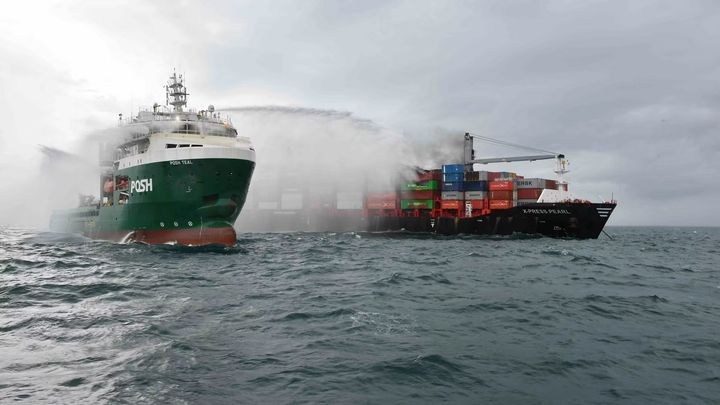
The number of fires on container ships has doubled over the past twenty years. Larger ships and new types of cargo affect fire safety on board, and the existing minimum rules from the International Maritime Organization (IMO) do not seem to match today's risk picture. It was against this backdrop that the European Maritime Safety Agency (EMSA) asked DBI to lead the CARGOSAFE project, which in 2023 published a report with 17 possible measures on how to improve fire safety on container ships.
An expert group in the IMO has scrutinized the CARGOSAFE report and concluded that it meets the requirements of a Formal Safety Assessment, also known as FSA. Thus, the report's conclusions and recommendations are ready to be addressed in the IMO’s Subcommittee on Ship Systems and Equipment, SSE, on March 4-8.
– It is not an everyday occurrence that an FSA report goes through this type of review so smoothly. But since we strictly followed the FSA procedure in CARGOSAFE, the path is paved for relatively quick processing, says DBI's project manager for CARGOSAFE, Anders V. Kristensen.
– Changing the regulation for safety at sea is a process that takes many years. Therefore, it is especially gratifying to see that recommendations from the FSA-based approach have now reached the IMO SSE Subcommittee, which will make changes to SOLAS (the International Convention for the Safety of Life at Sea), continues Anders V. Kristensen.
Long-term Benefits from systematic approach
Formal Safety Assessment (FSA) is a structured and systematic method used to assess risks and identify the most effective ways to improve safety in the maritime sector. FSA was developed in response to the Piper Alpha disaster in 1988, where an oil platform in the North Sea exploded, and 167 people lost their lives.
FSA consists of five steps, explained in the table below. All five steps are resource-intensive if they are to be done properly, but both EMSA and IMO have praised DBI's approach, and CARGOSAFE has been called a model project on how to approach improving safety at sea.
| Number | Step | Explanation |
| 1 | Identification of Hazards (Hazid) | What might go wrong? Listing all relevant scenarios with potential causes and outcomes. |
| 2 | Assessment of risks | How bad and how likely is it? |
| 3 | Risk control options | What can we do about it? Which rules can be changed to reduce risks? |
| 4 | Cost-benefit assessment | What do the proposals cost, and how much better will it be? |
| 5 | Recommendations for decision-making | What actions should be taken? |
– Admittedly, it's a difficult and complicated process, but the hard work pays off in the long run when the subsequent process goes much smoother, says Anders V. Kristensen.
To illustrate the complexity of the work, he mentions extensive input from the industry already in step 1, identification of hazards. An associated expert group assisted in step 2, the risk analysis, by grouping the identified hazards into the areas of prevention, detection, firefighting, and containment. In step 3 – risk analysis – the hazards were assessed in matrices with consequence calculations for each hazard. The cost-benefit assessment in step 4 was difficult to calculate since all costs must be viewed in a holistic perspective. Every factor ranging from environmental costs to loss of human lives needs to be quantified, and since the maritime sector usually keeps such valuations confidential, this was also not an easy task.
8 Cost-Effective Recommendations
Boiled down, the work resulted in 8 suggestions for improvements in fire safety, which – depending on ship size – may be cost-effective to implement. The SSE Committee is expected to decide which of the following recommendations will ultimately be incorporated into SOLAS.
- Improved control of lashing
- Heat detection
- Portable IR cameras for crew to enhance manual detection
- Improved manual firefighting tools for individual container breaching and firefighting
- Manual firefighting tools that increase reach
- Methods for unmanned firefighting
- Active protection underneath hatch covers to protect from fire spread towards the deck
- Passive protection to protect from fire spread towards the deck
Related links
Contacts
Morten K. ThomsenPR ManagerDBI – Dansk Brand- og sikringsteknisk Institut
Tel:51572338mok@brandogsikring.dkAnders V. KristensenSenior Project Manager, Maritime
Tel:+4550807809avk@dbigroup.dkSubscribe to releases from Dansk Brand- og sikringsteknisk Institut
Subscribe to all the latest releases from Dansk Brand- og sikringsteknisk Institut by registering your e-mail address below. You can unsubscribe at any time.
Latest releases from Dansk Brand- og sikringsteknisk Institut
Carsten Damgaard bliver administrerende direktør i DBI18.9.2026 08:53:58 CEST | Pressemeddelelse
DBI's bestyrelse har valgt den 55-årige Carsten Damgaard til ny administrerende direktør i DBI med virkning fra den 1. januar 2027. Han afløser Jesper Ditlev, som efter 26 år i DBI – heraf 17 som administrerende direktør – efter eget ønske har valgt at træde tilbage for at give plads til et velplanlagt lederskifte.
Aalborg Universitet og DBI indgår strategisk samarbejde29.6.2026 07:00:00 CEST | Pressemeddelelse
AAU og DBI har indgået en strategisk samarbejdsaftale om brand og sikkerhed. Partnerskabet skal styrke koblingen mellem forskning, myndighedsbetjening og praksis og accelerere omsætningen af ny viden til løsninger for virksomheder, myndigheder og samfund.
Mere plast i bilerne presser brandsikkerhed i p-huse21.4.2026 12:00:00 CEST | Pressemeddelelse
Moderne biler er større og brænder langt bedre end tidligere. Det udfordrer brandsikkerheden i eksisterende parkeringshuse, da reglerne er ikke fulgt med udviklingen. En ny rapport kan hjælpe p-husejere med at kortlægge risikoen.
New tool to accelerate safe, green maritime transition4.12.2025 07:00:00 CET | Press release
A new scenario-based digital tool helps the maritime sector adopt methanol, ammonia, and hydrogen by clarifying risks and regulatory gaps for safe, compliant green-fuel transitions. The maritime industry is facing a massive shift towards greener, less CO2-intensive fuels. But the transition will only happen if the alternative fuels can be implemented in a safe and compliant way. A new report from DBI is now giving the industry a clearer route to adopting these fuels without compromising safety. The METAFUEL project has mapped the hazards of methanol, ammonia and hydrogen across the full fuel-handling chain and turned that knowledge into a scenario-based decision tool intended to guide safer design and retrofitting in the maritime industry. “The green transition will be impossible without safety. You want to be able to load your cargo or passengers without thinking twice if it is a methanol-powered ship. The entire value chain needs to make sure that regardless of fuel, it is 'just a sh
Digitalt værktøj skal accelerere grøn omstilling til søs4.12.2025 07:00:00 CET | Pressemeddelelse
Et nyt værktøj hjælper den maritime sektor med at omstille til metanol, ammoniak og brint ved at anvise, hvad man kan gøre ved risici og manglende regler.
In our pressroom you can read all our latest releases, find our press contacts, images, documents and other relevant information about us.
Visit our pressroom