Mori Memorial Foundation’s Global Power City Index 2025 Sees City Rankings Shift Due to Tourism Gains in East Asia and Inflationary Pressures in the West
17.12.2025 04:00:00 CET | Business Wire | Press release
The Mori Memorial Foundation’s Institute for Urban Strategies, a research body established by Mori Building, Tokyo’s leading urban landscape developer, today published its annual Global Power City Index (GPCI) 2025, a report evaluating the urban competitiveness of 48 major cities worldwide. The report also includes the GPCI–Financial Centers index, an assessment of cities as international financial centers, and the new GPCI–Startup Ecosystems index, which assesses the competitiveness of startup environments.
This press release features multimedia. View the full release here: https://www.businesswire.com/news/home/20251216187692/en/
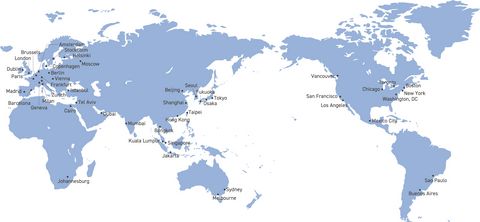
48 Major Cities Evaluated in Mori Memorial Foundation’s GPCI-2025 Report
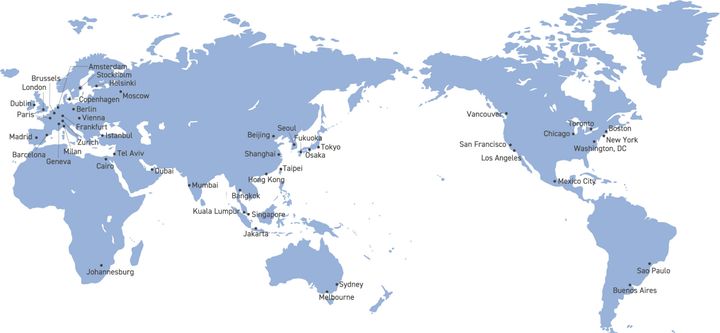
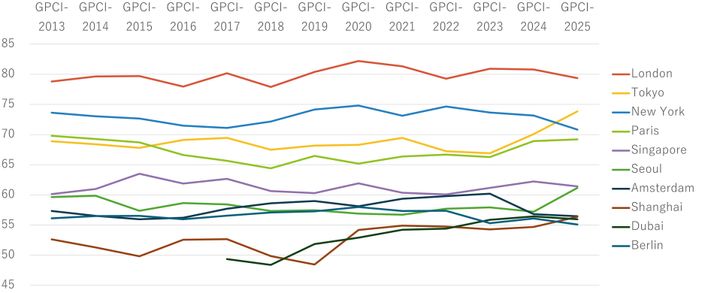
This year’s report highlights the remarkable rise of East Asian cities and the stagnation of several Western cities, showing how global challenges, such as geopolitical tensions and regional disparities in inflation, are greatly impacting the performance of major cities worldwide.
The results reflect positive trends in East Asia, including Tokyo’s rise to 2nd place, its highest position since the index began, supported by improvements in Livability and Cultural Interaction urban functions. Several other East Asian cities also achieved notable advancements, including Seoul solidifying its position in 6th, Shanghai climbing to 8th, Beijing rising from 16th to 12th and Taipei advancing from 30th to 24th. Overall, East Asian cities benefited from enhanced accessibility, growing tourism infrastructure and cultural appeal.
In contrast, many Western cities faced rising inflation and declining international connectivity. London retained its top spot for the 14th consecutive year, though its overall score declined slightly. New York dropped to 3rd, while Paris and Amsterdam struggled with affordability and cultural interaction due to inflationary pressures and weakened performance in other key areas.
These results suggest that global challenges such as inflation and shifting tourism dynamics are reshaping urban competitiveness, as East Asian cities leverage growth opportunities through tourism and infrastructure investment, while Western cities grapple with economic pressures and the consequences of global disruptions.
The GPCI assesses the competitiveness of cities using 72 indicators spread across six core urban functions: Economy, R&D, Cultural Interaction, Livability, Environment and Accessibility.
Highlights
London (1st)
London retained its top position thanks to strong performance in indicators such as “Variety of Workplace Options,” “Number of International Students,” “World’s Top Universities” and “Number of Startups.” It also improved in “Workstyle Flexibility” and ranked 1st in “Urban Greenery.” However, slight declines in “Tourist Attractions,” “Nightlife Options” and “Number of Retail Shops” led to a slight drop in London’s overall score.
Tokyo (2nd)
Tokyo rose to 2nd place for the first time, following nine consecutive years in 3rd, driven by a substantial improvement in its overall score. Although Tokyo’s Economy ranking declined, it excelled in Livability (1st) and Cultural Interaction (2nd), including 1st in “Nightlife Options” and 2nd in “Tourist Attractions.” Tokyo also made significant progress in its Environment ranking, rising from 18th to 7th, including 2nd in the newly added “Corporate Sustainability Assessment” indicator.
New York (3rd)
New York slipped to 3rd, down from 2nd for the first time since 2012, after experiencing the largest decline in overall score among the 48 cities. The city faced challenges in Livability, ranking last in “Price Level,” and saw declines in Environment. Scores for “Tourist Attractions” and “Nightlife Options” in Cultural Interaction also dropped slightly. Despite these challenges, New York continues to lead in Economy and R&D, maintaining top rankings through its unrivaled performance in “Stock Market Capitalization” and “R&D Expenditure.”
Paris (4th)
Paris remained in 4th, with a slightly higher score supported by the 2024 Paris Olympics and its status as a leading global tourist destination. The city excelled in Accessibility, surpassing New York to claim 2nd place. However, like other Western cities facing inflationary pressures, Paris experienced challenges in indicators such as “Price Level,” which dropped the city to 2nd place in Livability.
Singapore (5th)
Singapore retained its 5th place ranking, supported by improvements in Economy, including a higher score in “Variety of Workplace Options.” In Environment, the city’s “Biodiversity” and “Urban Greenery” rankings were the highest among the GPCI’s overall top 10 cities. However, global inflationary pressures led to a sharp decline in “Price Level,” causing Singapore’s Livability ranking to fall to 31st place.
Seoul (6th)
Seoul grew its score the most of any top 10 city to edge closer to Singapore. It was 5th again in R&D, placing 2nd in “Number of Patents,” 3rd in “Number of Researchers” and among the top 10 in “World’s Top Universities.” In Environment, Seoul ranked 4th in “Corporate Sustainability Assessment.” In Cultural Interaction, Seoul improved in “Number of Foreign Visitors,” “Tourist Attractions,” “Nightlife Options” and “Attractiveness of Dining Options,” reflecting strong visitor amenities.
Amsterdam (7th)
Amsterdam retained its 7th place ranking, supported by improvements in “Workstyle Flexibility” under the Livability function and a 10th place ranking in “Biodiversity” in the Environment function. However, challenges for Amsterdam included a decline in “Price Level” within Livability, as well as lower scores for “Tourist Attractions” and “Nightlife Options” in Cultural Interaction.
Shanghai (8th)
Shanghai rose three places to 8th, boosted by strong R&D scores, including in “Number of Researchers” and “World’s Top Universities.” It made significant progress in Cultural Interaction, improving its tourism appeal with more highly evaluated attractions, shopping and dining experiences. In Accessibility, Shanghai rose three places to 4th due to improvements in “Number of Air passengers,” “Number of Arrival and Departures at Airports” and “Travel Time to Airports.”
Dubai (9th)
Dubai slipped one rank to 9th but achieved several key improvements, including its first ranking in the Economy top 10 thanks to a higher GDP growth rate. In Cultural Interaction, Dubai rose to 5th in “Number of International Conferences” and improved its rankings in “Nightlife Options,” “Attractiveness of Shopping Options” and “Attractiveness of Dining Options.” In Accessibility, Dubai ranked 3rd in “Cities with Direct International Flights.” While Livability saw gains in “Number of Medical Doctors” and “Risk to Mental Health,” a decline in “Workstyle Flexibility” lowered the city’s overall ranking.
Berlin (10th)
Berlin dropped one rank to 10th but raised its Livability ranking to 4th with a significant boost in “Workstyle Flexibility,” although its “Price Level” worsened. In Cultural Interaction, improved indicators such as “Nightlife Options” and “Number of Cultural Events” lifted its ranking to 8th. Despite higher scores in “Biodiversity” and “Urban Greenery,” Berlin’s Environment ranking dropped six places to 15th due to declines in “Commitment to Climate Action” and “Satisfaction with Urban Cleanliness.”
Osaka (18th)
Osaka achieved the largest score increase and rise in overall ranking among all 48 cities, climbing from 35th to 18th. The city improved its rankings in five of the six functions, excluding R&D. In Economy, Osaka recorded a sharp recovery in GDP growth rate, and in Cultural Interaction the city rose from 23rd to 13th thanks to improvements in “Number of Foreign Visitors,” “Nightlife Options,” “Attractiveness of Shopping Options” and “Attractiveness of Dining Options.”
Taipei (24th)
Taipei rose six positions to rank 24th overall, driven by significant progress in Environment. Taipei ranked 1st in the newly added “Corporate Sustainability Assessment” indicator and 8th in “Biodiversity,” boosting its Environment ranking from 20th to 2nd,an impressive 18-place improvement.
GPCI–Financial Centers
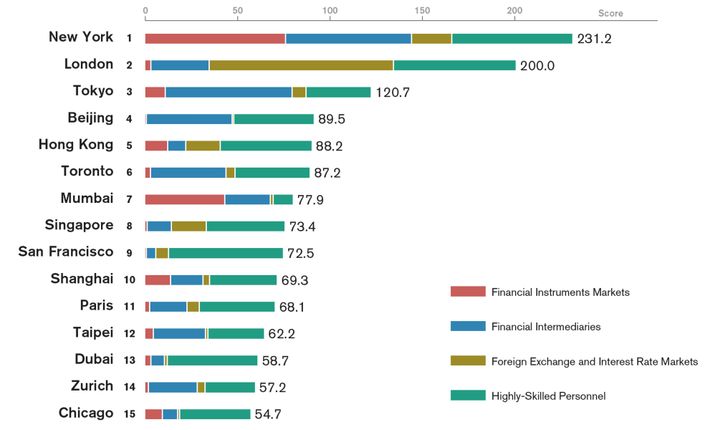
GPCI–Financial Centers evaluates the same 48 cities as the GPCI using 14 indicators in four groups: Financial Instruments Markets, Financial Intermediaries, Foreign Exchange and Interest Rate Markets, and Highly Skilled Personnel. In 2025, New York, London and Tokyo retained their top three positions. Shanghai experienced a significant decline in Financial Instruments Markets, dropping from 4th to 10th. Beijing and Hong Kong each rose by one position, ranking 4th and 5th respectively. They were followed by Toronto, Mumbai, Singapore, San Francisco and Shanghai, in that order.
New York (1st): New York received high scores across all four indicator groups. Like last year, it ranked first in “Stock Market Capitalization,” “Stock Market Trading Value,” “World’s Top Asset Managers” and “International Law Firm Offices.” This year it was also first in “Capital Raised Through IPOs.”
London (2nd): London retained its 1st place position in Foreign Exchange and Interest Rate Markets and earned 1st ranking in Highly Skilled Personnel.
Tokyo (3rd): Tokyo maintained a high score in Financial Intermediaries for the third consecutive year and its ranking in “Capital Raised Through IPOs” improved from 5th to 4th.
Beijing (4th): Beijing demonstrated its strength in two indicators: “Financial Intermediaries” and “Highly Skilled Personnel.”
Hong Kong (5th): Hong Kong improved its Financial Instruments Markets ranking by two places to 4th, boosted by a 3rd place in “Capital Raised Through IPOs.”
GPCI–Startup Ecosystems
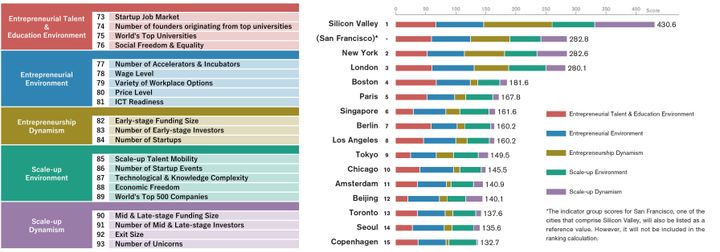
To address the growing importance of cities fostering startups and expanding into global markets, the Global Power City Index (GPCI) has introduced the Startup Ecosystems index. In addition to the same six core functions used in the GPCI, this new index includes a “Startup” function covering 21 indicators in 5 groups (Entrepreneurial Talent & Educational Environment, Entrepreneurial Environment, Entrepreneurial Dynamism, Scale-up Environment and Scale-up Dynamism), resulting in a seven-function framework for evaluating competitiveness as startup hubs.
The index covers 47 GPCI target cities and Silicon Valley, which comprises the city and county of San Francisco and San Mateo, Santa Clara and Alameda counties, reflecting the region’s comprehensive role as a global startup hub.
Silicon Valley (1st): Silicon Valley dominated four of the five indicator groups, excluding Entrepreneurial Talent & Education Environment, outperforming all cities by a significant margin. Notably, it ranked first in all indicators under Entrepreneurship Dynamism and Scale-up Dynamism.
New York (2nd): New York ranked second in Entrepreneurship Dynamism and Scale-up Dynamism, and third in Entrepreneurial Environment and Scale-up Environment.
London (3rd): London narrowly trailed New York to finish third, supported by a balance of strengths spanning all indicators.
Boston (4th): Boston ranked first in Entrepreneurial Talent & Education Environment, surpassing Silicon Valley, and was very strong in “Number of Founders Originating from Top Universities” and “World’s Top Universities.”
Paris (5th): Paris demonstrated strengths in key areas, ranking second in “World’s Top 500 Companies” and fourth in both the “Scale-up Talent Mobility” and “World’s Top Universities.”
The full press release and summary report is downloadable at https://mori-m-foundation.or.jp/english/ius2/gpci2/index.shtml
View source version on businesswire.com: https://www.businesswire.com/news/home/20251216187692/en/
Subscribe to releases from Business Wire
Subscribe to all the latest releases from Business Wire by registering your e-mail address below. You can unsubscribe at any time.
Latest releases from Business Wire
Incentive Market Set to Surpass $80B by 2030s — IMA Launches Tools to Help the Industry Keep Pace4.5.2026 16:28:00 CEST | Press release
With combined business spend on loyalty, employee recognition, and channel incentives projected to exceed $80 billion by the 2030s, the incentive industry is entering a period of rapid scale and strategic pressure. This press release features multimedia. View the full release here: https://www.businesswire.com/news/home/20260422729016/en/ In response, the Incentive Marketing Association (IMA) launched a new suite of resources designed to help incentive professionals navigate an environment that’s becoming more specialized, fragmented, and central to business performance. “It’s not just more money coming in—it’s more complexity,” said Vince Chiofolo, President of the Incentive & Engagement Solution Providers (IESP). “Buyers are demanding programs that evolve fast, integrate deeply, and feel personal at scale. These new tools were built for that.” IMA’s Suite of Tools Includes: New Industry Report — Inside the Incentive Buyer’s Mind Drawn from insights of 50+ program owners, the report f
Tigo Energy Breaks Global Growth Benchmark; Boosts U.S. Energy Feature in Predict+4.5.2026 15:00:00 CEST | Press release
Advanced energy prediction platform adds real-time energy pricing for North American Independent System Operator (ISO) customers, accelerates meters-connected growth. Tigo Energy, Inc. (NASDAQ: TYGO) (“Tigo” or “Company”), a leading provider of intelligent solar and energy solutions, today announced that the Predict+ platform now offers integrated real-time spot market pricing for ISO customers in the United States. Predict+ provides utilities with deep insights into grid demand, renewable generation, and energy market dynamics, enhancing the precision, scalability, and robustness of energy forecasting to up to 97.5% accuracy through machine learning and artificial intelligence. For energy providers, Predict+ helps streamline operations, reduce volatility, and maximize performance. Predict+ empowers utility operators to adapt to real-world demand challenges when balancing renewable and baseload generation sources, particularly during extreme weather events and market disruptions. On th
Airship Announces 2026 Elevate Customer Experience Award Winners4.5.2026 15:00:00 CEST | Press release
Southwest Airlines, The Economist, and OneFootball among brands recognized at Elevate’26 Customer Experience Summit for setting the standard in mobile-first and AI-centered customer experiences Airship, the mobile-first customer experience company, today announced the winners of the 2026 Elevate Customer Experience Awards. Global brand leaders from The Economist, Southwest Airlines, and OneFootball were among those honored at the Elevate’26 Customer Experience Summit. The Elevate Awards spotlight global companies that have developed exceptional mobile-first customer experiences for their customers, created innovative campaigns, leveraged AI agents to reach new levels of productivity, and achieved real business results. "Evolving mobile-first consumer behaviors and unprecedented advancements in AI are driving a seismic shift that is reshaping how brands interact with their customers," said Brett Caine, CEO, Airship. "The 2026 Elevate Award winners aren’t just adapting, they’re leading t
Alnylam to Present New Analyses at Heart Failure 2026 Underscoring Consistent Clinical Profile of Vutrisiran in ATTR-CM4.5.2026 14:30:00 CEST | Press release
Alnylam Pharmaceuticals, Inc. (Nasdaq: ALNY), the leading RNAi therapeutics company, today announced it will present new data analyses for vutrisiran in patients with the cardiomyopathy of wild-type or hereditary transthyretin-mediated amyloidosis (ATTR-CM) at Heart Failure 2026, a scientific congress of the European Society of Cardiology, taking place May 9-12, 2026, in Barcelona, Spain. ATTR-CM is a heterogeneous and rapidly progressive disease, and patients often present with complex clinical profiles. At Heart Failure 2026, Alnylam will present multiple new analyses from the Phase 3 HELIOS-B study of vutrisiran, which continue to support its use as a first-line treatment for patients with ATTR-CM, and further characterize its clinical profile across patients with a high disease burden, and in the context of concomitant therapies. Vutrisiran is the first and only transthyretin (TTR) silencer for ATTR-CM that delivers rapid knockdown of TTR at the source. Additional analyses being pr
Takeda Announces Positive Topline Results from Pivotal Phase 2/3 Clinical Trial of TAK-881 in Primary Immunodeficiency Disease (PID)4.5.2026 14:00:00 CEST | Press release
Investigational TAK-881 was comparable to established HYQVIA while also demonstrating reduced infusion volume and duration for PID patients Takeda (TSE:4502/NYSE:TAK) today announced that TAK-881-3001, a pivotal Phase 2/3 clinical trial in patients with Primary Immunodeficiency Disease (PID), met its primary endpoint, which demonstrated pharmacokinetic (PK) comparability between the investigational TAK-881 [Immune Globulin Subcutaneous (Human), 20% Solution (SCIG 20%) with Recombinant Human Hyaluronidase] and HYQVIA [Immune Globulin Infusion (Human) 10% with Recombinant Human Hyaluronidase]. Additionally, secondary endpoints showed that TAK-881, a SCIG 20% facilitated with hyaluronidase, demonstrated safety, efficacy and tolerability profiles comparable to HYQVIA, an established SCIG 10% facilitated with hyaluronidase. These findings support the potential of TAK-881 to deliver the required immunoglobulin (IG) dose for PID patients in half the volume of HYQVIA, reducing infusion duratio
In our pressroom you can read all our latest releases, find our press contacts, images, documents and other relevant information about us.
Visit our pressroom