
Your Christmas decorations may be hiding a tiny bit of badger and toad
16.12.2025 09:27:05 CET | Københavns Universitet | Press release
Researchers at the University of Copenhagen have discovered that moss acts as a natural trap for environmental DNA. This discovery opens the door to using moss as a simple, gentle and inexpensive method of monitoring biodiversity – from birds and mammals to fungi, insects and microbes.

Right now, many of us have a bit of moss sitting in our Christmas decorations at home. Some of us picked it ourselves in the forest, others bought it in a shop. But few have probably thought about the fact that moss can be full of small remains from foxes, hares, badgers or other animals that live in the area where the moss grew.
However, that is precisely the case, as a research team led by the University of Copenhagen has now shown. In a new study, they demonstrate that moss works as a natural collector of environmental DNA – the small fragments of genetic material that animals, plants and microorganisms constantly shed into their surroundings. And moss could become an important tool for monitoring global biodiversity at a time when species are disappearing rapidly and climate change is reshaping ecosystems.
A stumble that sparked an idea
It was purely by chance – indeed, by an accident – that biologist Kasun Bodawatta from the University of Copenhagen came up with the idea that moss can store animal DNA:
"I was doing fieldwork on the Danish island of Christiansø when I tripped and fell on a patch of soft moss. And then I thought: Hey, it's just like a sponge. Maybe moss works like sponges that absorb environmental DNA, just as sea sponges can be used to collect DNA in marine ecosystems," says Kasun Bodawatta, former postdoc and now guest researcher at the Globe Institute at the University of Copenhagen and the senior author of the study.
He and a team of fellow researchers from the University of Copenhagen then set about analysing moss from the Lille Vildmose nature reserve in Denmark.
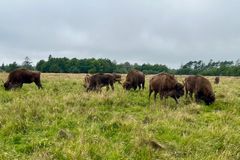
In small moss samples measuring 6x6 centimetres, the researchers identified 13 bird species (including graylag goose and common redstart), 11 mammal species (including bison, badger and pipistrelle bat) and two amphibian species. In addition, they found 54 different invertebrates, 21 plants, 553 bacterial genera and 210 fungal genera.
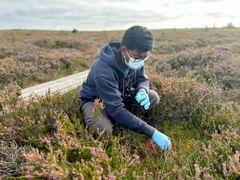
‘By simply swabbing the surface of tiny pieces of moss with a cotton bud, we were able to detect wild, local animals like bison and badgers – and not just pig DNA, which is spread across much of the Danish landscape. This shows the great potential moss has for monitoring natural biodiversity,’ says Kasun Bodawatta.
A global and easily accessible method
The collection of environmental DNA (eDNA) is already a widely used tool for monitoring nature, but on land there is a lack of easily accessible, robust and inexpensive ways to collect eDNA. Here, moss can be a crucial supplement.
The study shows that the sponge-like structure of moss allows it to trap material it comes into contact with. And this applies not only in temperate Danish landscapes: the researchers also sampled moss in savannah and forest habitats in Ivory Coast. Their findings suggest that moss-based DNA sampling could work globally.
"The special thing about moss is that it is found on almost every continent and, unlike most other methods, the cotton swab approach requires no electricity, expensive equipment or specialised fieldwork. In principle, you can go for a walk in the forest, swab a handful of moss and get a biological fingerprint of the area," says Associate Professor and co-author Kathrin Rousk from the Department of Biology at the University of Copenhagen.
The cotton swab method is both effective and gentle. In most cases, it was not necessary to remove or destroy moss, making the technique suitable in fragile or protected habitats. In addition, due to its simplicity, the method is ideal for use in citizen science, the researchers point out.
The researchers also discovered that moss picks up DNA not only from animals that touch it directly, but also from species that have merely passed through the air above it. In Ivory Coast, they were even able to detect DNA from a rare bird species in places where the birds were no longer present, suggesting that moss can store DNA for relatively long periods.
‘The fascinating thing is that something as simple as moss – something we hardly notice – can tell us so much about the nature around us. We still need to refine the technique, but moss is extremely promising as a way to monitor animal and plant life around the world,’ concludes Kasun Bodawatta.
________________________________________
WHAT THEY FOUND IN THE MOSS
In the 25 moss samples collected from Lille Vildmose, the researchers found:
• 13 species of birds
• 11 species of mammals
• 2 species of amphibians
• 54 genera of invertebrates
• 21 genera of plants
• 553 species of bacterial genera
• 210 species of fungal genera
In the 29 moss samples collected in Ivory Coast – analysed only for vertebrate DNA – they found:
• 18 genera of birds
• 13 genera of mammals
• 2 species of amphibians
ABOUT THE STUDY
• The study has just been published in the journal Molecular Ecology Resources.
• The researchers behind the study are Henry F. N. Lankes, Lene Bruhn Pedersen, Jacob Heilmann-Clausen, Kristine Bohmann and Kasun Bodawatta from the Globe Institute; Rasmus Stenbak Larsen, Kathrin Rousk, Anders Priemé and Michael Poulsen from the Department of Biology; Natasha de Vere from the Natural History Museum of Denmark and N’golo A Koné from Station de Recherche en Ecologie du Parc National de la Comoé, Ivory Coast.
• The study was supported by a Villum Experiment grant.
Keywords
Contacts
Kasun H. Bodawatta
Guest researcher
Globe Institute
University of Copenhagen
Email: bodawatta@sund.ku.dk
T: +45 35 33 06 46
Maria Hornbek
Communications Consultant
UCPH Communication
University of Copenhagen
Email: maho@adm.ku.dk
M: +45 22 95 42 83
Images
Links
Subscribe to releases from Københavns Universitet
Subscribe to all the latest releases from Københavns Universitet by registering your e-mail address below. You can unsubscribe at any time.
Latest releases from Københavns Universitet
Stort dansk studie: Kræftpatienter rammes langt oftere af psykiske lidelser28.7.2026 06:05:00 CEST | Pressemeddelelse
Med en kræftdiagnose er der dobbelt så høj risiko for, at man senere udvikler en psykisk lidelse, end hvis man er kræftfri. I det første år er der fem gange øget risiko for at blive indlagt med en psykisk diagnose eller få udskrevet medicin til behandling af sådanne sygdomme.
Fra Nordjylland til Amager: DNA-støvsuger afslører det lokale dyreliv i dansk natur23.7.2026 06:05:00 CEST | Pressemeddelelse
Forskere har udviklet en DNA-støvsuger, der kan suge genetiske spor fra dyr ud af luften og afsløre, hvilke dyr der lever i et område. I to nye studier tager forskerne luftprøver i tre naturområder i Danmark og viser, at metoden kan bruges til at kortlægge det lokale dyreliv. Dermed rykker de et stort skridt tættere på bedre overvågning af biodiversitet ved hjælp af DNA fra luft.
Nu taler vi ikke længere kun om sorte huller, vi lytter til dem22.7.2026 14:30:00 CEST | Pressemeddelelse
For første gang i historien samler et internationalt forskerhold både teorien og observationerne af sorte hullers vibrationer i én samlet status over feltet. En af forskerne bag, kalder det ”et nyt stadie i astronomien”.
Når storebror bringer virus med hjem, kan det koste lillesøster dyrt senere i livet22.7.2026 06:38:13 CEST | Pressemeddelelse
Spædbørn, der udsættes for luftvejssygdomme via ældre søskende, klarer sig typisk dårligere i uddannelse, indkomst og helbred i voksenlivet. Det viser ny forskning fra Københavns Universitet.
Danmark skal have vådområderne tilbage: Nyt studie viser, hvor klimaeffekten er størst16.7.2026 06:05:00 CEST | Pressemeddelelse
Inden for fire år skal Danmark og resten af EU have genoprettet mindst 30% af de vådområder, som har det skidt i dag. Men hvor giver det bedst mening at sætte ind? Det giver forskere fra Københavns Universitet nu et bud på med det første detaljerede kort over Europas vådområder. Kortet lukker et videnshul og viser, hvor effekten på klima og biodiversitet formentlig er størst.
In our pressroom you can read all our latest releases, find our press contacts, images, documents and other relevant information about us.
Visit our pressroom