AI-Generated Code Poses Major Security Risks in Nearly Half of All Development Tasks, Veracode Research Reveals
30.7.2025 13:50:00 CEST | Business Wire | Press release
Comprehensive Analysis of More Than 100 Large Language Models Exposes Security Gaps: Java Emerges as Highest-Risk Programming Language, While AI Misses 86% of Cross-Site Scripting Threats
Veracode, a global leader in application risk management, today unveiled its 2025 GenAI Code Security Report, revealing critical security flaws in AI-generated code. The study analyzed 80 curated coding tasks across more than 100 large language models (LLMs), revealing that while AI produces functional code, it introduces security vulnerabilities in 45 percent of cases.
This press release features multimedia. View the full release here: https://www.businesswire.com/news/home/20250730694951/en/
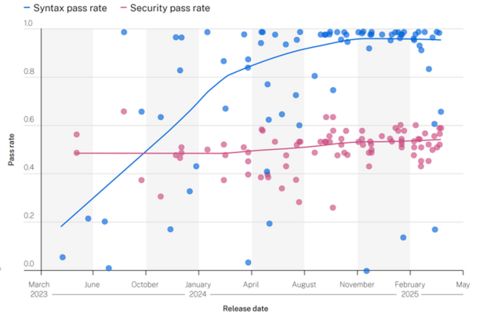
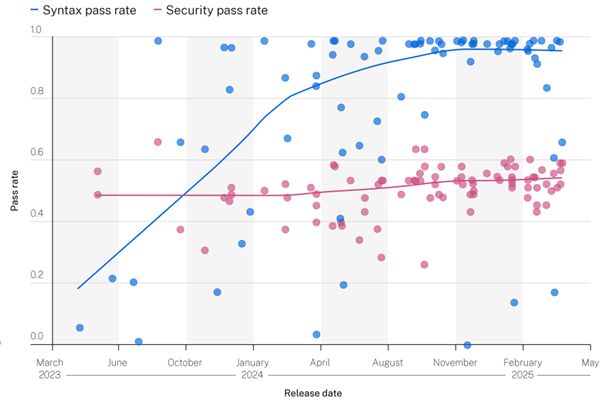
Security and Syntax Pass Rates vs LLM Release from the Veracode 2025 GenAI Code Security Report
The research demonstrates a troubling pattern: when given a choice between a secure and insecure method to write code, GenAI models chose the insecure option 45 percent of the time. Perhaps more concerning, Veracode's research also uncovered a critical trend: despite advances in LLMs’ ability to generate syntactically correct code, security performance has not kept up, remaining unchanged over time.
“The rise of vibe coding, where developers rely on AI to generate code, typically without explicitly defining security requirements, represents a fundamental shift in how software is built,” said Jens Wessling, Chief Technology Officer at Veracode. “The main concern with this trend is that they do not need to specify security constraints to get the code they want, effectively leaving secure coding decisions to LLMs. Our research reveals GenAI models make the wrong choices nearly half the time, and it’s not improving.”
AI is enabling attackers to identify and exploit security vulnerabilities quicker and more effectively. Tools powered by AI can scan systems at scale, identify weaknesses, and even generate exploit code with minimal human input. This lowers the barrier to entry for less-skilled attackers and increases the speed and sophistication of attacks, posing a significant threat to traditional security defenses. Not only are vulnerabilities increasing, but the ability to exploit them is becoming easier.
LLMs Introduce Dangerous Levels of Common Security Vulnerabilities
To evaluate the security properties of LLM-generated code, Veracode designed a set of 80 code completion tasks with known potential for security vulnerabilities according to the MITRE Common Weakness Enumeration (CWE) system, a standard classification of software weaknesses that can turn into vulnerabilities. The tasks prompted more than 100 LLMs to auto-complete a block of code in a secure or insecure manner, which the research team then analyzed using Veracode Static Analysis. In 45 percent of all test cases, LLMs introduced vulnerabilities classified within the OWASP (Open Web Application Security Project) Top 10—the most critical web application security risks.
Veracode found Java to be the riskiest language for AI code generation, with a security failure rate over 70 percent. Other major languages, like Python, C#, and JavaScript, still presented significant risk, with failure rates between 38 percent and 45 percent. The research also revealed LLMs failed to secure code against cross-site scripting (CWE-80) and log injection (CWE-117) in 86 percent and 88 percent of cases, respectively.
“Despite the advances in AI-assisted development, it is clear security hasn’t kept pace,” Wessling said. “Our research shows models are getting better at coding accurately but are not improving at security. We also found larger models do not perform significantly better than smaller models, suggesting this is a systemic issue rather than an LLM scaling problem.”
Managing Application Risks in the AI Era
While GenAI development practices like vibe coding accelerate productivity, they also amplify risks. Veracode emphasizes that organizations need a comprehensive risk management program that prevents vulnerabilities before they reach production—by integrating code quality checks and automated fixes directly into the development workflow.
As organizations increasingly leverage AI-powered development, Veracode recommends taking the following proactive measures to ensure security:
- Integrate AI-powered tools like Veracode Fix into developer workflows to remediate security risks in real time.
- Leverage Static Analysis to detect flaws early and automatically, preventing vulnerable code from advancing through development pipelines.
- Embed security in agentic workflows to automate policy compliance and ensure AI agents enforce secure coding standards.
- Use Software Composition Analysis(SCA) to ensure AI-generated code does not introduce vulnerabilities from third-party dependencies and open-source components.
- Adopt bespoke AI-driven remediation guidance to empower developers with precise fix instructions and train them to use the recommendations effectively.
- Deploy a Package Firewall to automatically detect and block malicious packages, vulnerabilities, and policy violations.
“AI coding assistants and agentic workflows represent the future of software development, and they will continue to evolve at a rapid pace,” Wessling concluded. “The challenge facing every organization is ensuring security evolves alongside these new capabilities. Security cannot be an afterthought if we want to prevent the accumulation of massive security debt.”
The complete 2025 GenAI Code Security Report is available to download on the Veracode website.
About Veracode
Veracode is a global leader in Application Risk Management for the AI era. Powered by trillions of lines of code scans and a proprietary AI-assisted remediation engine, the Veracode platform is trusted by organizations worldwide to build and maintain secure software from code creation to cloud deployment. Thousands of the world’s leading development and security teams use Veracode every second of every day to get accurate, actionable visibility of exploitable risk, achieve real-time vulnerability remediation, and reduce their security debt at scale. Veracode is a multi-award-winning company offering capabilities to secure the entire software development life cycle, including Veracode Fix, Static Analysis, Dynamic Analysis, Software Composition Analysis, Container Security, Application Security Posture Management, Malicious Package Detection, and Penetration Testing.
Learn more at www.veracode.com, on the Veracode blog, and on LinkedIn and X.
Copyright © 2025 Veracode, Inc. All rights reserved. Veracode is a registered trademark of Veracode, Inc. in the United States and may be registered in certain other jurisdictions. All other product names, brands or logos belong to their respective holders. All other trademarks cited herein are property of their respective owners.
View source version on businesswire.com: https://www.businesswire.com/news/home/20250730694951/en/
Subscribe to releases from Business Wire
Subscribe to all the latest releases from Business Wire by registering your e-mail address below. You can unsubscribe at any time.
Latest releases from Business Wire
BeOne Presents Compelling Data in Hard-to-Treat Liver and Lung Cancers at ESMO 202624.10.2026 10:15:00 CEST | Press release
Potential first-in-class GPC3 x 4-1BB bispecific achieves a 36% confirmed response rate at Phase 3 dose and favorable safety profile in heavily pretreated liver cancerBrain-penetrant PRMT5 inhibitor shows promising antitumor and CNS activity in the largest publicly shared MTAP-deficient datasetFirst clinical data of CEA-targeting ADC demonstrates encouraging and sustained responses in CEAhigh NSCLC BeOne Medicines Ltd. (Nasdaq: ONC; HKEX: 06160; SSE: 688235), a global oncology company, today announced new data from multiple differentiated investigational medicines across its priority solid tumor disease areas at the European Society for Medical Oncology (ESMO) Congress 2026 (October 23–27, Madrid). The presentations span gastrointestinal, lung, and breast cancers, and reflect the growing momentum of BeOne’s solid tumor franchise. Mark Lanasa, M.D., Ph.D., Chief Medical Officer, Solid Tumors at BeOne, said: “At ESMO, we are showing how our strategy of matching the right modality to dise
Phase 3 RAINIER Results Supporting Best-in-Class Potential of Povetacicept in IgA Nephropathy Published in the New England Journal of Medicine and Presented at the American Society of Nephrology Kidney Week 202623.10.2026 19:42:00 CEST | Press release
- Vertex is on track for the U.S. FDA Prescription Drug User Fee Act (PDUFA) date of November 30 for potential accelerated approval of povetacicept –- Data published in NEJM and presented at ASN highlight povetacicept’s unique trifecta of efficacy, favorable safety, and the simplicity of dosing at-home every 4 weeks with a low-volume autoinjector –- Data presented at ASN include a qualitative study examining patient perspectives on current and emerging IgAN therapies, showing that 96% of participants preferred an autoinjector over a prefilled syringe, and 80% of participants preferred dosing every 4 weeks versus weekly dosing - - New clinical studies of povetacicept underway including a study evaluating patient experience on povetacicept administered via autoinjector - Vertex Pharmaceuticals Incorporated (Nasdaq: VRTX) today announced the publication of Phase 3 RAINIER results for povetacicept in the New England Journal of Medicine (NEJM), presentation of these data at the American Soc
BeOne Medicines Reports Sustained Survival Benefit with TEVIMBRA-ZIIHERA Combination in First-Line HER2+ Gastroesophageal Cancer23.10.2026 16:15:00 CEST | Press release
New data from HERIZON-GEA-01 Phase 3 trial show 36-month overall survival of nearly 40% with TEVIMBRA plus ZIIHERA and chemotherapy, and median OS reaching 27 monthsTEVIMBRA-containing arm was associated with a four-month longer median OS compared with ZIIHERA plus chemotherapy BeOne Medicines Ltd. (Nasdaq: ONC; HKEX: 06160; SSE: 688235), a global oncology company, today announced new survival results from the planned second interim analysis (IA2) and final formal analysis of the Phase 3 HERIZON-GEA-01 trial, further confirming the benefit of TEVIMBRA® (tislelizumab) plus ZIIHERA® (zanidatamab) and chemotherapy as first-line treatment for patients with HER2-positive locally advanced or metastatic gastroesophageal adenocarcinoma (GEA). The results will be presented today as a late-breaking abstract during a rapid oral session at the European Society for Medical Oncology (ESMO) Congress 2026 in Madrid, Spain (LBA79). Mark Lanasa, M.D., Ph.D., Chief Medical Officer, Solid Tumors at BeOne,
Lifezone Metals Confirms Advanced Negotiations with Orion CMC on Kabanga Nickel Project23.10.2026 16:10:00 CEST | Press release
Lifezone Metals Limited (NYSE: LZM) notes comments made today by Oskar Lewnowski, Founder and Group Chief Executive of Orion Resource Partners, in an interview with Bloomberg Television regarding the Company’s Kabanga Nickel Project in Tanzania. In response to inbound inquiries from media outlets and investors following the interview, the Company can confirm that negotiations with Orion Critical Mineral Consortium (Orion CMC) regarding a significant equity investment into the Kabanga Nickel Project are at an advanced stage. The Orion CMC is a global investment platform launched by Orion Resource Partners in partnership with the U.S. International Development Finance Corporation (DFC) and Abu Dhabi's sovereign investor ADQ. As previously announced, the Company has been running a competitive process, led by Standard Chartered Bank, to secure a strategic investment into the Kabanga Nickel Project. Social Media LinkedIn | X | YouTube About Lifezone Metals Lifezone Metals (NYSE: LZM) is com
inDrive and Pony.ai Announce Collaboration to Explore Autonomous Mobility in Kazakhstan Built on NVIDIA Hyperion23.10.2026 15:00:00 CEST | Press release
Collaboration will establish the roadmap for bringing Pony.ai robotaxis to Kazakhstan on the inDrive ride-hailing platform, leveraging the NVIDIA Hyperion and the NVIDIA Halos safety system. inDrive, the global mobility and delivery platform, today announced it has signed a memorandum of understanding (MOU) with NVIDIA and Pony.ai, a global leader in the large-scale commercialization of autonomous driving technology, to explore the future of autonomous ride-hailing. Kazakhstan will serve as the first test market. This press release features multimedia. View the full release here: https://www.businesswire.com/news/home/20261023143469/en/ inDrive partners with Pony.ai and NVIDIA to explore autonomous mobility in Kazakhstan Kazakhstan was chosen first for its regulatory readiness following the creation of the country’s first structured legal framework for driverless transport, as part of its “Year of Digitalization and Artificial Intelligence.” Combined with Kazakhstan’s position as a lea
In our pressroom you can read all our latest releases, find our press contacts, images, documents and other relevant information about us.
Visit our pressroom