
Researchers develop new robot: The future of scaffolding is here
2.7.2025 09:35:44 CEST | Syddansk Universitet | Press release
Together with the German scaffolding manufacturer PERI and several other European partners, researchers from SDU’s Centre for Large Structure Production (LSP) have developed a robot that can relieve scaffolders. The robot will be tested in real-life conditions over the next years.
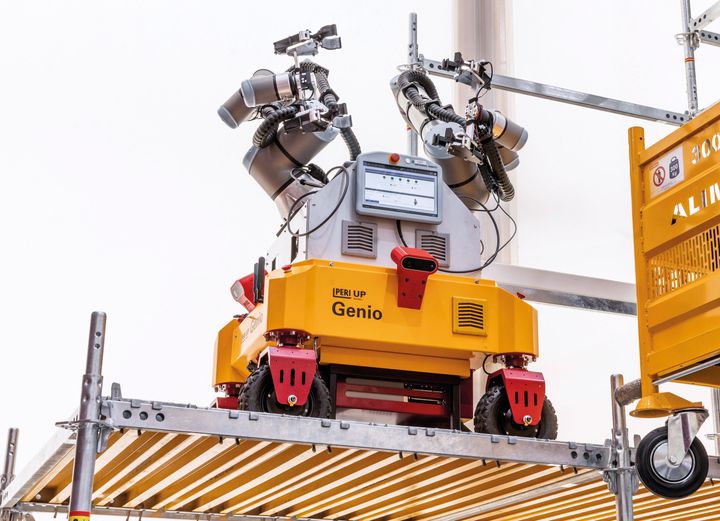
In just a couple of years, scaffolders may find themselves meeting a completely new kind of colleague in the site cabin:
The robot Genio.
Genio is a mobile robot equipped with two robotic arms that executes scaffold assembly based on a digital plan created by the scaffolder. After designing the scaffolding in a 3D environment and defining the assembly sequence, the scaffolder hands over the physical execution to Genio, who carries out the heavy lifting and positioning on its own. Throughout the process, the scaffolder stays in control – overseeing, coordinating material logistics, and managing adjustments via tablet or smartphone.
The robot has been developed by the scaffolding manufacturer PERI in collaboration with researchers from the University of Southern Denmark, the Belgian universities KU Leuven and UC Leuven Limburg, RWTH Aachen University in Germany, and the Jožef Stefan Institute in Slovenia.
The goal, the partners say, is to support scaffolders with a new tool, making their work safer, less physically demanding and quicker, thereby also helping to meet the growing demand for skilled labour.
- We are developing the robot to make the physically demanding scaffolding work on construction sites easier and safer. The close collaboration between humans, robots and machines addresses the shortage of skilled workers in a highly efficient and digital way, says Peter Rübel, Senior Business Development Manager at PERI.
Mobile and flexible
At the University of Southern Denmark, it is Professor Christian Schlette, Head of the Centre for Large Structure Production (LSP), who has led the research team.
And there is good reason why no one has developed a scaffolding robot before, he explains. It’s not an easy task.
- Scaffolding work usually takes place outdoors, so the robot must be able to operate in changing environments. It has to be very mobile and able to handle scaffolding components that are not necessarily identical and may have dents and scratches from years of use, says Christian Schlette.
- These are all characteristics that typically only humans are good at.
What has now made it possible is, of course, technological advancement, but above all the close collaboration between research teams across Europe, the professor says.
- We could only achieve this thanks to all the close partners, each of whom is an expert in their own field. And thanks to PERI, who were open-minded and ready to develop something entirely new, says Christian Schlette.
Tests on construction sites
Right now, Genio is still at the prototype stage. It works as intended, but so far it has only been tested in closed, controlled environments.
The robot was first presented to the construction industry at the major construction trade fair bauma in Munich in April 2025.
The partners have now launched another three-year research project, with the aim of testing the robot on realistic test construction sites.
- Over the coming years, in close collaboration with our customers and research consortium, we aim to bring the prototype to market maturity, explains Oliver Schilling, Scaffolding Automation Specialist at PERI.
- We will define specific requirements and areas of application – such as façade scaffolding, shoring, or industrial uses and beyond. On test construction sites, we will evaluate process reliability, usability, speed, and other relevant factors.
Fact box: About the project
Genio has been developed by the scaffolding company PERI in collaboration with researchers from LSP at the University of Southern Denmark, KU Leuven, RWTH Aachen University, UC Leuven Limburg and the Jožef Stefan Institute.
Based on a digital twin and defined assembly sequence provided by the scaffolder, Genio autonomously handles the positioning, lifting, and connecting of PERI UP components. An integrated transport system delivers the materials to the required level, while the scaffolder monitors progress, ensures safety, and makes real-time adjustments via an app.
The idea for the robot originated in 2019, and the first functional prototype in a controlled environment was presented at the bauma construction fair in 2025 in Munich. The partners are now working to test the robot under real-life conditions on a construction site so that, potentially, a finished product can be ready in just three years.
Alternative languages
Subscribe to releases from Syddansk Universitet
Subscribe to all the latest releases from Syddansk Universitet by registering your e-mail address below. You can unsubscribe at any time.
Latest releases from Syddansk Universitet
Forskere på SDU skal undersøge, hvad der egentlig sker, når man koger en bønne7.5.2026 10:25:39 CEST | Pressemeddelelse
Forskere fra SDU Food Matters på Syddansk Universitet skal over de næste fem år analysere, hvordan bønners naturlige mikrostrukturer ændrer sig under tilberedning, og hvordan den viden kan bruges til at udvikle bedre plantebaseret mad. Projektet er støttet af Novo Nordisk Fonden med 12,5 millioner kroner.
Nyt forskningscenter skal styrke samspillet mellem jura, kunstig intelligens og robotteknologi7.5.2026 10:20:35 CEST | Pressemeddelelse
Juridisk Institut ved Syddansk Universitet etablerer CLAIR – Center for Law, AI and Robotics. Centret skal bidrage med ny viden, der kan omsættes i både uddannelse, lovgivning og praksis i mødet mellem jura og teknologi.
Danskernes opbakning til AI i mødet med det offentlige afhænger af, hvor tit de bruger AI og i mindre grad af deres alder7.5.2026 07:00:00 CEST | Pressemeddelelse
En ny rapport fra Digital Democracy Centre tager temperaturen på danskernes holdninger til kunstig intelligens i den offentlige sektor. Det overordnede resultat er, at danskernes opbakning afhænger meget af sagstype og desuden hvilken type AI-baseret værktøj, der er tale om.
Globale eksperter er enige: Sundhedsvæsenet skal tænke fysisk aktivitet ind i behandling af kroniske sygdomme6.5.2026 10:19:59 CEST | Pressemeddelelse
Et internationalt konsensusarbejde ledet og koordineret af forskere fra Syddansk Universitet og Københavns Universitet viser, hvordan sundhedsprofessionelle systematisk kan vurdere, ordinere og fremme fysisk aktivitet i mødet med patienter med kroniske sygdomme
Angela Chang udnævnt til professor i global sundhedsøkonomi og målemetoder ved SDU5.5.2026 16:25:04 CEST | Pressemeddelelse
Ny professor skal styrke forskningen i globale sundhedsuligheder og udvikle bedre metoder til at måle sygdom og livskvalitet. Målet er at skabe viden, der kan bruges i sundhedspolitik og internationale indsatser.
In our pressroom you can read all our latest releases, find our press contacts, images, documents and other relevant information about us.
Visit our pressroom