
Core samples from Greenland's seabed provide first historical overview of plastic pollution
21.3.2025 10:52:58 CET | Københavns Universitet | Press release
By coring the seabed at 850 m water depth in Disko Bay off Greenland's west coast, researchers from the University of Copenhagen have obtained the first historical record of plastic pollution in Greenland. The new data suggest a link to local socio-economic development and represent a step towards developing a common method for analyzing and mapping global microplastic pollution.
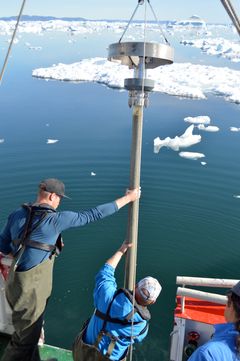
Using so called seabed coring somewhat similar to the ice core drilling techniques used by glaciologists, researchers from the University of Copenhagen in cooperation with colleagues from Aarhus University have achieved the first historical record of plastic pollution on Greenland's seabed.
The record shows an increased accumulation of microplastics on the seabed since the 1950s, with significant fluctuations. While particular environmental conditions such as freezing weather and glacier discharge could play a role, interestingly such increases and decreases in plastic accumulation also align with historical socio-economic development in Greenland.
"Our data shows a concurrence between the construction projects and other socio-economic events that took place locally in Greenland during the country's modernization, and major increases in the amount of plastic accumulating on the seabed. As researchers in plastic pollution, we can use this knowledge to reassess the sources of plastic," says Ph.D Karla Parga Martinez from the Department of Geosciences and Natural Resource Management, who is currently a Postdoc at McGill University, Canada.
A prevailing view has been that the majority of plastic comes to the Arctic via ocean currents, but the new data highlights that local sources also play a significant role. According to the researchers, this knowledge can help them refine the global data on plastic contamination.
"There is a strong desire among scientists to obtain high-quality data on plastic in the oceans, so we have a proper overview of the problem of plastic pollution, and also develop models to monitor where the trends are heading. This research project is an important step in that direction. For the first time we now have a historical overview from the Arctic region of this plastic pollution," says coauthor Dr. Nicole Posth, Associate Professor at the Department of Geosciences and Natural Resource Management.
This achievement could help push for new solutions by documenting the wide distribution of plastics across its production history.
“It is important to show that plastic is making its way to the ocean floor - that our actions directly influence our environment. We have ever-increasing evidence of plastic´s negative impact on ecosystem (and human) health. This is now a reality, we must explore the scope of, and new studies like this one is needed to provide the evidence,” says Nicole Posth
A method to be followed
The researchers developed refined methods of coring in the ocean sediments and identifying plastics by their polymer composition by analyzing the total contents of samples.
By jamming a tube into the seabed, the researchers were able to retrieve cores of the seabed for analysis. These samples were dated using radionuclide dating, where decaying isotopes are measured to determine a materials age.
Slicing the cores into what corresponds to relatively short time periods and isolating the microplastics from the seabed components (sand, clay, organic debris etc.), they could then compare the plastic´s chemical composition to a library of known plastics from different ages.
Finally matching the microplastic type to the age of the seabed sediment from which it was extracted, they could build a record back in history.
According to the researchers such methodical refinements could end up playing a larger role in our understanding of plastic contamination in the world ocean as they could be applied in many other places globally and provide solid, more aligned global data.
“When we meet to communicate our results in the scientific community, we need to be able to “speak the same language”, so broadly applicable methods and transparency about characteristics of the study sites are important, to be able to align results across the globe and between labs,” says Posth.
Tangible evidence of the Anthropocene
The so-called Anthropocene refers to the period of Earth’s recent history where human activity has affected the climate and ecosystems of our planet. The concept has become an accepted term in cultural and societal debates, but as a scientific concept, it remains controversial.
“It is not an accepted geological time period. However, plastic accumulation in the seabed is now a very tangible part of that discussion because we have an undeniable proof that humanity has left its geological imprint even in this remote location," says Dr Nicole Posth.
Plastic contamination of the oceans leave a human trace that is measureable on a global and historical scale, and one that we are only now beginning to understand the impact of.
“If we are to assess the consequences of our actions as a species to the biosphere we inhabit, understanding the geological history of our presence is necessary. That is why historical records of plastic contamination, such as the one we have created in West Greenland are important”, the researcher concludes.
*
Facts: Anthropocene
The Anthropocene is an unofficial and continuously debated period of geologic time defined as the period in Earth's history where human activity has had a significant impact on the planet's climate and ecosystems.
Facts: Seabed coring
Seabed coring involves dropping a heavy metal sampler through more than 800 meters of water, hitting the seabed mud vertically.
The sampler tube is immediately filled with sediment layers of the seabed surface. It is then hauled to the surface revealing datable contents including plastics of various kinds.
Facts: Radionnuclide dating
The age of the seabed samples is determined using so-called radionuclide dating.
Due to their rate of decay, using natural lead isotopes and artificial cesium isotopes – the latter being the result of nuclear weapons testing in the atmosphere in the 1960´s and with a half-life of around 30 years - it is possible to date the seabed and the plastics found in it to successfully determine its age.
About the research:
The research paper was published in Nature Communications.
Contributing researchers:
From Department of Geosciences and Natural Resource Management, University of Copenhagen:
Karla Parga Martínez, Nicole R. Posth and Thorbjørn J. Andersen
From Department of Ecoscience, Aarhus University, Roskilde, Denmark
Vitor da Silva & Jakob Strand
Keywords
Contacts
Kristian Bjørn-HansenJournalist and Press ContactCopenhagen University
Tel:+45 93516002kbh@adm.ku.dkNicole Rita Elisabeth PosthAssociate ProfessorDepartment of Geosciences and Natural Resource Management, University of Copenhagen
Tel:+4535334277nrep@ign.ku.dkImages

Links
ABOUT THE FACULTY OF SCIENCE
The Faculty of Science at the University of Copenhagen – or SCIENCE – is Denmark's largest science research and education institution.
The Faculty's most important task is to contribute to solving the major challenges facing the rapidly changing world with increased pressure on, among other things, natural resources and significant climate change, both nationally and globally.
Subscribe to releases from Københavns Universitet
Subscribe to all the latest releases from Københavns Universitet by registering your e-mail address below. You can unsubscribe at any time.
Latest releases from Københavns Universitet
Fugleinfluenza truer danske kvæg. Nyt værktøj kan advare landmænd, før smitten spredes19.3.2026 07:00:00 CET | Pressemeddelelse
Fugleinfluenza kan smitte både køer og mennesker. Forskere fra Københavns Universitet har udviklet et værktøj, som kan forudse, hvor og hvornår smitterisikoen er størst.
Fortidens massive hvalfangst truer fremtidens grønlandshvaler17.3.2026 16:00:00 CET | Pressemeddelelse
Kommerciel hvalfangst har gjort grønlandshvalen sårbar 1.000 år ud i fremtiden.
AI skulle lette lægernes arbejde – i stedet bruger de timer på at rette fejl17.3.2026 12:44:38 CET | Pressemeddelelse
AI-baseret journalisering skulle effektivisere arbejdet på landets hospitaler. Men i praksis ender læger med at bruge værdifuld arbejdstid på at rette fejl, træne algoritmer og løse administrative opgaver, som før lå hos sekretærerne, viser ny forskning fra Københavns Universitet.
Mørke personlighedstræk har betydning for valg af karriere10.3.2026 05:45:38 CET | Pressemeddelelse
Personer med høj andel af såkaldte mørke personlighedstræk har betydeligt mindre interesse for sociale og kreative jobs end andre mennesker har. Det viser ny forskning fra Københavns Universitet.
Københavns Universitet lancerer stor vidensportal til kvinder i overgangsalderen5.3.2026 11:00:00 CET | Pressemeddelelse
Mange kvinder mangler viden om overgangsalderen, som længe har været et underprioriteret emne. En pjece og en ny vidensportal fra forskningsinitiativet Kvinder i Sund Overgang (KiSO) ved Københavns Universitet skal hjælpe kvinder med at få overblik og forstå denne fase af livet.
In our pressroom you can read all our latest releases, find our press contacts, images, documents and other relevant information about us.
Visit our pressroom