
Flirting with Fraud: Why Sextortion Is the Most Devastating Dating Scam
13.2.2025 14:00:00 CET | Business Wire | Press release
Sextortion has emerged as one of the most dangerous forms of romance scams, preying on online daters and, tragically, claiming the lives of teenagers. Fraudsters use fake profiles to lure victims into sharing intimate content, only to threaten exposure unless a ransom is paid. Regula, a global developer of identity verification (IDV) solutions, shares a vision of how social media and dating platforms can strengthen protections to safeguard users.
This press release features multimedia. View the full release here: https://www.businesswire.com/news/home/20250213790016/en/
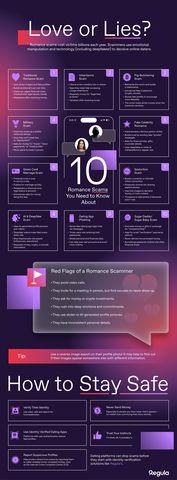
Can you spot a romance scam? Scammers are getting smarter, using fake identities, AI, and emotional manipulation to exploit trust. See how these scams work and what can be done to stop them. (Graphic: Regula)
Romance scams come in many forms, exploiting trust and emotional vulnerability to defraud victims. Their common tactics include:
- Catfishing: Scammers create fake identities to build trust and manipulate victims.
- Military Scams: Fraudsters pose as deployed soldiers seeking financial assistance.
- Inheritance Scams: Victims are deceived with false claims of large inheritances requiring upfront fees.
- Pig-Butchering (Crypto Investment) Scams: Scammers feign romantic interest to lure victims into fraudulent investment schemes.
However, according to reports from leading child safety organizations, including the National Center for Missing and Exploited Children (NCMEC) and Thorn, sextortion is one of the most severe threats, with cases surging at an alarming rate. The FBI reported over 12,000 complaints in 2023 alone, resulting in millions in financial losses, severe psychological trauma, and, in some cases, even fatalities. Younger users and those new to online dating are particularly vulnerable.
Common sextortion tactics include:
- Fake Identities: Scammers pose as attractive singles, influencers, or even celebrities to build quick trust.
- Rapid Escalation: Conversations quickly shift from introductions to intimate exchanges.
- Blackmail Threats: Once explicit content is shared, scammers demand money, cryptocurrency, or further compromising images under the threat of exposure.
- AI-Driven Deception: Some scams leverage deepfake videos or AI-powered chatbots to manipulate victims.
The Role of Identity Verification in Preventing Sextortion
Sextortion thrives in environments where fake profiles and anonymity enable bad actors to operate freely. Social media and dating platforms play a critical role in combating this threat—through proactive moderation, AI-powered content monitoring, and user education. Stronger identity verification during registration is also a valuable tool in this arsenal, but it must be implemented thoughtfully, balancing fraud prevention with user privacy and accessibility.
Different online platforms use varying levels of verification, ranging from strongest to weakest:
- ID & Biometric Verification – Matching government-issued IDs with real-time selfies for authentication.
- Real-Time Selfies Without ID Validation – Confirming a live presence but without a verified identity document.
- Basic Checks – Verification through phone numbers, email, or linked social media accounts.
- Self-Reported Identity Without Validation – The least secure method, relying solely on user-provided information.
How Biometric and ID Verification Strengthens Security:
- Eliminating Fake Profiles: Biometric checks make it significantly harder for scammers to create fake accounts.
- Anti-Spoofing Technology: Prevents impersonation by detecting fraudulent attempts using photos or masks.
- Liveness Detection: Confirms a real person is present, preventing AI-generated deception.
“When faced with strong verification measures, scammers don’t simply disappear—they move to less secure platforms where they can continue their schemes unchecked. Standardizing biometric ID verification across multiple platforms would make it significantly harder for them to do so, creating a safer ecosystem across social media, dating apps, and other online services." – Jan Stepnov, Identity Verification Expert at Regula.
Empowering Users to Stay Safe
While platforms must take stronger security measures, users can also protect themselves by:
- Being Cautious of Fast-Moving Relationships: Avoid engaging in intimate exchanges early in conversations.
- Interacting with Verified Users: Prioritize connections with verified profiles.
- Reporting Suspicious Activity: Flagging blackmail attempts and scam behavior.
- Never Paying Ransoms: Complying with extortion often leads to further threats.
For more insights on how identity verification is transforming online dating security, visit Regula’s blog.
About Regula
Regula is a global developer of forensic devices and identity verification solutions. With our 30+ years of experience in forensic research and the most comprehensive library of document templates in the world, we create breakthrough technologies for document and biometric verification. Our hardware and software solutions allow over 1,000 organizations and 80 border control authorities globally to provide top-notch client service without compromising safety, security, or speed. Regula has been repeatedly named a Representative Vendor in the Gartner® Market Guide for Identity Verification.
Learn more at www.regulaforensics.com.
View source version on businesswire.com: https://www.businesswire.com/news/home/20250213790016/en/
Subscribe to releases from Business Wire
Subscribe to all the latest releases from Business Wire by registering your e-mail address below. You can unsubscribe at any time.
Latest releases from Business Wire
DDN Selected to Modernize Research Data Infrastructure at UNSW Sydney26.10.2026 22:30:00 CET | Press release
DDN EXAScaler and Arcitecta Mediaflux will replace 11 legacy storage systems, simplifying access to research data while balancing performance and cost DDN, the global leader in AI and data intelligence solutions, today announced that UNSW Sydney has selected DDN to deliver a new research data storage environment as part of the university’s Research Data Experience (RDE) program. Working with Australian software company Arcitecta, DDN will combine its EXAScaler parallel file system with Arcitecta’s Mediaflux® data management platform to help researchers spend less time managing data and more time using it. Following an extensive 18-month evaluation, UNSW selected an integrated approach that will replace 11 legacy storage systems with a coordinated environment for high-performance storage and enterprise data management. The decision reflects a broader challenge facing research-intensive institutions: how to support rapidly expanding scientific datasets while simplifying infrastructure, i
Agent Assurance by TestMu AI Is Now Generally Available, Letting Teams Test What Their AI Agents Actually Change26.10.2026 16:15:00 CET | Press release
The trial includes 4,000 credits and four concurrent runs, so a team can generate functional and adversarial suites from its own agent's docs and endpoint, with code optional, and gate CI on evidence-backed verdicts without booking a demo. TestMu AI (formerly LambdaTest), the world's first Agentic AI-powered Quality Engineering platform, today announced the general availability of Agent Assurance. Agent Assurance tests AI agents that take actions, such as calling tools, writing files, and changing records, by checking what a run actually changed rather than what the agent says it did. Any team can now create a TestMu AI account and run it against its own agent without booking a demo first. Agent Assurance launched on August 17, 2026, behind a waitlist and a guided onboarding session. Since then, Rook, the CLI that runs Agent Assurance, has shipped a steady run of releases, shaped by feedback from early teams. Agent evaluation has mostly graded the final reply, and that reply can be wro
Actiphy Announces ImageServer for Centralized Backup Storage and Post-Backup Processing26.10.2026 16:13:00 CET | Press release
New platform combines centralized backup management, Inter-File Deduplication, automated workflows, and remote replication. Actiphy™, Inc., a provider of backup, disaster recovery, and virtualization software, today announced Actiphy ImageServer™, a centralized platform for storing, managing, verifying, and replicating backups created with ActiveImage Protector™. This press release features multimedia. View the full release here: https://www.businesswire.com/news/home/20261026410729/en/ Actiphy ImageServer Console ImageServer combines the management capabilities of Actiphy ImageCenter™ with the secure storage of Actiphy StorageServer™. By moving Verify, Replication, Consolidation, and BootCheck™ to a dedicated server, ImageServer reduces processing load on protected systems and simplifies backup administration. As organizations protect more systems and retain more backup generations, storage and administrative demands grow. ImageServer addresses these challenges by centralizing backup
Dubai Chambers Launches World's First Agentic AI Marketplace by a Chamber of Commerce26.10.2026 16:06:00 CET | Press release
Dubai Chambers has launched Chamber AI Hub, the world's first Agentic AI marketplace developed by a chamber of commerce, enabling businesses in Dubai to access ready-to-use AI agents that independently perform a range of administrative and operational tasks. This press release features multimedia. View the full release here: https://www.businesswire.com/news/home/20261026467531/en/ H.E. Sultan bin Saeed Al Mansoori Chairman of Dubai Chambers. (Photo: AETOSWire) The marketplace currently offers 22 specialised AI agents across seven business functions including Compliance, Procurement, Operations, Finance, Sales, Human Resources, and Logistics. The offering is set to expand to 100 agents. The initiative supports Dubai's efforts to accelerate the adoption of Agentic AI across the private sector, helping businesses enhance efficiency, strengthen competitiveness, and transform their operating models. H.E. Eng. Sultan bin Saeed Al Mansoori, Chairman of Dubai Chambers, commented: “Success in
Media Release: Allianz Beach Arena for the LA28 Olympic and Paralympic Games Joins the Allianz Family of Stadiums26.10.2026 15:37:00 CET | Press release
First Olympic and Paralympic venue in history to display the Allianz name and the eighth member of the Allianz Family of Stadiums.The nearly 15,000 seat temporary arena on the Long Beach waterfront will host Olympic Beach Volleyball and Paralympic Blind Football (Soccer).Allianz unveils its customized LA28 Games emblem, marking the start of its preparations for the LA28 Olympic and Paralympic Games. For the first time in Olympic and Paralympic history, a competition venue will carry the Allianz name. The Allianz Beach Arena in Long Beach, California, for the LA28 Olympic and Paralympic Games will become the newest member of the Allianz Family of Stadiums. This press release features multimedia. View the full release here: https://www.businesswire.com/news/home/20261026919959/en/ Allianz's "custom A" emblem for LA28. From Horse Guards Parade in London to Copacabana Beach in Rio and the Eiffel Tower in Paris, Olympic Beach Volleyball has always found its home in iconic settings around th
In our pressroom you can read all our latest releases, find our press contacts, images, documents and other relevant information about us.
Visit our pressroom