
Flirting with Fraud: Why Sextortion Is the Most Devastating Dating Scam
13.2.2025 14:00:00 CET | Business Wire | Press release
Sextortion has emerged as one of the most dangerous forms of romance scams, preying on online daters and, tragically, claiming the lives of teenagers. Fraudsters use fake profiles to lure victims into sharing intimate content, only to threaten exposure unless a ransom is paid. Regula, a global developer of identity verification (IDV) solutions, shares a vision of how social media and dating platforms can strengthen protections to safeguard users.
This press release features multimedia. View the full release here: https://www.businesswire.com/news/home/20250213790016/en/
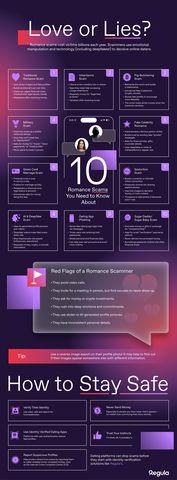
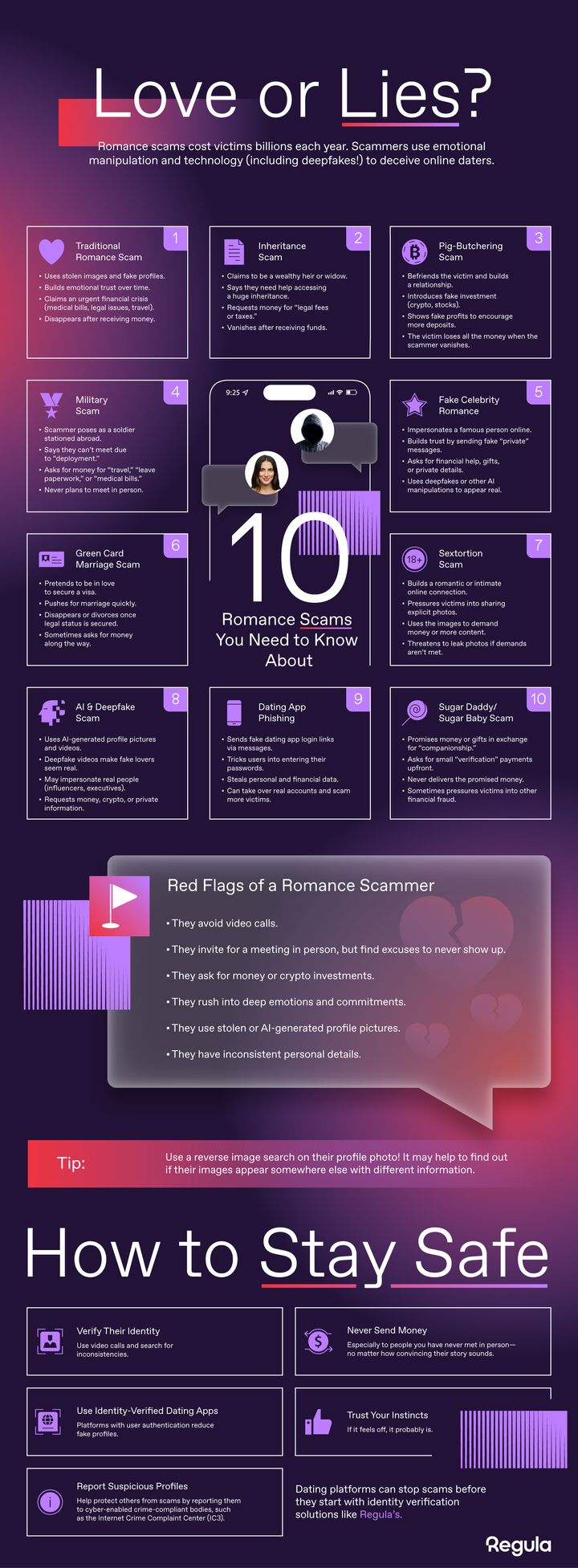
Can you spot a romance scam? Scammers are getting smarter, using fake identities, AI, and emotional manipulation to exploit trust. See how these scams work and what can be done to stop them. (Graphic: Regula)
Romance scams come in many forms, exploiting trust and emotional vulnerability to defraud victims. Their common tactics include:
- Catfishing: Scammers create fake identities to build trust and manipulate victims.
- Military Scams: Fraudsters pose as deployed soldiers seeking financial assistance.
- Inheritance Scams: Victims are deceived with false claims of large inheritances requiring upfront fees.
- Pig-Butchering (Crypto Investment) Scams: Scammers feign romantic interest to lure victims into fraudulent investment schemes.
However, according to reports from leading child safety organizations, including the National Center for Missing and Exploited Children (NCMEC) and Thorn, sextortion is one of the most severe threats, with cases surging at an alarming rate. The FBI reported over 12,000 complaints in 2023 alone, resulting in millions in financial losses, severe psychological trauma, and, in some cases, even fatalities. Younger users and those new to online dating are particularly vulnerable.
Common sextortion tactics include:
- Fake Identities: Scammers pose as attractive singles, influencers, or even celebrities to build quick trust.
- Rapid Escalation: Conversations quickly shift from introductions to intimate exchanges.
- Blackmail Threats: Once explicit content is shared, scammers demand money, cryptocurrency, or further compromising images under the threat of exposure.
- AI-Driven Deception: Some scams leverage deepfake videos or AI-powered chatbots to manipulate victims.
The Role of Identity Verification in Preventing Sextortion
Sextortion thrives in environments where fake profiles and anonymity enable bad actors to operate freely. Social media and dating platforms play a critical role in combating this threat—through proactive moderation, AI-powered content monitoring, and user education. Stronger identity verification during registration is also a valuable tool in this arsenal, but it must be implemented thoughtfully, balancing fraud prevention with user privacy and accessibility.
Different online platforms use varying levels of verification, ranging from strongest to weakest:
- ID & Biometric Verification – Matching government-issued IDs with real-time selfies for authentication.
- Real-Time Selfies Without ID Validation – Confirming a live presence but without a verified identity document.
- Basic Checks – Verification through phone numbers, email, or linked social media accounts.
- Self-Reported Identity Without Validation – The least secure method, relying solely on user-provided information.
How Biometric and ID Verification Strengthens Security:
- Eliminating Fake Profiles: Biometric checks make it significantly harder for scammers to create fake accounts.
- Anti-Spoofing Technology: Prevents impersonation by detecting fraudulent attempts using photos or masks.
- Liveness Detection: Confirms a real person is present, preventing AI-generated deception.
“When faced with strong verification measures, scammers don’t simply disappear—they move to less secure platforms where they can continue their schemes unchecked. Standardizing biometric ID verification across multiple platforms would make it significantly harder for them to do so, creating a safer ecosystem across social media, dating apps, and other online services." – Jan Stepnov, Identity Verification Expert at Regula.
Empowering Users to Stay Safe
While platforms must take stronger security measures, users can also protect themselves by:
- Being Cautious of Fast-Moving Relationships: Avoid engaging in intimate exchanges early in conversations.
- Interacting with Verified Users: Prioritize connections with verified profiles.
- Reporting Suspicious Activity: Flagging blackmail attempts and scam behavior.
- Never Paying Ransoms: Complying with extortion often leads to further threats.
For more insights on how identity verification is transforming online dating security, visit Regula’s blog.
About Regula
Regula is a global developer of forensic devices and identity verification solutions. With our 30+ years of experience in forensic research and the most comprehensive library of document templates in the world, we create breakthrough technologies for document and biometric verification. Our hardware and software solutions allow over 1,000 organizations and 80 border control authorities globally to provide top-notch client service without compromising safety, security, or speed. Regula has been repeatedly named a Representative Vendor in the Gartner® Market Guide for Identity Verification.
Learn more at www.regulaforensics.com.
View source version on businesswire.com: https://www.businesswire.com/news/home/20250213790016/en/
Subscribe to releases from Business Wire
Subscribe to all the latest releases from Business Wire by registering your e-mail address below. You can unsubscribe at any time.
Latest releases from Business Wire
SBC Medical to Participate in Several Upcoming Investor Conferences in September 20261.9.2026 19:35:00 CEST | Press release
SBC Medical Group Holdings Incorporated (Nasdaq: SBC) (“The Company” or “SBC Medical”), a Medical Services Organization (MSO) providing management support across a wide range of healthcare fields, today announced its participation in several upcoming investor conferences in September 2026. SBC Medical will conduct presentations and one-on-one meetings with institutional investors. Below is a summary of the Company’s scheduled participation in upcoming investor conferences: H.C. Wainwright 28th Annual Global Investment Conference Date: September 14 2026 Format: In-person (NY) Registration: https://my.ct.events/register.aspx?meid=cff43623-9e9f-45d4-bbc3-ee19e9c372c1&rpid=a667ca45-171e-4306-98eb-c466e8b7e6c1 ArcStone Kingswood Growth Summit 2026 Date: September 16 2026 Format: In-person (Toronto) Registration:https://www.meetmax.com/sched/event_144037/investor_reg_new.html?attendee_role_id=ARCSTONE_ATTENDEE CLSA 33rd Investors’ Forum 2026 Date: September 21, 2026 Format: In-person (Hong K
Crimson Moon Available Now, Bringing Heavy-Metal Gothic Action to Solo and Co-op Players on PC, PlayStation 5, and Xbox Series X|S1.9.2026 19:00:00 CEST | Press release
ProbablyMonsters’ action-adventure RPG offers blood-soaked combat, monstrous showdowns, and deep replay value for $19.99 USD ProbablyMonsters, an independent video game company creating original AA games with AAA sensibilities, today launched Crimson Moon on PC via Steam and Epic Game Store, PlayStation 5, and Xbox Series X|S for $19.99 USD. A $29.99 USD Deluxe Edition is also available and includes an exclusive armor set, weapon cosmetic, and upcoming game expansion. Watch the official Crimson Moon launch trailer on YouTube to see the game’s gothic heavy-metal power fantasy, crafted for both solo and co-op players, in action. This press release features multimedia. View the full release here: https://www.businesswire.com/news/home/20260901064893/en/ Crimson Moon is a gothic high renaissance action-adventure RPG built around intense, replayable missions that blend brutal precision with deep character progression. Players take on the role of the Nephilim, powerful human-angel hybrids bo
Rigaku Launches CT Lab HR160 High-Resolution X-ray CT System1.9.2026 17:00:00 CEST | Press release
- Developed in collaboration with Excillum for battery, semiconductor devices, and advanced materials analysis - Rigaku Corporation, a global solutions partner in X-ray analytical systems and a group company of Rigaku Holdings Corporation (Headquarters: Akishima, Tokyo; President and CEO: Jun Kawakami; “Rigaku”), today announced the launch of the CT Lab HR160, a high-resolution X-ray computed tomography (CT) system for battery, semiconductor devices, electronic components, and advanced materials analysis. The system is developed in collaboration with Excillum AB, the global source for X-ray innovation (Headquarters: Stockholm, Sweden; CEO: David Lindblom; “Excillum”). This press release features multimedia. View the full release here: https://www.businesswire.com/news/home/20260901074099/en/ Photo: CT Lab HR160 High-Resolution X-ray CT System CT Lab HR160 combines Rigaku’s X-ray CT imaging expertise with Excillum’s NanoTube N3 X-ray source. Operating at up to 160 kV to support a wide r
GigaDevice Joins the Zephyr® Project to Foster Global Open-Source Ecosystem1.9.2026 16:00:00 CEST | Press release
GigaDevice, a leading semiconductor company specializing in Flash memory, 32-bit microcontrollers (MCUs), sensors, and analog products, has officially joined the Zephyr® Project, one of the world’s leading open-source real-time operating systems (RTOS). Hosted by the Linux Foundation®, the Zephyr® Project welcomes GigaDevice as a Silver Member, making GigaDevice a dual Silver Member of both the Zephyr® Project and the Linux Foundation. Leveraging its comprehensive GD32 MCU portfolio, GigaDevice will actively participate in the Zephyr® community, promoting deeper integration between its MCU technologies and the global open-source RTOS ecosystem. This will provide customers and developers in industrial, IoT, consumer electronics, and other fields with a more open, standardized, and efficient embedded development environment, while continuing to contribute to the growth of the global embedded open ecosystem and broader access to technology. With the continued evolution of the Internet of
Vivax-Metrotech Partners with Oaktree to Accelerate Strategic Growth1.9.2026 16:00:00 CEST | Press release
Vivax-Metrotech Corporation (“Vivax-Metrotech”), a leading manufacturer of precision locating and inspection devices for utility infrastructure, and Oaktree’s Power Opportunities strategy, today announced a partnership to accelerate Vivax-Metrotech’s growth trajectory and strengthen its leading position. For more than 60 years, Vivax-Metrotech has delivered best-in-class solutions for the utility industry with a focus on underground infrastructure. From its origins in California, the company has expanded across the United States and internationally, developing and supplying locator systems, inspection cameras, and associated digital solutions that help utilities, municipalities, and service providers safely build, maintain, and manage their assets. Today, Vivax-Metrotech is firmly established as a leading player in the U.S. and Global utility locator equipment and inspection device markets. The partnership with Oaktree’s Power Opportunities group will support Vivax-Metrotech’s continue
In our pressroom you can read all our latest releases, find our press contacts, images, documents and other relevant information about us.
Visit our pressroom