Veracode Research Highlights Financial Sector’s Escalating Security Debt
29.10.2024 12:50:00 CET | Business Wire | Press release
State of Software Security Report Finds Half of Financial Organizations Have High-Severity Security Flaws in Their Apps
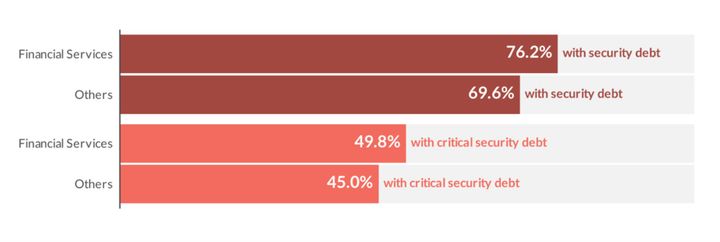
Veracode, a global leader in application risk management, today released new research that highlights the state of software security debt within the financial services sector. Security debt, defined for this report as flaws that remain unfixed for longer than a year, exists in 76 percent of organizations in the financial services sector, with 50 percent of organizations carrying critical security debt.
This press release features multimedia. View the full release here: https://www.businesswire.com/news/home/20241029540325/en/
Figure 1: Prevalence of security debt in the financial sector (Graphic: Business Wire)
With the average cost of a data breach in the financial industry estimated to be $6.08 million1, the research comes at a critical time for one of the most highly targeted industries by sophisticated threat actors. According to a U.S. Treasury Department report in March 2024, threat actors use AI-based tools to find and exploit software vulnerabilities at an unprecedented rate. At the same time, increasing industry competition and customer expectations for convenience require organizations to accelerate innovation.
“The high rate of security debt in the financial sector poses significant risks to organizations and their customers if not addressed quickly. As AI-driven cyber-attacks continue to grow in strength and numbers, and organizations struggle to keep up with evolving regulations due to existing security debt, the current landscape allows threat actors to exploit vulnerabilities at an alarming, unprecedented rate,” said Chris Wysopal, Chief Security Evangelist at Veracode. “Our latest State of Software research highlights the critical need for financial institutions to address both first-party and third-party code vulnerabilities now. Organizations that leave flaws unremedied for longer than a year are exposed to prolonged and dangerous threats.”
Delayed Flaw Remediation Threatens Financial Sector Security
Veracode researchers found 40 percent of all applications in the financial sector have security debt, which is slightly better than the cross-industry average of 42 percent. In addition, just 5.5 percent of financial sector applications are flaw-free, compared to 5.9 percent across other industries. While slightly fewer financial sector applications have security debt, they accumulate more of it.
The report also highlights the need for financial services organizations to address security debt in both first-party and third-party code. Eighty-four percent of all security debt affects first-party code, but the majority (78.6 percent) of critical security debt comes from third-party dependencies. This reinforces the importance of the Cybersecurity and Infrastructure Security Agency’s efforts to help secure the open-source ecosystem with its Open Source Software Security Roadmap and Secure by Design Pledge.
The analysis further explores remediation timelines in the financial services sector. Researchers found that financial organizations fix half of first-party flaws in the first nine months, compared to 13 months for third-party flaws. Of those, 52 percent of third-party flaws turn into security debt, while 44 percent of first-party flaws turn into security debt.
The Importance of Prioritization in Risk Remediation
The proliferation of supply chain attacks targeting the financial services industry has brought about a growing number of cybersecurity regulations with a sharper focus on software security. For example, regulatory frameworks like the ISO 20022, the Payment Card Industry Data Security Standard (PCI DSS), NIS2, and the Digital Operational Resilience Act (DORA) require organizations to prevent vulnerabilities from being deployed in applications.
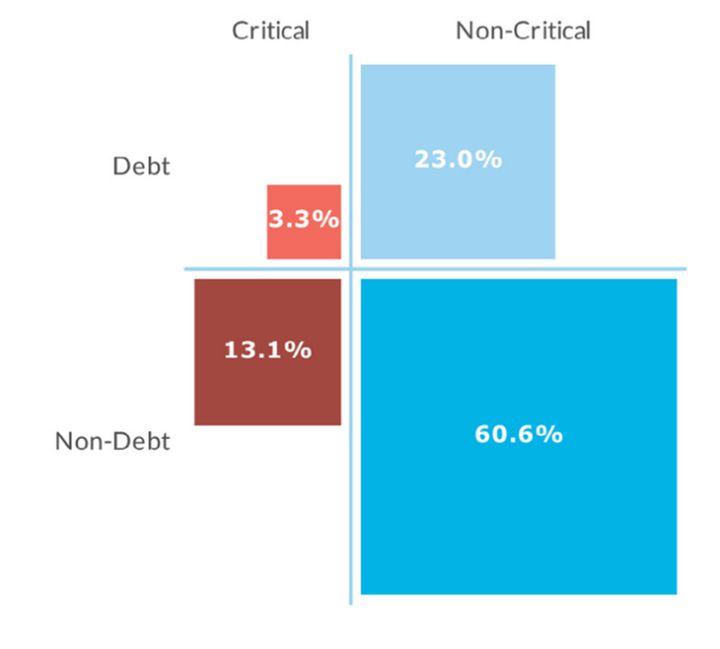
This puts organizations at risk of non-compliance because of existing security debt and outdated remediation strategies. Veracode’s research reveals that organizations can address this risk by prioritizing the 3.3% of flaws that constitute critical security debt. Remediating the most dangerous flaws first means financial entities can then move on to tackle other critical flaws or non-critical debt according to their risk tolerance and capabilities.
The Role of Application Security Posture Management
The increased need for risk prioritization creates a significant demand for Application Security Posture Management (ASPM) to continuously track risk through the collection, visibility and analysis of security issues across the software development cycle. Veracode's Application Risk Management Platform provides a comprehensive, unified view of risk across code and applications, empowering developers and security teams to remediate issues swiftly. With the AI-powered solution, Veracode Fix, teams can proactively prevent new vulnerabilities and effectively reduce existing security backlogs. The platform’s contextual analysis uncovers root causes, guiding developers toward optimal next steps that maximize risk reduction with minimal effort.
Wysopal closed, “It has never been more important for the financial services sector to stay ahead of evolving cybersecurity threats, particularly with increasingly sophisticated AI-driven attacks threatening the security of their assets. I urge financial institutions to prioritize timely security debt reduction by adopting AI-powered remediation and ASPM tools which can detect, prioritize and fix vulnerabilities within seconds.”
The Veracode State of Software Security Financial Services 2024 report is available to read on the Veracode website.
1 IBM, “Cost of a Data Breach Report 2024”, IBM and Ponemon Institute, July 30, 2024
About the State of Software Security Report
The Veracode State of Software Security 2024 report analyzed data from large and small companies, commercial software suppliers, software outsourcers, and open-source projects. The research draws from more than a million (1,007,133) applications across all scan types, 1,553,022 dynamic analysis scans, and 11,429,365 static analysis scans. All those scans produced 96 million raw static findings, 4 million raw dynamic findings, and 12.2 million raw software composition analysis findings.
About Veracode
Veracode is a global leader in Application Risk Management for the AI era. Powered by trillions of lines of code scans and a proprietary AI-assisted remediation engine, the Veracode platform is trusted by organizations worldwide to build and maintain secure software from code creation to cloud deployment. Thousands of the world’s leading development and security teams use Veracode every second of every day to get accurate, actionable visibility of exploitable risk, achieve real-time vulnerability remediation, and reduce their security debt at scale. Veracode is a multi-award-winning company offering capabilities to secure the entire software development life cycle, including Veracode Fix, Static Analysis, Dynamic Analysis, Software Composition Analysis, Container Security, Application Security Posture Management, and Penetration Testing.
Learn more at www.veracode.com, on the Veracode blog, and on LinkedIn and X.
Copyright © 2024 Veracode, Inc. All rights reserved. Veracode is a registered trademark of Veracode, Inc. in the United States and may be registered in certain other jurisdictions. All other product names, brands or logos belong to their respective holders. All other trademarks cited herein are property of their respective owners.
View source version on businesswire.com: https://www.businesswire.com/news/home/20241029540325/en/
Subscribe to releases from Business Wire
Subscribe to all the latest releases from Business Wire by registering your e-mail address below. You can unsubscribe at any time.
Latest releases from Business Wire
NIQ (NYSE: NIQ) Unveils Six New AI-Powered Capabilities at C360, Executing on Its Vision for Agentic Commerce9.6.2026 21:00:00 CEST | Press release
New capabilities help organizations operationalize trusted market intelligence across enterprise AI environments and workflows, while preparing for the future of agentic commerce NielsenIQ (NYSE: NIQ) today unveiled six new AI-powered capabilities at C360, the company's flagship client and industry event, marking a major milestone in the execution of NIQ’s AI strategy. Thenew capabilities help brands, retailers, and other organizations operationalize trusted market intelligence across enterprise workflows, AI environments, and the emerging world of agentic commerce. NIQ’s AI value creation strategy is built on two foundational principles: Delivering The Full View™: Combining the industry’s broadest and deepest datasets, advanced AI models, and rich content to help organizations unlock actionable insights and drive AI innovation at scale. Enabling AI-Powered Capabilities: Delivering trusted intelligence and proprietary IP through NIQ’s advanced AI applications, assistants, and agents em
H55 Delivers Certification-Grade Propulsion Battery Modules to Pratt & Whitney Canada, Supporting Demonstration of Hybrid-Electric Aircraft Technology9.6.2026 17:31:00 CEST | Press release
Production-conforming systems manufactured in a regulator-approved facility mark H55’s transition from technology development to commercialization of certification-grade energy storage solutions for hybrid-electric aviation. H55 today announced the delivery of certification-grade propulsion battery modules to Pratt & Whitney Canada in support of the RTX Hybrid-Electric Flight Demonstrator — a milestone that further validates H55’s transition from technology development to industrial-scale execution and represents an important step in the commercialization of the company’s certification-grade energy storage technologies for hybrid-electric aerospace applications. Pratt & Whitney is an RTX business. This press release features multimedia. View the full release here: https://www.businesswire.com/news/home/20260609825006/en/ H55 Adagio Battery Modules in Pratt & Whitney Canada Hangar ©RTX The delivery represents more than hardware integration. It demonstrates H55’s ability to manufacture p
New Polymorph of Indomethacin Discovered9.6.2026 17:00:00 CEST | Press release
- Joint Research Involving Rigaku Published in Crystal Growth & Design - Rigaku Corporation, a global solution partner in X-ray analytical systems and a group company of Rigaku Holdings Corporation (headquarters: Akishima, Tokyo; CEO: Jun Kawakami; “Rigaku”), announced that the results of a joint research project conducted with Shionogi & Co., Ltd., JEOL Ltd., and Meiji Pharmaceutical University have been published in Crystal Growth & Design, a world-renowned international journal in the field of crystallography. This press release features multimedia. View the full release here: https://www.businesswire.com/news/home/20260609347405/en/ Cover of the June 2026 issue of Crystal Growth & Design, featuring this research. This research uncovered a previously unknown polymorph (κ-form) of indomethacin, a widely used pain relief and anti-inflammatory drug. The research team also conducted structural analysis and characterization of the newly identified crystal form. Although indomethacin has
SLB Collaborates with Qualcomm on Edge AI Solutions for Energy Operations9.6.2026 16:28:00 CEST | Press release
Collaboration combines edge computing and energy workflows to support real-time operational decision-making Global energy technology company SLB (NYSE: SLB) today announced a memorandum of understanding with Qualcomm Technologies, Inc. to enable edge AI solutions for the energy industry, supporting real-time operational decision-making across wells, facilities and production systems. The collaboration combines Qualcomm Technologies’ low-power edge computing and AI processing capabilities, with SLB’s Agora™ edge AI and IoT solutions developed for remote and operationally complex environments. “Together, SLB and Qualcomm Technologies aim to help operators apply AI more effectively across energy infrastructure,” said Rakesh Jaggi, president, Digital, SLB. “Many energy operations rely on real-time decision-making in remote environments where connectivity and responsiveness directly affect performance. AI systems designed around the realities of energy operations can help support more consi
RevBits and Stony Brook University’s Ethos Lab Establish a Collaborative Partnership to Further the Field of Cyber Security Education and Application9.6.2026 16:15:00 CEST | Press release
Through the partnership, RevBits will provide its full suite of cybersecurity solutions to Stony Brook University’s Ethos Lab, to deliver the capability to advance student education and equip them with the knowledge needed to face modern cyber threats in a realistic, contained environment. Stony Brook University’s (SBU) Ethos Lab, in the College of Engineering and Applied Sciences Department of Computer Science, recently announced a collaborative partnership with RevBits, LLC. Through the partnership, SBU’s Ethos Lab will utilize the RevBits solutions suite to build computer science labs and a cybersecurity-focused curriculum, reinforcing lessons from the classroom. The platform simulates environments containing five major threat landscapes, including Endpoint Security, Privileged Access Management, Email Security, Zero Trust Network and Deception Technology. SBU’s Department of Computer Science was recently designated as a National Center of Academic Excellence in Cybersecurity Resear
In our pressroom you can read all our latest releases, find our press contacts, images, documents and other relevant information about us.
Visit our pressroom